Drone Pressure Washing Guide: A Safer Way to Clean Roofs, Buildings, Windows & High-Rise Exteriors
Discover how drone pressure washing offers safer, faster, and more efficient cleaning for elevated and hard-to-reach surfaces
Quick Answer: What Is Drone Pressure Washing?
Drone pressure washing is an innovative exterior cleaning method that uses specialized drones equipped with precision spray nozzles and water supply systems to clean roofs, facades, windows, and high-rise building surfaces without requiring workers to climb ladders or use scaffolding.
Key Benefits:
- Safety: Operators stay on the ground, eliminating fall hazards
- Access: Reaches steep roofs, tall facades, and difficult architectural features
- Efficiency: Faster setup than scaffolding or boom lifts
- Precision: Controlled spray with soft wash or pressure wash options
- Compliance: Operated by FAA Part 107 certified or registered pilots with proper insurance
Introduction
Cleaning the outside of a building looks simple from the ground, but anyone who has managed roof washing, facade cleaning, or high-rise window cleaning knows how complicated it can become. Ladders have limits. Scaffolding takes time. Boom lifts are expensive. Rope access requires highly specialized crews. And whenever workers are operating at height, safety becomes a serious concern.
That is one reason drone pressure washing is getting more attention in building maintenance. Instead of sending workers onto steep roofs, tall facades, ledges, or suspended platforms, a pressure washing drone can reach many of those areas while the operator stays safely on the ground.
This does not mean drones replace every type of exterior cleaning. Some surfaces still need hand detailing, brushing, or ground-level pressure washing. But for roofs, windows, facades, upper-story siding, commercial buildings, and high-rise exteriors, drone pressure washing can make the job safer, faster, and easier to plan.
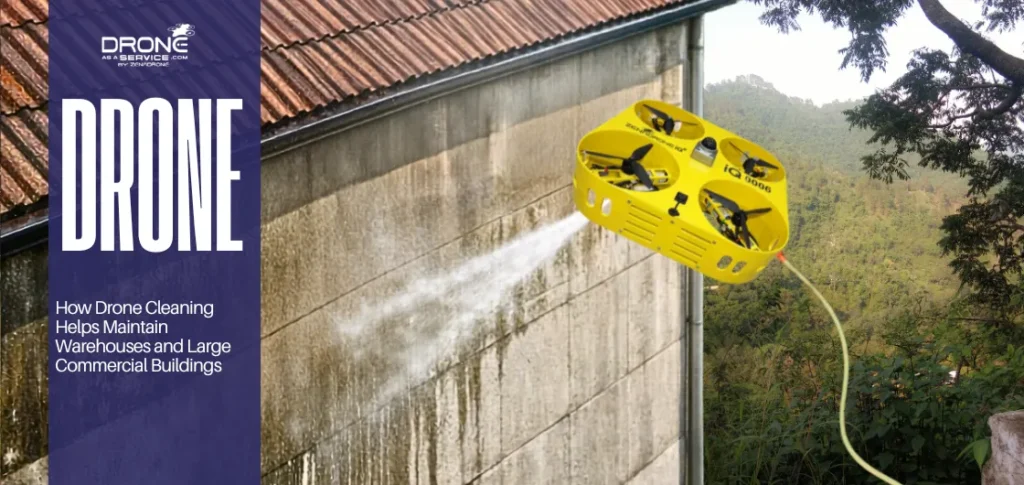
You may read also: How Drone Cleaning Helps Maintain Warehouses and Large Commercial Buildings
Anyhow, in this guide, we’ll explain how drone pressure washing works, where it makes sense, what surfaces it can clean, how it compares with traditional methods, what affects the cost, and why FAA compliance, insurance, and surface protection matter.
Drone Pressure Washing Method: Simple Understanding
Drone pressure washing is an exterior cleaning method that uses a specially equipped drone to spray water, soft wash solution, or cleaning detergent onto hard-to-reach building surfaces.
A professional pressure washing drone is usually connected to a ground-based water supply, pump system, and hose. The drone itself does not normally carry large amounts of water. Instead, the water pressure, cleaning solution, and spray flow are managed from the ground while the drone delivers the spray to roofs, walls, windows, and facades.
You may also see this service described as:
- Drone power washing
- Aerial pressure washing
- Drone roof cleaning
- Drone building cleaning
- Drone facade cleaning
- Drone exterior cleaning
- Drone window cleaning
- High-rise drone cleaning
- Commercial drone cleaning services
The basic idea is simple: use drone access where traditional access is risky, expensive, slow, or disruptive.
But the actual service is more than just flying a drone with a hose. A proper drone cleaning job includes surface inspection, pressure calibration, flight planning, safety perimeter setup, weather checks, cleaning solution selection, and post-cleaning review.
Why Is Drone Pressure Washing Becoming Popular?
Most property owners and facility managers are not interested in drone cleaning just because it sounds high-tech. They care about practical problems: safety, access, time, cost, disruption, and results.
Traditional exterior cleaning often involves ladders, scaffolding, boom lifts, or rope access crews. These methods can work well, but they also bring extra planning, labor, equipment rental, and liability concerns.
Drone pressure washing solves several of those pain points at once. It keeps the operator on the ground, reduces the need for heavy access equipment, and makes it easier to clean areas that are difficult to reach manually.
Traditional Cleaning vs Drone Pressure Washing
| Factor | Traditional Pressure Washing | Drone Pressure Washing |
|---|---|---|
| Worker access | Workers may climb ladders, roofs, scaffolds, or lifts | Operator remains on the ground |
| Setup time | Can take hours or days, especially with scaffolding | Usually faster setup |
| Equipment needed | Ladders, boom lifts, scaffolding, ropes, platforms | Drone, hose/tether, pump, water supply |
| Best for | Ground-level areas, walkways, decks, driveways | Roofs, facades, windows, high-reach areas |
| Safety risk | Higher risk when working at height | Lower height-related risk |
| Site disruption | Can block sidewalks, parking, entrances | Smaller work zone in many cases |
| Cost drivers | Labor, lift rental, scaffold rental, permits | Drone crew, water setup, surface complexity |
| Surface control | Depends on manual positioning | Precision spray with live camera monitoring |
Drone cleaning is not a magic replacement for every situation, but for high-reach exterior cleaning, it can be a very practical alternative.
How Does Drone Pressure Washing Work?
A good drone pressure washing service follows a structured process. This is important because every building is different. A clay tile roof does not need the same cleaning method as a concrete wall. A glass facade does not need the same pressure as a brick exterior.
Here is how the process usually works.
1. Property Inspection
Before the drone ever leaves the ground, the crew inspects the property. This helps them understand the cleaning challenge and avoid damage.
They may look at:
-
- Building height
- Roof pitch
- Facade material
- Window layout
- Nearby power lines
- Trees and obstacles
- Water source availability
- Pedestrian areas
- Parking lots and entrances
- Surface stains or organic growth
Some teams use a drone camera for the inspection itself. This can be useful for tall buildings, steep roofs, gutters, ledges, chimneys, skylights, and areas that are hard to see from the ground.
2. Surface Assessment
Surface assessment matters because pressure washing is not always the right answer. Sometimes soft washing is safer and more effective.
For example, roof shingles often need a low-pressure soft wash to remove algae, moss, and black streaks. High pressure could damage the granules on asphalt shingles or crack older tiles.
On the other hand, concrete and some brick surfaces may tolerate stronger pressure if the goal is to remove grime, pollution stains, or heavy buildup.
Common Contaminants Drone Cleaning Can Target
| Contaminant | Common Location | Typical Cleaning Approach |
|---|---|---|
| Moss | Roofs, shaded areas | Soft wash treatment |
| Algae | Shingles, siding, facades | Soft wash or detergent rinse |
| Mildew | Stucco, siding, exterior walls | Low-pressure wash |
| Mold | Exterior walls, shaded surfaces | Cleaning solution + rinse |
| Soot | Commercial facades, industrial buildings | Controlled pressure wash |
| Pollution stains | Urban buildings, glass, stone | Detergent or pressure rinse |
| Bird droppings | Ledges, signs, windows | Targeted rinse/treatment |
| Hard water stains | Windows, glass panels | Deionized water or specialty cleaning |
| Dirt and grime | Siding, brick, panels | Pressure or soft wash depending on surface |
This is where professional judgment matters. A good provider does not use the same pressure setting on every surface.
3. Flight Planning and Safety Setup
Drone pressure washing is both a cleaning job and a drone operation. That means the crew needs to think about site safety and airspace safety.
Before cleaning starts, the operator usually creates a flight plan and safety plan. This may include:
- Setting a safety perimeter
- Checking wind and weather
- Reviewing airspace restrictions
- Identifying no-fly zones
- Checking for nearby airports
- Avoiding power lines and antennas
- Planning emergency landing areas
- Managing pedestrian and vehicle traffic
- Confirming FAA Part 107 compliance
Important Compliance Note
In the United States, commercial drone operations generally require an FAA Part 107 registered pilot. Depending on the location, the pilot may also need airspace authorization.
This is one reason many property owners choose a Drone as a Service (DaaS) model. With DaaS, the provider handles the drone, pilot, compliance, insurance, and equipment instead of the customer having to buy and manage everything.
4. Equipment Setup
Most pressure washing drones work with a tethered hose system. The drone carries the spray nozzle while the water and cleaning solution come from the ground.
A typical setup may include:
- Pressure washing drone
- Tethered hose system
- High-pressure water pump
- Soft wash system
- Precision spray nozzle
- Water source or water tank
- Biodegradable cleaning solution
- Deionized water system for windows
- Real-time video monitoring
- Backup batteries and safety controls
The operator calibrates the spray before cleaning begins. This helps control pressure, flow rate, spray angle, and distance from the surface.
5. Aerial Cleaning
Once the drone is in position, the operator uses live video feedback to guide the cleaning path. The drone can move along the roofline, facade, windows, siding, or ledges while applying water or cleaning solution.
Depending on the surface, the process may include:
- Pre-rinse
- Soft wash application
- Dwell time for detergent
- Controlled rinse
- Spot treatment
- Final inspection
For delicate surfaces, the drone may use a low-pressure rinse. For stronger materials like concrete or durable brick, higher pressure may be used if it is safe.
6. Post-Cleaning Review
After the work is complete, the provider may capture before-and-after photos or video. For commercial properties, this can be helpful for maintenance records, property management reports, insurance documentation, or tenant communication.
A post-cleaning report may include:
- Areas cleaned
- Surface conditions found
- Photos or videos
- Stains that may need follow-up
- Damage noticed during inspection
- Recommended maintenance schedule
This makes drone cleaning useful not just as a one-time service, but as part of a larger building maintenance plan.
Main Applications of Drone Pressure Washing
Drone pressure washing is most useful when access is the problem. If a surface is high, steep, awkward, fragile, or expensive to reach manually, drones can often make the work easier.
Drone Roof Cleaning
Roofs are one of the strongest use cases for drone cleaning. Many roofs develop moss, algae, lichen, black streaks, leaves, and organic debris over time. This is especially common in humid areas, shaded neighborhoods, and properties surrounded by trees.
Traditional roof cleaning can be risky because workers may need to walk on steep or slippery surfaces. It can also damage fragile materials if the wrong pressure is used.
Drone roof cleaning allows the operator to treat the roof from the air without walking across it.
Roof Types That May Benefit
| Roof Type | Recommended Method | Notes |
|---|---|---|
| Asphalt shingles | Soft wash | Avoid high pressure to protect granules |
| Clay tile | Low-pressure soft wash | Helps avoid cracking tiles |
| Slate roof | Gentle soft wash | Fragile and expensive to repair |
| Metal roof | Low to moderate pressure | Depends on coating and age |
| Commercial flat roof | Soft wash or rinse | Useful for dirt, algae, and debris |
| Steep roof | Drone soft wash | Reduces need for roof walking |
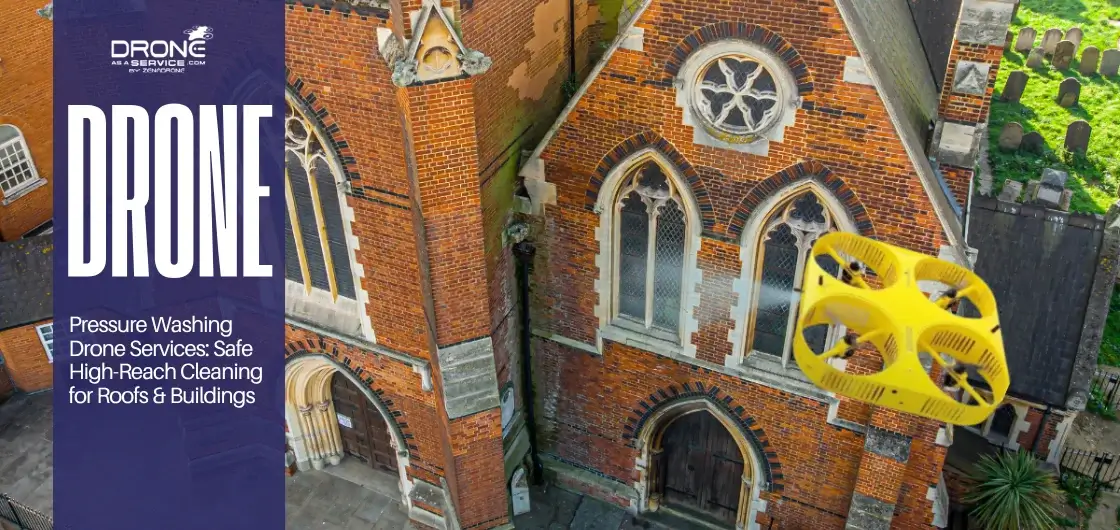
| Church roof | Soft wash | Often tall, steep, and difficult to access |
For most roofs, soft washing is better than high-pressure washing. The goal is to remove moss and algae growth without damaging the roofing system.
Drone Facade Cleaning
Building facades collect pollution, dust, soot, mildew, algae, and stains. This is especially common on commercial buildings, hotels, hospitals, apartment complexes, warehouses, and properties in busy urban areas.
Drone facade cleaning can reach upper walls, ledges, signage, decorative trim, and corners that are difficult to clean from the ground.
Facade Materials and Cleaning Method
| Facade Material | Cleaning Approach | Risk Level |
|---|---|---|
| Brick | Moderate pressure or soft wash | Depends on age and mortar condition |
| Concrete | Pressure wash when appropriate | Usually durable |
| Stucco | Soft wash | High pressure can damage texture |
| EIFS | Very low pressure | Requires extra care |
| Stone masonry | Low pressure | Older stone can be fragile |
| Glass panels | Deionized water / low pressure | Avoid harsh pressure |
| Aluminum panels | Controlled pressure | Protect coatings |
| Vinyl siding | Soft wash | Avoid forcing water behind panels |
| Wood siding | Low pressure | Prevent surface damage |
A big advantage here is reduced disruption. Scaffolding can block sidewalks, storefronts, parking lots, and entrances. Drone cleaning often requires a smaller work zone.
Drone Window Cleaning
High-rise window cleaning usually requires water-fed poles, boom lifts, suspended platforms, or rope access crews. These methods are common, but they can be expensive and time-consuming.
Drone window cleaning can help with upper-story windows, glass facades, skylights, atriums, and other hard-to-reach glass surfaces.
For windows, many systems use deionized water. Deionized water helps reduce streaks and mineral spots because it has fewer dissolved minerals than regular tap water.
Drone Window Cleaning Is Useful For
| Property Type | Window Cleaning Use |
|---|---|
| Office towers | Glass facade and upper windows |
| Hotels | Guest-facing windows and balconies |
| Hospitals | Exterior glass with less disruption |
| Condos | High windows and balcony glass |
| Apartments | Multi-story window maintenance |
| Atriums | Interior/exterior glass access challenges |
| Shopping centers | Large glass entrances and panels |
Drone window cleaning may not replace detailed hand-polishing in every case, but it can be very useful for frequent exterior glass maintenance.
Commercial Building Cleaning
Commercial properties need exterior cleaning for more than appearance. A dirty facade or stained roof can affect brand image, tenant satisfaction, guest experience, and property value.
Drone building cleaning is commonly used for:
- Office buildings
- Apartment buildings
- Condo towers
- Hotels
- Hospitals
- Schools
- Warehouses
- Industrial facilities
- Shopping centers
- Churches
- Government buildings
- HOA communities
- Corporate campuses
For property managers, the biggest advantage is often scheduling. Drone cleaning can reduce setup time and make recurring exterior maintenance easier.
High-Rise Building Cleaning
High-rise cleaning is where drones can provide a major safety and access benefit. Cleaning upper floors, glass facades, ledges, and architectural details usually requires specialized access equipment.
A high-rise cleaning drone can reach many exterior areas without putting a worker directly on a rope, lift, or platform.
High-Rise Cleaning Method Comparison
| Method | Pros | Limitations |
|---|---|---|
| Rope access | Good for detailed work | Requires workers suspended at height |
| Scaffolding | Stable access | Expensive, slow setup, disruptive |
| Boom lift | Useful for mid-height access | Height and reach limits |
| Water-fed pole | Good for lower windows | Limited reach |
| Drone cleaning | Fast access to high areas | Weather and airspace dependent |
Drone high-rise cleaning still needs careful planning. Wind, nearby buildings, balconies, antennas, power lines, and pedestrian traffic all matter.
Safety: The Biggest Reason Drone Cleaning Makes Sense
The strongest argument for drone pressure washing is not only speed or cost. It is safety.
Working at height is one of the most serious risks in building maintenance. Ladders, scaffolding, roof edges, rope systems, and boom lifts all introduce safety concerns.
Drone cleaning helps reduce that exposure because the operator stays on the ground.
Safety Comparison
| Safety Factor | Traditional Method | Drone Method |
|---|---|---|
| Fall exposure | Higher | Lower |
| Ladder use | Common | Reduced |
| Roof walking | Often required | Often avoided |
| Scaffold setup | May be required | Often avoided |
| Worker position | On elevated surface | Ground-based |
| Pedestrian control | Needed | Still needed |
| Weather sensitivity | Moderate | High for wind |
| Insurance concern | Higher working-at-height risk | Lower height exposure |
Important Safety Note: This does not mean drone pressure washing has no risks. Drones need safe flight paths, trained pilots, proper insurance, and weather monitoring. But it can remove one of the most dangerous parts of exterior cleaning: putting workers at height.
FAA Compliance and Drone Insurance
Because drone pressure washing involves commercial drone flight, compliance is important. A professional drone service provider should understand both cleaning safety and aviation rules.
In the U.S., key compliance factors include:
- FAA Part 107 certification/registration
- Remote ID compliance
- Visual line of sight operation
- Airspace authorization when needed
- No-fly zone awareness
- Weather monitoring
- Drone maintenance checks
- Safety perimeter planning
- Liability insurance
- Drone insurance
If a building is near an airport, hospital helipad, stadium, government facility, or restricted airspace, extra authorization may be required.
Why Hiring a Professional Matters
This is why hiring a professional drone service provider is usually better than trying to manage the equipment yourself. The DaaS (Drone as a Service) model allows property owners to use the technology without buying a pressure washing drone, training pilots, or managing compliance and insurance.
Ready to Experience Safer, Smarter Building Cleaning?
Contact us today to schedule a drone pressure washing consultation for your property.
Frequently Asked Questions About Drone Pressure Washing
Here are answers to the most common questions property owners ask about drone pressure washing services.
❓ What is drone pressure washing?
Drone pressure washing is a modern exterior cleaning method that uses specially equipped drones to spray water, soft wash solutions, or cleaning detergents onto roofs, facades, windows, and other hard-to-reach building surfaces. The drone is typically tethered to a ground-based water supply and pump system, allowing operators to clean high or steep surfaces safely from the ground without the need for ladders, scaffolding, or boom lifts.
❓ How does a pressure washing drone work?
A pressure washing drone works by carrying a spray nozzle that is connected to a ground-based water pump and hose system. The operator controls the drone’s flight path using live video feedback while managing water pressure, spray angle, and cleaning solution application from the ground. The drone can precisely target roofs, walls, windows, and other surfaces while the operator remains safely positioned on the ground level.
❓ Is drone pressure washing safe for my roof?
Yes, when performed by trained professionals using the correct method. Most roofs should be cleaned with soft washing rather than high-pressure washing to avoid damaging shingles, tiles, or protective coatings. Professional drone operators assess the roof material and condition before selecting the appropriate pressure setting and cleaning solution. This approach is often safer than traditional methods where workers walk directly on the roof surface.
❓ How much does drone pressure washing cost?
The cost of drone pressure washing varies based on several factors:
- Building height and size – Taller buildings or larger surface areas require more time
- Surface type and condition – Different materials and contamination levels affect pricing
- Accessibility – Location, water access, and airspace restrictions can impact cost
- Cleaning method – Soft washing, pressure washing, or specialty treatments
- Frequency – One-time cleanings vs. recurring maintenance contracts
Contact us for a customized quote based on your specific property needs.
❓ What surfaces can drone pressure washing clean?
Drone pressure washing is effective for cleaning a variety of building surfaces including:
- Roofs (asphalt shingles, metal, tile, slate, flat commercial roofs)
- Building facades (brick, concrete, stucco, stone, EIFS)
- Windows and glass panels
- Siding (vinyl, wood, aluminum)
- High-rise exteriors and upper-story walls
- Commercial building exteriors
- Ledges, signage, and architectural details
❓ Can drone pressure washing remove moss and algae from roofs?
Yes, drone pressure washing is highly effective at removing moss, algae, lichen, and black streaks from roofs. Professional services use soft wash treatment with specialized cleaning solutions that kill organic growth at the root level. This method is gentler than high-pressure washing and helps prevent damage to shingles or tiles while providing longer-lasting results. The drone can safely access steep or slippery roofs without workers having to walk on the surface.
❓ Do I need FAA approval for drone pressure washing on my property?
As the property owner, you typically do not need FAA approval. However, the drone service provider must have an FAA Part 107 certified or registered pilot and comply with all federal aviation regulations. If your property is near an airport, hospital helipad, or in restricted airspace, the service provider may need to obtain special airspace authorization (LAANC) before conducting operations. A professional drone service will handle all compliance requirements on your behalf.
❓ How is drone pressure washing safer than traditional methods?
Drone pressure washing significantly reduces safety risks because operators remain on the ground throughout the entire cleaning process. Traditional methods often require workers to climb ladders, walk on steep roofs, or work from scaffolding, boom lifts, or rope access systems—all of which involve fall hazards. With drone cleaning, there’s no need for workers to operate at dangerous heights, reducing liability concerns and workplace injuries while maintaining effective cleaning results.
❓ What is the difference between soft washing and pressure washing?
Soft washing uses low-pressure water combined with specialized cleaning solutions to remove dirt, algae, moss, and stains without damaging surfaces. It’s ideal for delicate materials like roof shingles, stucco, and painted surfaces. Pressure washing uses high-pressure water to blast away stubborn grime and is better suited for durable surfaces like concrete, brick, and some metal panels. Professional drone operators select the appropriate method based on the surface material and contamination level to ensure safe and effective cleaning.
❓ How long does drone pressure washing take?
The time required depends on the size and complexity of the job. A typical residential roof cleaning might take 1-3 hours, while larger commercial buildings or high-rise facades could take several hours or require multiple sessions. Drone cleaning is generally faster than traditional methods because it eliminates time-consuming setup of scaffolding or boom lifts. The service provider will give you an estimated timeframe during the property inspection and quote process.
❓ Can drone pressure washing be done in any weather?
No, drone operations are weather-dependent. High winds, heavy rain, lightning, or freezing temperatures can make drone flight unsafe or ineffective. Most professional services require calm weather conditions with wind speeds below 15-20 mph and no precipitation. The service provider will monitor weather forecasts and may need to reschedule if conditions are not suitable for safe drone operations. This weather sensitivity is one of the few limitations of drone cleaning compared to some traditional methods.
❓ Is drone pressure washing suitable for residential homes?
Yes, drone pressure washing works well for residential properties, especially for homes with steep roofs, multi-story structures, or hard-to-reach areas. It’s particularly useful for removing moss and algae from roofs, cleaning second-story siding, or washing windows on tall homes. However, for simple ground-level cleaning like driveways, walkways, or single-story siding, traditional pressure washing may be more cost-effective. A professional service can assess your home and recommend the best cleaning approach.
❓ What should I look for when hiring a drone pressure washing company?
When choosing a drone pressure washing provider, verify:
- FAA Part 107 certification/registeration – Ensures the pilot is legally authorized
- Insurance coverage – Both liability and drone hull insurance
- Experience and training – Ask about their cleaning expertise and flight hours
- Safety protocols – How they plan flights and manage risks
- References and portfolio – Previous work examples and customer reviews
- Surface knowledge – Understanding of different materials and appropriate cleaning methods
❓ Will drone pressure washing damage my landscaping or plants?
Professional drone pressure washing services take precautions to protect landscaping. They typically use biodegradable, plant-safe cleaning solutions and can pre-wet vegetation or cover sensitive plants before cleaning. The operator can also control spray direction to minimize overspray onto landscaped areas. If you have particularly sensitive plants or gardens, inform the service provider during the initial consultation so they can plan appropriate protection measures.
❓ How often should I have my building cleaned with drone pressure washing?
Cleaning frequency depends on your location, climate, and building type. Most residential roofs benefit from cleaning every 1-3 years, while commercial buildings in urban or humid areas may need annual or semi-annual cleaning. Properties surrounded by trees, in high-pollution areas, or in humid climates typically require more frequent maintenance. Regular drone inspections can help identify when cleaning is needed before organic growth or staining becomes severe. Many property owners opt for scheduled maintenance contracts to keep their buildings consistently clean.