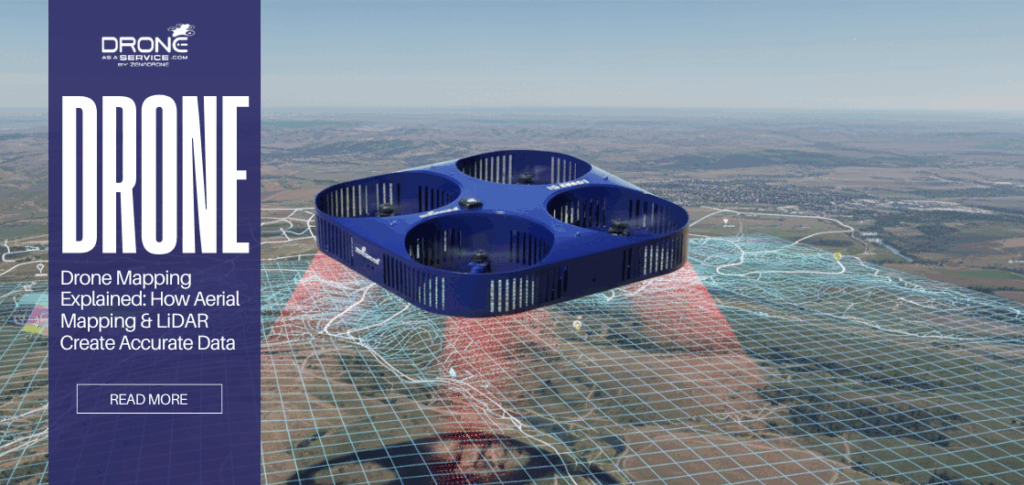

Drone Mapping Explained: How Aerial Mapping & LiDAR Create Accurate Data
Drone mapping has transformed how industries capture, analyze, and visualize geographic data. Instead of relying on slow, labor-intensive ground surveys, organizations now use mapping drones (UAVs) to generate highly accurate maps, 3D models, and terrain data in a fraction of the time.
This guide explains what drone mapping is, how it works, the role of LiDAR and photogrammetry, and how businesses use drone mapping services to make faster, data-driven decisions.
Whether you’re a surveyor, engineer, or business owner, understanding how drone mapping works can help you make smarter decisions for your projects.
What Is Drone Mapping?
Drone mapping is the process of using UAVs equipped with cameras and sensors, and when planning missions, it’s important to know flight performance limits such as distance capabilities..
It is widely used in:
- Land surveying
- Construction planning
- Topographic mapping
- Infrastructure inspection
- Environmental monitoring
In simple terms, drones help with cartography (mapping) by capturing thousands of overlapping aerial data points, which software then stitches into georeferenced maps and models with survey-grade accuracy.
How Does Drone Mapping Work? (Step-by-Step)
1. Flight Planning & Control Points
Before any drone takes off, operators carefully plan the flight. This includes:
- Defining flight altitude
- Setting image overlap
- Marking area boundaries
For high accuracy, Ground Control Points (GCPs) or RTK/PPK systems are often used. These ensure the data collected is survey-grade.
In practice, this means fewer errors and more reliable maps; exactly what professional projects require.
2. Aerial Data Capture
Mapping drones follow pre-programmed flight paths and capture:
- High-resolution aerial imagery
- LiDAR point clouds
- Multispectral data (if required)
This is where aerial mapping drones outperform traditional methods by covering large areas quickly and safely.
3. Data Processing
Once the drone lands, the raw data is processed using specialized photogrammetry processing software and converts data into:
- Orthomosaic maps
- Digital Surface Models (DSM)
- Digital Terrain Models (DTM)
- 3D point clouds and meshes
This is called photogrammetry (for images) or LiDAR processing.
For most beginners, this step might sound technical but it’s what transforms a collection of images into actionable insights you can actually use.
4. Final Mapping Outputs
Clients receive survey-ready deliverables, such as:
- Topographic maps
- Contour lines
- Volumetric calculations
- 3D models
Having all this in hand quickly allows projects to stay on schedule, reduce mistakes, and save costs.
Types of Drone Mapping Technologies
Aerial Photogrammetry Mapping
Uses overlapping images to create:
- 2D orthomosaic maps
- 3D models
- Surface measurements
This is ideal for construction progress tracking and land visualization.
UAV LiDAR Mapping
Uses laser pulses to measure distance and elevation.
Key advantages:
- Works through vegetation
- Extremely high accuracy
- Ideal for terrain and infrastructure mapping
This is common in UAV LiDAR mapping and forestry projects because LiDAR is especially helpful in projects where you need detailed elevation data or need to map areas with dense tree cover.
Topographic Mapping with Drones
Topographic drone mapping focuses on:
- Elevation
- Slopes
- Terrain contours
It’s widely used in civil engineering, mining, and urban planning, giving teams a clear sense of the landscape before they even step on site.
Mapping & Surveying Drones: Hardware Explained
Types of Mapping Drones
- Multirotor drones: Precise, ideal for small to medium areas
- Fixed-wing drones: Longer flight times, large-area mapping
Sensors Used in UAV Mapping
- RGB cameras (standard mapping)
- LiDAR sensors (terrain & vegetation)
- Multispectral sensors (agriculture & analysis)
Choosing the right hardware and sensor setup is critical. It directly affects the accuracy and usefulness of your mapping project.
Drone Mapping Services vs In-House Mapping
When to Use Drone Mapping Services
Professional drone mapping services are ideal when you need:
- Survey-grade accuracy
- Regulatory compliance
- Advanced sensors (LiDAR)
- Reliable data processing
In-House vs Professional UAV Mapping
Factor | In-House | Drone Mapping Services |
Equipment Cost | High | Included |
Expertise | Limited | Expert Pilots & Analysts |
Accuracy | Varies | Consistent & Validated |
Compliance | Risky | Fully Compliant |
For most projects, professional services ensure accuracy, efficiency, and safety, without the headaches of owning drones and training staff.
Industries Using Drone Mapping
Construction & Infrastructure
- Site planning
- Progress tracking
- Volume measurements
Land Surveying & Urban Planning
- Boundary mapping
- Elevation models
- Development planning
Agriculture & Environmental Mapping
- Crop analysis
- Drainage mapping
- Land assessment
Energy, Mining & Utilities
- Corridor mapping
- Terrain modeling
- Asset monitoring
Across industries, drone mapping saves time, reduces risk, and provides insights that were previously impossible.
Benefits of Drone Mapping Over Traditional Methods
Benefit | Traditional Surveying | Drone Mapping |
Speed | Days or Weeks | Hours |
Safety | Field Exposure | Remote Capture |
Accuracy | Limited Points | Dense Data |
Cost | High Labor | Cost Effective |
Data Richness | Minimal | 2D, 3D & Analytics |
Even for seasoned surveyors, drone mapping dramatically improves productivity.
Accuracy in Drone Mapping: What Affects Results?
GCPs vs RTK/PPK
- GCPs: Highest accuracy, more setup
- RTK/PPK: Faster, still highly precise
Flight Parameters
- Altitude
- Image overlap
- Weather conditions
Sensor Quality
Higher-quality sensors produce better mapping outputs. Simple as that, understanding these factors ensures your project delivers data you can trust.
Drone Mapping Regulations (Brief Overview)
Professional drone mapping requires:
- Licensed pilots (e.g., FAA Part 107 in the U.S.)
- Airspace authorization
- Safety and data compliance
This is why experienced drone mapping companies are preferred for commercial projects. They manage both risk and accuracy, so you don’t have to.
How to Choose the Right Drone Mapping Company?
Choosing the right drone mapping company can make the difference between a smooth project and a frustrating, error-prone experience. Here’s what you should pay attention to:
- Proven Industry Experience
Look for a company that has successfully handled projects. Whether it’s construction, agriculture, or infrastructure, experience ensures they know the best practices and potential pitfalls. - LiDAR and Photogrammetry Capabilities
Not all drones or companies offer advanced mapping technologies. Make sure your provider has the right sensors and software, including LiDAR and photogrammetry tools, to deliver high-accuracy data that meets your project’s requirements. - Clear Deliverables
Ask how the data will be delivered. Will you get 3D models, topographic maps, orthomosaics, or volumetric calculations? Clear, actionable deliverables save time and avoid confusion later. - Regulatory Compliance
Drones operate under strict rules. A reputable company will have licensed pilots, FAA registration or approvals (or local compliance certifications), and insurance in place, so your project stays safe and legal. - Scalable Service Coverage
Your project needs may grow. Choose a provider who can scale up quickly, whether it’s mapping larger areas, adding additional drones, or increasing data processing capabilities.
By keeping these factors in mind, you ensure your drone mapping project runs smoothly, safely, and efficiently, giving you reliable data and peace of mind.
FAQ Section
How Accurate is Drone Mapping?
Drone mapping accuracy depends on the setup and technology used. With professional methods like RTK/PPK GPS and Ground Control Points (GCPs), accuracy can reach 1–5 cm, which is suitable for most surveying and mapping needs. Basic setups may only achieve meter-level accuracy, while advanced LiDAR systems can capture highly detailed terrain, even through vegetation.
Is LiDAR Better than Photogrammetry for Drone Mapping?
LiDAR excels at capturing highly accurate elevation data and can penetrate vegetation, making it ideal for topographic surveys. Photogrammetry, on the other hand, works best for visual surface models and creating detailed 3D maps from overlapping images. Many projects combine both for optimal results.
Can Drones Replace Land Surveyors?
No. Drones don’t replace surveyors entirely but enhance their capabilities. UAV mapping speeds up data collection, increases safety, and provides dense datasets. Surveyors still interpret the data, ensure compliance, and make final decisions, but drones make their work faster and more precise.
How Do Drones Help with Cartography?
Drones capture high-resolution, georeferenced aerial imagery that can be processed into digital maps and 3D terrain models. This allows cartographers and planners to visualize, analyze, and measure landscapes accurately and efficiently, saving time compared to traditional ground surveys.
Final Thoughts
Drone mapping is no longer experimental, it is a core tool for modern mapping and surveying. By combining aerial mapping drones, LiDAR technology, and expert data processing, businesses gain faster insights, higher accuracy, and better decision-making.
Whether you need topographic data, 3D models, or large-scale aerial mapping, professional UAV mapping services deliver results that traditional methods cannot match.
Read Our Other Blogs
02 January 2026
Drone Mapping Explained: How Aerial Mapping & LiDAR Create Accurate Data
Drone Mapping Explained: How Aerial Mapping & LiDAR Create Accurate Data Drone mapping has transformed how industries capture, analyze, and...
01 January 2026
What Is a Drone Service? How UAVs Are Used by Modern Businesses
What Is a Drone Service? How UAVs Are Used by Modern Businesses? As businesses look for faster, safer, and more...
18 December 2025
Drone Insurance: What You Need to Know
Drone Insurance: What You Need to Know The insurance industry is currently undergoing a massive shift. For decades, the sector...
18 December 2025
Night Vision Drones: Technology, Applications & Buying Guide
Night Vision Drones: Complete Guide Night vision drones have changed the way we watch and explore the world after dark...
17 December 2025
What Is Return-to-Home (RTH) on Drones?
What Is Return-to-Home (RTH) on Drones? The worst thing that could happen is losing an expensive drone while on a...
17 December 2025
Is It Legal to Fly a Drone Over Private Property?
Is It Legal to Fly a Drone Over Private Property? The drone revolution is upon us, but the fight for...