Drone as a Service

Thermal Drones: What They’re Used For, How They Work, and When They’re Needed

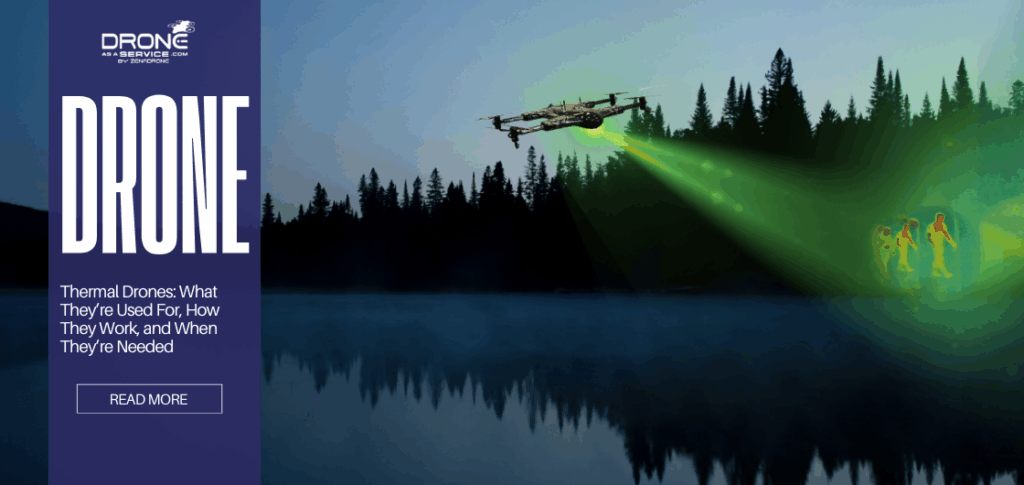
Thermal drone capturing infrared heat data during an aerial inspection.

TL;DR

Introduction

Thermal drones are flying thermometers equipped with microbolometers that map infrared radiation instead of visible light. While a standard drone relies on reflected light to show you “the view,” a thermal drone detects emitted heat energy to visualize temperature differentials.

A typical “spy movie” myth is that these sensors see through walls or glass; in reality, they only read surface temperatures and are effectively blinded by glass windows.

This article aims to break down exactly how thermal drones work, what they detect, and why industries need them. This article also aims to serve as an informative guide, rather than a buying guide, on thermal drones’ use cases.

What Are Thermal Drones

A thermal drone is an uncrewed aircraft equipped with a sensor that detects infrared energy to create a visual map of heat. Think of it as a flying heat-seeker that lets you “see” the energy everything — from a stray kitten to a faulty power line — naturally gives off, regardless of how dark it is outside.

The Quick Breakdown

While your standard drone is essentially a flying GoPro, a thermal drone is more of a flying data collector. Here is how they stack up:

Heat Signatures: Everything with a temperature above absolute zero emits infrared radiation. In reality, thermal cameras are limited to surface temperatures, which means a glass window can make them “blind.”

The “Skin Deep” Rule: These sensors only read the outermost layer of an object. They aren’t X-ray specs; they simply tell you how hot the surface is.

Visual Camera vs. Thermal Camera

FeatureVisual Camera (RGB)Thermal Camera (IR)
Detection MethodRelies on external light bouncing off objects.Detects the natural energy objects emit as heat.
Ideal SettingBest used during the day or in well-lit areas.Operates in total darkness or heavy smoke.
Main LimitationEasily affected by shadows, fog, or camouflage.Blocked by glass and affected by reflective surfaces.
End ResultA familiar, lifelike image of the scene.A functional map of temperature variations.

Radiometric and Non-Radiometric

In the field, this distinction is between simply spotting a problem and actually quantifying it.

  • Non-Radiometric: This provides a clear visual of heat differences. It’s perfect for search and rescue missions where you need to find a “glowing” person in a dark, cold forest.
  • Radiometric: This is the tool for high-stakes engineering. Every single pixel carries a specific temperature value. Instead of just seeing that a solar panel is “hot,” a radiometric camera lets you know it’s precisely 85°C, providing the raw data needed for a professional report.

How Thermal Drones Work

Infrared thermal image showing heat signatures of objects detected by a drone

Thermal Imaging Basics

Every object with a temperature above absolute zero emits infrared radiation. While our eyes are limited to the visible light spectrum, thermal cameras are specifically designed to detect this invisible energy. The drone’s sensor captures these heat waves and translates them into a visual map of temperature variations.

Think of it as shifting your perspective: instead of seeing an object by the light that bounces off it, you are seeing it by the energy it naturally “leaks” into the environment. This allows the drone to visualize a person or a machine based entirely on heat output.

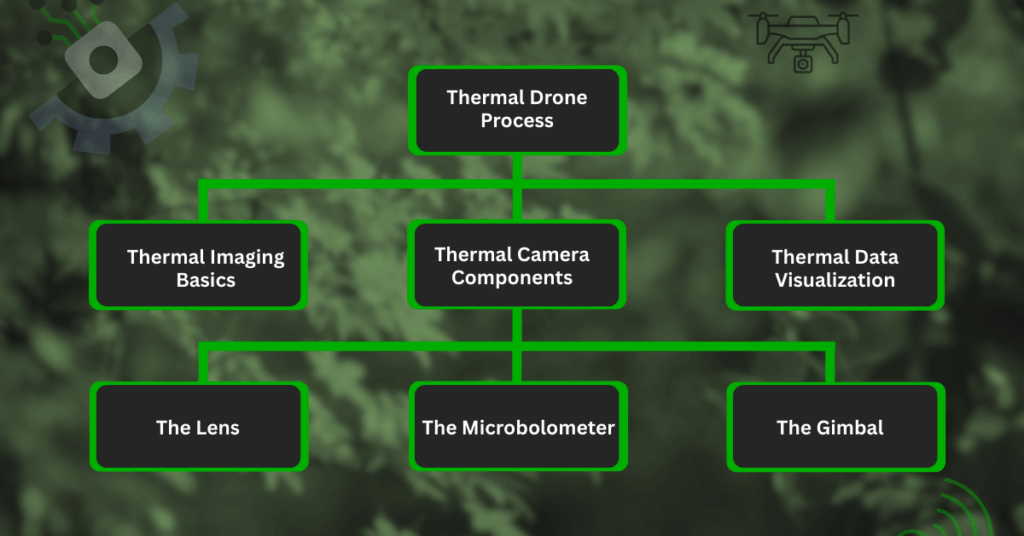
Thermal Camera Components

The Lens: Most thermal drones use Germanium lenses. This specialized material is necessary because standard glass is opaque to infrared radiation, preventing heat energy from reaching the sensor.

The Microbolometer: This is the core sensor. It does not capture light; instead, it measures changes in electrical resistance caused by incoming heat and converts those signals into digital data.

The Gimbal: Thermal sensors are sensitive to motion, so a high-quality gimbal is essential. It stabilizes the camera during wind or drone movement, ensuring heat signatures remain clear rather than appearing blurred.

Thermal Data Visualization

After capturing thermal data, the drone displays it using various color palettes. The most common industry standards are White Hot (where hotter areas appear bright) and Black Hot (where hotter areas appear dark).

Search and rescue teams often prefer these palettes because the strong contrast makes it easier to quickly identify warm objects that stand out from the background.

However, interpreting this data requires understanding the difference between relative and absolute temperature.

Relative Temperature

Relative temperature compares heat differences within the visible scene. The camera identifies the hottest and coldest areas at that moment and highlights them using the brightest colors in the selected palette. These colors indicate which areas are warmer or cooler relative to each other, not their exact temperature.

Absolute Temperature

Absolute temperature refers to the exact surface measurement, such as 45°C. It provides the precise temperature at a specific point rather than a comparison within the scene.

This distinction is crucial for operators. Not everything that appears hot is necessarily dangerous. For example, a metal roof during summer may look extremely hot compared to nearby objects, but it is simply absorbing solar energy not indicating a fire or internal fault.

What Are Thermal Drones Used For

Side-by-side comparison of visual camera image and thermal heat map from a drone

Search and Rescue

Thermal drones act as a powerful force multiplier for rescue teams when every second matters. They are especially valuable during nighttime operations because they do not rely on visible light to detect the heat signature of a lost individual.

When scanning dense forests or rough, hard-to-reach terrain, these drones can cover large areas in minutes, highlighting heat signatures that ground crews might otherwise miss.

Firefighting

Thermal sensors allow firefighters to see through heavy smoke that would otherwise block visibility. By detecting hotspots hidden within walls or beneath rooflines, crews can focus their efforts more accurately and reduce the risk of structural collapse.

This significantly improves firefighter safety by providing a clear view of the fire’s core without exposing teams to unnecessary danger.

Electrical & Industrial Inspections

In industrial environments, excess heat is often the first indicator of a problem. Thermal drones enable technicians to inspect overheated components in high-voltage power lines and heavy machinery without close physical exposure.

Early detection of temperature spikes allows companies to perform preventive maintenance, reducing the risk of catastrophic equipment failure and costly unplanned downtime.

Energy & Solar

Maintaining a solar farm is a large-scale challenge, but thermal drones simplify the process by identifying faulty solar cells from the air. A damaged or underperforming panel often runs hotter than the rest of the array, appearing as a distinct bright spot on the display.

This enables operators to monitor efficiency across thousands of panels and replace only the components that are actually failing.

Agriculture & Environment

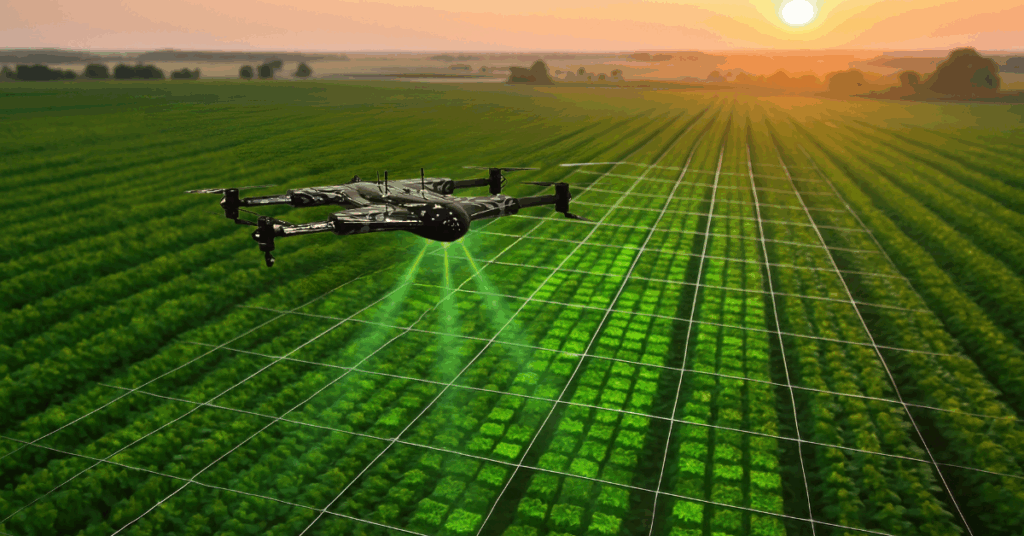
Farmers use thermal drones to monitor crop stress, which often appears as subtle changes in leaf temperature before visible wilting occurs.

These sensors are also effective for detecting irrigation leaks or areas where water distribution is uneven. By mapping heat variations, growers can optimize resource use, conserving both water and operational costs.

What Thermal Drones Can and Cannot Detect

Thermal sensors have specific physical limitations that operators must understand. To get the most out of a thermal drone, you need to separate “movie magic” from actual science. Here are the real capabilities and limitations of thermal drones:

Capability YES / NO Explanation
Heat Differences YES Thermal drones excel at mapping thermal contrast — clearly showing where one object is warmer or cooler than its surroundings.
People and Animals YES Living beings act as natural thermal beacons. Drones can detect their heat signatures even in total darkness or light vegetation.
Equipment Anomalies YES They can identify overheating transformers, motor friction, or failing solar cells long before physical breakdown occurs.
Through Walls NO Thermal radiation cannot penetrate solid materials such as wood, brick, or concrete. You only see the surface temperature of the wall.
Through Glass NO Glass behaves like a mirror to thermal sensors. It reflects infrared energy rather than allowing the camera to see inside.
X-Ray Vision NO Thermal cameras are not X-ray devices. They cannot see internal skeletal structures or reveal hidden objects beneath clothing.

Myths and Facts

Myth 1

People often believe drones can see individuals moving inside a house.

The Fact: Thermal sensors only measure the wall’s surface temperature. If a room is warm, the wall may appear warm — but you cannot see the people inside.

Myth 2

A common belief is that you can inspect a room through a window.

The Fact: Glass is infrared-opaque. Instead of seeing through it, the camera typically displays a reflection of the drone or the sky.

Myth 3

It is often assumed that thermal drones can see through objects like a medical X-ray.

The Fact: Thermal imaging strictly measures surface heat energy. While it can see through smoke (since smoke consists of particles), it cannot see through solid objects or clothing.

Myth 4

A bright spot on the screen always indicates danger.

The Fact: A hot spot may simply be a metal surface heated by the sun. Professional interpretation is necessary to distinguish between normal solar loading and an actual equipment fault.

When Are Thermal Drones Actually Needed

  1. When visibility is poor but heat is present

    When darkness, smoke, or fog make regular cameras almost useless, thermal sensors step in. Instead of relying on light, they detect heat, allowing them to map a scene even when visibility is close to zero.

  2. When safety or time is critical

    In emergencies such as search and rescue operations, every second counts. Thermal drones can scan large areas in minutes and quickly highlight individuals who would be nearly impossible to spot with the naked eye.

  3. When temperature differences affect decisions

    When confirming an electrical fault or identifying insulation gaps, a thermal sensor provides objective temperature data to support informed, professional decisions.

  4. When camouflage or dense brush is an issue

    In wildlife monitoring or security operations, thermal sensors cause living targets to stand out as bright heat signatures against cooler surroundings, making visual camouflage ineffective.

  5. When identifying invisible mechanical failures

    Thermal drones are effective for detecting motor friction or pipe blockages that appear normal to a standard camera but emit excessive heat due to internal issues.

Limitations & Practical Considerations

To use a thermal drone effectively, you must look beyond the high-tech visuals and understand the physics behind the sensor. Field reliability depends on knowing when environmental or material factors may distort the data.

Effects of Weather on Precision

Thermal sensors are sensitive to weather conditions. Rain, snow, fog, or high humidity can scatter infrared radiation, reducing image clarity and affecting temperature accuracy. In extreme conditions, heat signatures may appear muted or distorted.

Surface Emissivity and Reflectivity

Not all materials emit heat equally. Shiny surfaces such as glass or polished aluminum have low emissivity, meaning they reflect surrounding thermal energy rather than accurately displaying their own temperature. This can lead to misleading or false readings if not properly accounted for.

Accuracy vs. Interpretation

A high-end sensor is only part of the equation — operator expertise is equally critical. A visible “hot spot” on a circuit breaker could indicate an impending failure, or it could simply be solar reflection. Misinterpreting thermal data can result in unnecessary repairs or overlooked hazards.

The Need for Post-Processing

For professional reporting, the image displayed on the controller is rarely the final output. Raw thermal data typically requires specialized software adjustments for atmospheric conditions and emissivity settings after the flight to ensure technically accurate and defensible results.

Thermal Drones vs Standard Drones

Feature Standard Drone (RGB) Thermal Drone (IR)
Primary Goal Captures visual detail and true-to-life colors. Detects heat signatures and energy loss.
Detection Method Relies on reflected visible light (photons). Detects infrared radiation emitted by objects.
Visibility Requires a light source (sunlight, moonlight, or artificial lighting). Operates in total darkness and can see through smoke.
Detail Level High resolution; ideal for detecting small cracks or surface defects. Lower resolution; optimized for detecting temperature differences.

FAQS

What are thermal drones used for?

They are primarily used to detect heat signatures for life-saving missions and industrial maintenance. Whether it’s finding a missing hiker in a forest or spotting a failing electrical transformer before it explodes, these drones turn invisible heat into actionable data.

Thermal drones work perfectly at night because they don’t need light; they “see” the heat energy that objects naturally emit. While a standard camera sees nothing in the dark, a thermal sensor picks up the temperature contrast between a warm person and the cold ground.

No, thermal drones do not have the ability to provide images of solid objects such as walls or doors. They measure the temperature of the surface they are examining, but are only able to detect a “ghost heat” when a fire in the wall is hot enough to heat even the surface.

They are highly accurate at detecting temperature differences, but the exact numerical reading can be influenced by weather and surface materials. For professional results, you have to account for things like humidity and “reflectivity” to ensure the data is technically sound.

Thermal drones should be grounded during heavy rain or when you only need high-resolution visual details, like reading small text. If your goal is to see through glass or get a clear “lifelike” photo, a standard visual drone is actually the better tool for the job.

Conclusion

Although a thermal drone is an influential tool, its worth can all be presented in the capabilities of an operator to put intricate heat maps into proper usage. 

It is not until you learn the science behind the data, e.g., the surface reflectivity and weather effects, not to mention just the colors on your screen, that the technology becomes a real solution

Read Our Other Blogs

Item #1

THANK YOU

Thank you for booking a consultation with Drone as a Service! One of our team members will contact you shortly.