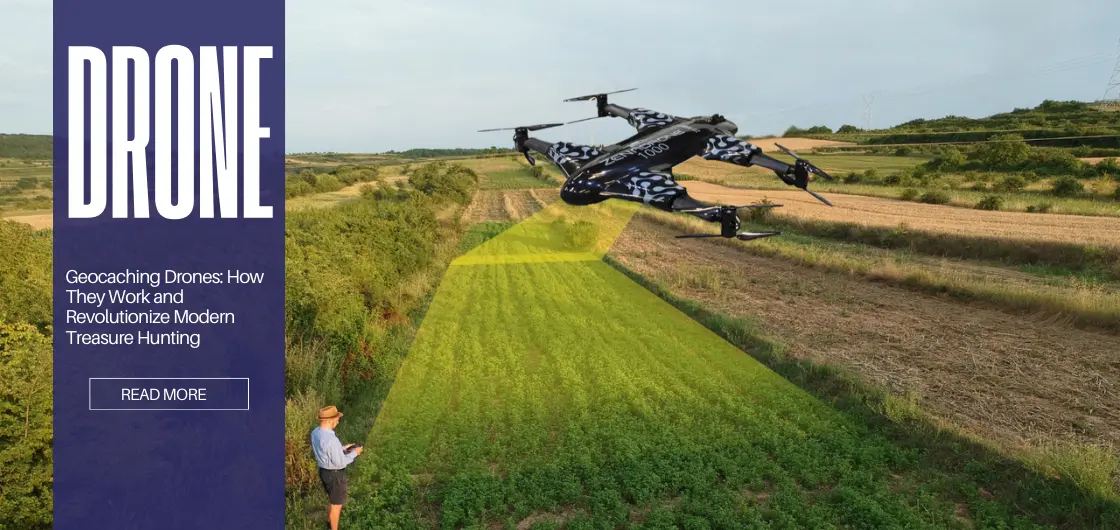
Geocaching Drones: How They Work and Revolutionize Modern Treasure Hunting
What is Geocaching? Geocaching is considered a modern treasure hunt. This activity uses GPS to locate hidden containers, called caches, in urban and natural settings. What started with handheld GPS devices has turned into a tech-enhanced experience.
In fact, the latest development is that drone geocaching technology offers explorers a new perspective on the world from above, making it easier to locate, document, and access caches in previously inaccessible or challenging locations.
To delve deeper into this topic, this article will guide you on how drone geocaching works, what tools and technology you need, how hard it is to search from the air, and the most important rules that every pilot should follow to stay safe.
What is a Geocaching Drone?
A geocache drone is an unmanned aerial vehicle that has been modified or built to assist with Geocaching. The main goal is to help find, record, or even hide geocaches. These drones provide information that enhances what people can learn by exploring on the ground, like navigating through tight spaces.
A drone can easily look at the tops of trees in a thick forest and find a cache on a cliffside, or even take pictures of a remote area. Drone geocaching makes the hobby safer and more efficient while also opening up new options for adventure.
How Geocaching works: The basic mechanisms
Like mentioned, geocaching drones use GPS navigation but also sensors, and cameras built into the drone. The drone itself can locate the cache’s exact location by inputting its precise coordinates. However, mere coordinates aren’t enough; the operator needs eyes on the target. This is why most drones use First-Person View (FPV) technology. Which transmits a live video feed directly to the operator, enabling precise monitoring of the environment.
And because of this, advanced models have incorporated AI driven object tracking and mapping systems. This is to easily identify caches and navigate complicated terrain. All these features essentially ensured that drone-assisted Geocaching is accessible to people with different skill levels and valuable to experienced hobbyists.
Components and Features of a Geocaching Drone
What makes a drone, a geocaching drone? Essentially these are drones that are equipped with high-tech features that are designed to explore remote and challenging locations with precision and accuracy. It captures HD images and video recordings, enabling explorers to assess the geocache site accurately.
It comes with a built-in GPS module, ensuring accurate navigation to the coordinates you want and identifying obstacles that could cause a crash, such as in forests. These drones offer stability, ability to access remote locations over long ranges and long-lasting battery life which allows for extended flight times.
They are also are equipped with advanced functionalities like:
- Auto-return when the battery is low or the connection is lost
- Altitude hold which maintains a stable distance from the ground,
- Live GPS sharing
Advantages of Utilizing Drones in Geocaching
Here, we discuss the highlights of how drones help in Geocaching. The use of drones in Geocaching offers several advantages. For instance it improves the safety of explorers by giving them access to locations that are physically challenging.
Drones save a significant amount of time compared to ground searches, as they enable geocachers to survey areas more efficiently from above. Not to mention they are able to capture high quality videos from an aerial viewpoint that can also be used for mapping.
Furthermore, geocachers can use the data from the drones for strategic reasons. This is to encourage explorers to improve their teamwork and creativity during missions.
Challenges, Risks, and Safety Guidelines for Drone Geocaching
Disadvantages are always constant in every aspect even in geocaching. Specifically regarding drone use, the battery’s capacity determines how long and how far the drone can fly. This means that for difficult missions, careful preparation is needed, and for longer missions, more than one battery is required.
Another disadvantage are weather conditions like strong winds, fog, and rain. It’ll most likely cause your drone damage, complicate its controls and increase the risks of flying. Also there’s an issue of regulation and ethical limitations. Wherein pilots must not cross private properties, wildlife preserves and other restricted areas.
Getting Started with Drone Geocaching
After learning how drones help in Geocaching, here are some tips to get started:
- Choose the Right Drone: Opt for a GPS-enabled model that aligns with your skill level and the environment in which you plan to use it.
- Geocaching and mapping application: efficiently plan out your missions and track your location by installing applications that may help on your missions.
- Enhance Your Drone Handling Skills: take the time to learn from tutorials and practice manoeuvres on your own speed
- Join the community: Engage with people within the drone community to gain knowledge and tips.
- Document Your Findings with Integrity: to ensure transparency, record your flights and share your results.
Recommended Drones for Geocaching in 2025:
Below is the list of drones that have geocaching technology and other advanced capabilities. These drones are the ideal for various terrains and environments.
Zenadrone 1000: A top-tier drone featuring AI-assisted navigation, long endurance, and advanced mapping capabilities.
Zenadrone IQ Nano: a compact powerhouse designed for exceptional maneuverability, perfect for navigating tight spaces while delivering precise drone GPS navigation.
Zenadrone IQ Square: Supports LiDAR, thermal imaging, and HD cameras for comprehensive terrain detection.
These models accommodate a range of geocaching needs, from professional-level exploration to hobbyist-friendly adventures.
Equipment and Technology for Solar Drone Inspections
Drones are undoubtedly invaluable to solar farm inspections. With the right equipment and technology at your disposal, you can empower solar panel drone inspections. However, the question remains: what exactly should you look for in drones?
ZenaTech has the perfect answer for you – the ZenaDrone 1000. Engineered and optimized for solar panel inspection, it’s specially equipped with the right payloads and sensors, including:
- Thermal Sensor: Detects hotspots, microcracks, degradation, defects, faulty cells, and wiring issues by using radiometric infrared (IR) technology to collect thermal data.
- Multispectral Sensor: This evaluates vegetation encroachment, soiling, and shading to evaluate environmental impact by analyzing the light spectrum reflected from solar arrays.
- High-resolution RGB Camera: Captures 4k images and videos of module condition and integrity for visual audits, reporting, analytics, and documentation.
360 Degree LiDAR: Well, for this feature, it allows 3D mapping for environmental and site analysis, further optimizing panel placement and energy production. - Power Management System: Ensures safe extended flight times through long-lasting batteries. An automatic charging feature also allows it to automatically return to its charging pad, land, and start the charge cycle.
Even better, the ZenaDrone 1000 is designed with artificial intelligence and machine learning, supporting AI-assisted flight modes. This streamlines your solar drone inspections–from autonomous data collection to defect detection and analytics.Combined with automated reporting, ZenaDrone 1000 quickly delivers accurate and comprehensive data turned into actionable insights, improving decision-making.
The Future of Geocaching Drones
Drone technology has been nothing but extraordinary. It has unlocked exciting opportunities for many enthusiasts worldwide, even geocaching hobbyists. Because of the advancements, like the AI assisted navigation, it paved the way for predictive mapping and automated route planning. It essentially allowed drones to explore more efficiently and accurately, covering more ground in less time especially in group missions.
And the innovation doesn’t stop there, it brought augmented reality integration . Which provides users with a more engaging and participatory experience when searching for caches, adding an extra dimension to the exploration process.
It also fostered a new social element; team-based drone missions. Because of its gaining popularity, it fostered collaboration and a spirit of friendly rivalry among geocaching enthusiasts. These revolutionary advancements have changed Geocaching. Creating a more engaging and exciting experience for explorers.
Conclusion
Drones have had many innovations from the previous years, one is transforming the hobby of geocaching. Essentially it made it more efficient, precise and added a new excitement in searching for hidden treasures. Making explorations faster than ever before because of features like GPS navigation, aerial scouting, and real-time tracking.
Ultimately, to enhance your geocaching experience, always use drones safely and in accordance with the law. And not to mention, it takes a lot of commitment in purchasing a drone. It’s best to try services that may fit to your liking.
Read Our Other Blogs
27 February 2026
How to Check Weather Forecast Before Flying a Drone
How to Check Weather Forecast Before Flying a Drone Weather is not just a background condition for drone flying; it...
26 February 2026
Drone Surface Emissions Monitoring (DSEM): Ultimate Guide
Drone Surface Emissions Monitoring (DSEM): Ultimate Guide Drone Surface Emissions Monitoring (DSEM) is changing how we protect the environment. It...
26 February 2026
Geocaching Drones: How They Work and Revolutionize Modern Treasure Hunting
Geocaching Drones: How They Work and Revolutionize Modern Treasure Hunting What is Geocaching? Geocaching is considered a modern treasure hunt....
24 February 2026
How Drone Services Increased ROI For Irish Companies
How Drone Services Increased ROI For Irish Companies Drone Services ROI – Ireland TL;DR This guide shows how Irish businesses...
24 February 2026
Photogrammetry in Archaeology: Methods, Use Cases & Limitations
Photogrammetry in Archaeology: Methods, Use Cases & Limitation TL;DR Photogrammetry is a passive technique of remote sensing that uses redundancy...
23 February 2026
The Role of Software in Smarter Drone Power Distribution
The Role of Software in Smarter Drone Power Distribution With the constant development of technology, drones are now classified as...


