


Top 7 Drone Concrete Inspection Mistakes to Avoid
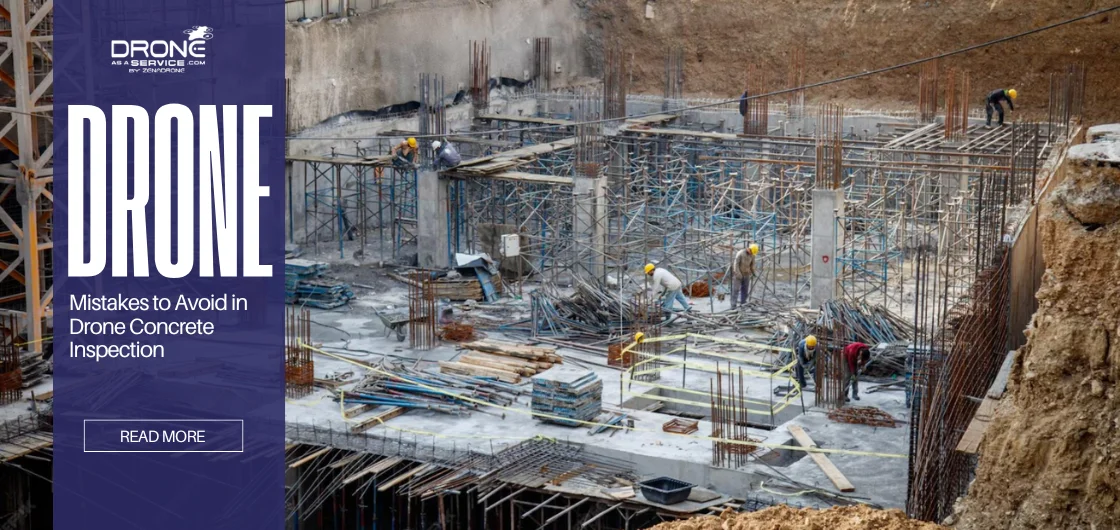
Drone concrete inspection uses UAVs to collect accurate data for evaluating concrete and infrastructure. High-resolution cameras, LiDAR, and GNSS allow safer access to hard-to-reach areas like bridges, tunnels, and high-rises.
Despite these advantages, common mistakes, such as GPS errors, environmental challenges, and minor workflow issues—can compromise data accuracy and reliability. Understanding these pitfalls is key to effective inspections.
This article highlights the top seven mistakes to avoid and offers practical solutions for flight planning, sensor calibration, and UAV workflows.
Why Drone Concrete Inspection Matters
Manual inspections can be slow, risky, costly, and sometimes inaccurate, especially in hard-to-reach areas. According to OSHA and NIOSH, falls from high-rises and confined spaces are leading causes of construction-related fatalities and injuries. Additionally, traditional inspections of high-rise structures and bridges can be very time-consuming. Drone inspection utilizing UAV provides a faster, safer, and more efficient way to capture high-quality concrete defect data, cutting inspection time by up to 70% and supporting accurate construction progress update reports.
Despite the fact that drones are very effective in spotting common defects in concrete—such as cracks, spalling, and roughness—there are still some limitations. These include the inability to detect subsurface defects and internal voids, as well as reduced accuracy in low-light conditions or on occluded surfaces.
Key questions to consider during drone concrete inspections:
- How can drones detect defects that are not visible on the surface?
- What environmental or operational factors may reduce inspection accuracy?
- When should drone inspections be combined with manual checks for best results?
UAV structural health monitoring may miss subsurface defects or rebar corrosion despite its ability to detect surface-level issues. Combining drone data with manual inspection ensures more reliable results.
It is essential to inspect concrete structures for extending infrastructure lifespan, safety, and maintenance. To improve long-term infrastructure monitoring accuracy, safety, and reliability, adopt these structural inspection best practices.
Top 7 Drone Concrete Inspection Mistakes
Learn the top 7 drone concrete inspection mistakes and follow step-by-step guidance to avoid errors, improve accuracy, and ensure safety.
Mistake 1 – Ignoring Positional Accuracy & Ground Control Points (GCPs)
Positional accuracy and proper use of ground control points (GCPs) are common mistakes often overlooked in drone concrete inspection. It is essential to utilize GCPs, for achieving centimeter-level precision in mapping cracks, spalling, surface defects, and structural deformation. Integrating RTK or PPK workflows enhances accuracy, reducing both errors and the number of GCPs required.
Inaccurate mapping of cracks and other surface defects is caused by GPS errors or misaligned images, compromising current and future repair planning.
An example of this is a distorted dimension of cracks from a 3D model of a bridge caused by GPS errors. Such an error could result in an erroneous evaluation, leading to overlooking maintenance, expensive re-inspections, or non-productive structural repairs. Accurate photogrammetry offers 2–5 cm precision in position, thus the measurements of cracks are reliable and support timely, and efficient interventions.
These common pitfalls can be avoided by incorporating GCPs during UAV flights and performing regular calibration checks on all sensors. Ensure precise 3D model and reliable concrete crack localization by using multi-sensor fusion, which integrates data from GPS, IMU, photogrammetry data, and LiDAR sensors for enhanced accuracy.
Improve your drone inspection accuracy and create consistent data for structural monitoring and maintenance decisions by following these practices.
Mistake 2 – Overlooking Subsurface Defects
One disadvantage of drone-based concrete inspection is its inability to detect subsurface flaws like internal voids, delamination, honeycombing, and rebar corrosion. Though it can spot surface cracks, it is not advisable to rely on visual data. To detect unhidden subsurface flaws, engineers incorporate ASTM-standard NDT methods like ultrasonic testing or GPR.
It is risky to rely solely on visual data, as hidden defects can remain undetected. Computer vision detects only surface defects, while internal issues require complementary NDT methods such as UPV, GPR, or infrared thermography.
The deterioration of these unnoticed defects may compromise the safety and lifespan of the structure, leading to costly repairs and emergency maintenance.
In order to mitigate this, it is recommended to incorporate targeted manual checks, non-destructive testing (NDT), or ground-penetrating radar (GPR) with drone inspections. The integration of these additional inspection methods assists engineers in collecting and drafting reliable and accurate maintenance plans.
Mistake 3 – Not Considering Environmental & Surface Conditions
Environmental and surface conditions, such as glare from wet concrete and texture shadows, often contribute to drone inspection pitfalls, reducing the quality of collected data. Other factors that contribute to unnoticed defects are poor lighting, shadows, surface stains, and vibrations.
All of these factors can lead to misleading and incomplete data, affecting drone inspection accuracy. Thus, it is essential to follow UAV survey best practices to reduce inaccuracy in data collection and assessment.
- To avoid these issues, consider these to achieve clear, accurate, and high-quality data:
- Avoid harsh shadows and conduct flights during optimal daylight conditions.
- To minimize blind spots, pass over critical areas multiple times to ensure all angles are captured.
- Use stabilization to reduce vibrations, and artificial lighting for surfaces with reflective or shaded lighting.
Mistake 4 – Ignoring Data Reliability & False Positives
Relying heavily on AI or computer vision for defect detection accuracy is one of the challenges in UAV surveying. While both of these positively contribute to UAV concrete crack detection, errors and misleading results are inevitable.
Typical computer vision models achieve 80-95% accuracy on detection, yet can generate false positives. These systems may flag shadows or surface stains as a critical crack and could sometimes miss an actual defect. Creating false positives and false negatives.
This risk is anchored by base-rate bias and the trade-off between accuracy and reliability. Base-rate bias comes into play when a rare defect is misclassified because the model presumes it is either more or less common than it is in reality. In this case, a model may issue flags for 10 cracks, even if only 6 are there (false positives) and at the same time skip 2 of the real cracks (false negatives).
Even advanced technology does not guarantee perfect data, proving reliability to it may cause overlooked structural issues, leading to poor maintenance decisions.
Structural inspection errors are really a matter of reliability. It is very important to highlight the importance of the AI-generated results being verified with engineers through the method of hybrid inspection consisting of drone data and manual verification.
This procedure ensures drone concrete inspection accuracy for reliable maintenance planning and minimal inspection errors.
Mistake 5 – Neglecting Regulatory, Safety & Operational Constraints
When UAV surveying is performed, it is very important to follow the flying regulations and requirements. As a matter of compliance, the operators will have to get the FAA Part 107 certificate and a waiver for BVLOS flights. One of the immediate risks resulting from improper compliance with laws and operational constraints is the pitfalls of drone inspection.
According to FAA regulations, It is considered a specialized commercial activity when performed over critical infrastructures or within complex airspace. These include bridges, power plants, dams, and major transportation hubs. Ignoring these surveying regulations, failing to comply with specific flight permits, or certification can result in fines and project discontinuation. It includes securing authorization when flying near airports and considering urban restrictions.
Address these challenges by pre-flight planning, risk assessment, and proper training protocols. Pilots should complete recurrent training, keep flight logs, and follow safety management systems (SMS). This includes assessing nearby power lines, air traffic, and drone survey limitations like battery limits and payload constraints.
Mistake 6 – Lack of Standardization & Workflow
Inconsistent data gathering, processing, and reporting are one of the challenges in drone-based inspection, producing unreliable results. Differences in camera angles, flight altitude, or image overlap can affect outcomes.
To counteract these inconsistencies, standardized metadata logs help ensure accuracy and repeatability by keeping detailed records. This includes flight parameters, sensor settings, environmental conditions, data collection details, and processing information.
A lack of a standardized workflow can lead to teams producing datasets that are not comparable among the different inspections. This leads to long-term monitoring becoming less effective, and the chance of missing defects gets higher.
To ensure that the results are both accurate and repeatable, it is crucial to strictly follow established drone inspection protocols that are in line with the ISO 21384 and ASTM UAV standards. It consists of pre-flight planning, UAV flight execution, UAV photogrammetry, and concrete processing to AI-assisted defect detection, manual verification, and final reporting. Version-controlled checklists and SOPs are used as a reference to maintain uniformity across inspections.
By implementing a standard inspection workflow, the quality indicators are maintained at the same level, making it easier for maintenance and structural health monitoring.
Mistake 7 – Not Planning for Cost, Risk, and Project Context
One of the main mistakes when utilizing drones for concrete inspections is focusing mainly on the speed and time, and overlooking the possibility of false positives and non-detection of defects. Without proper risk analysis, these mistakes can trigger mandatory re-inspections, increase labor costs, and extend project downtime, creating more trouble than they resolve.
Overlooking these mistakes may seem minor, but it can lead to costly repairs and operational delays, losing the purpose of drone surveying.
To eliminate this problem, consider a full-on cost-benefit analysis, risk assessments, and a plan for UAV survey specific to the project. It is easier to get accurate results and fewer discrepancies when the technique is tailored to the condition of the setting.
Proper planning will not only help in mitigating risks related to drone inspections but also lead to better cost efficiency in drone inspections. By tailoring surveys to project parameters such as structure type, altitude, surface complexity, and environmental conditions.
Real-World Examples & Case Studies
Concrete structural inspection by drone has been demonstrated in real-world projects as having both advantages and disadvantages.Drones have been deployed at bridge sites for high-resolution photographs of hard-to-reach or hazardous areas for inspection, like beams, piers, and undersides. In Minnesota, UAS were used to collect detailed imagery for bridge inspection and modeling that would be difficult or hazardous to obtain traditionally (MnDOT study).
The use of drones in bridge inspection projects have early revealed the presence of minor surface cracks and spalling, thereby preventing more significant damage in the future.
A project, for example, reported a significant reduction in the time required for fieldwork from 240 minutes to just about 60 minutes due to drone-assisted inspections, in addition to providing practically 100% coverage of the structure as opposed to ~80% obtained with the traditional methods (ScienceDirect). In some scenarios, however, there were indications of shadow lighting and reflective surfaces, which led to the false identification of cracks. Consequently, this illustrates the fact that environmental factors may sometimes cause blind spots.
Inspections of high-rise structures confirm both advantages and disadvantages. Drones facilitate quick and safe checking of whole structures, thereby eliminating the need for scaffolding, promoting safety and speed.
Moreover, some checks have also reported issues, for instance, the occurrence of false positives due to dirt or texture patterns. For this reason, manual verification and hybrid assessment workflows need to be emphasized.
Tunnel inspection is another case proving UAV structural health monitoring benefits, especially in confined areas where access for the workforce is not possible. However, low-light conditions are a usual problem, making proper lighting and multi-pass data crucial.
Best Practices for Accurate Drone Concrete Inspection
The use of systematic approaches is implied as a requirement for reaching high accuracy levels and handling potential challenges. When it comes to UAV surveying and integrity assessments, success is guaranteed when you adhere to industry standards.
Planning of Flights
Always plan your flights to maximize image overlap and schedule flights during even lighting. Always use GCPs and RTK / PPK systems if you are hoping for positional accuracy down to the centimeter.
Sensor Calibration
Always ensure the camera is calibrated and is in optimal settings, reducing motion blur, glare, or any other loss of quality. If there are any concerns about subsurface defects, then consider using a thermal sensor.
Processing of Data
Professional-quality 3D models and other images should be created using photogrammetry software. Try using AI-assisted software only for the sizing and identifying of the defect. Then, have a structural engineer verify the image to ensure that any critical defects are noted.
Inspection Using Hybrid UAVs
The best method should be a hybrid UAV that is designed to cover a large area. It is a UAV survey combined with NDT methods like ground penetrating radar.
Limitations & Future Trends
Continuing advancements with drone concrete inspections also come with limitations. Technology adoption such as SLAM-based LiDAR mapping and AI-based defect classification, despite being highly accurate and efficient, are still facing practical challenges in the field, according to industry authorities like Deloitte and the FAA’s UAM forecast.
For instance, problems like internal voids, delaminations, and rusty rebar are internal and require additional non-destructive testing (NDT) tools for inspection. Apart from this, poor weather conditions like strong winds, dust, glare, and low light can compromise the clarity of the images taken.
On top of that, flight path, autonomy, and data collection can be limited due to various regulatory restrictions. The AI crack detection models used in inspections can be unreliable and still have a long way to go from improving on generating false positives. This frequently occurs when the classifier is misled by irregular concrete surfaces, marks, or lights, and also, missing subtle cracks — to illustrate, UAV pictures classifiers have reported their precision to be as low as 88% and recall around 81% in actual flight scenarios, which indicates existing accuracy issues.
With more advances in AI models, noise reduction tech, and crack classification, the drone concrete inspection field is set to improve. The ability to integrate and use tools like LiDAR, multispectral imaging, and GPR devices, surface defect detection is set to be more precise.
From flight planning to completed reports, we are set to experience more fully automated processes without human input. AI models used in detecting cracks will improve in reliability and scalability, accompanied by more defined guidelines and standards of UAV surveying.
Conclusion
The key considerations that will be taken into account when avoiding common mistakes in drone concrete inspection will guarantee the delivery of results that are reliable, accurate, and safe. Adhering to best practices such as strict compliance with FAA Part 107 regulations and industry standards can lead to improved precision in drone concrete inspection, decreased costs, and gradual structural integrity upkeep over time.
Our Drones-as-a-Service unit offers professional UAV solutions that are carried out according to the specifications of each project for organizations that are in search of quick and precise inspections. We ensure the highest level of accuracy in drone inspection, ranging from flight planning to reporting. Contact us today to enhance your concrete inspection accuracy.
Frequently Asked Questions
Can aerial drones capture photos of every type of defect in concrete?
Drones can capture photos of surface-level defects such as cracks, spalling, and efflorescence (white mineral deposits on concrete surfaces). However, drone concrete inspections are unable to capture any internal defects unless additional non-destructive testing (NDT) equipment is procured.
How accurate is crack detection in surveying from a moving drone?
When using high-resolution sensors and proper flight planning, drone concrete inspection can carry out centimeter-level accuracy. Additional AI models may also be calibrated to be even more precise.
At what points should manual inspection complement drone inspection?
Sometimes, manual inspection is needed during drone concrete inspections, if a defect looks suspicious or if a defect needs to be verified in a more in-depth manner. There may also be internal damage that is visible only beyond the scope of the UAV.
Are drone concrete inspections also subject to certain legal restrictions?
Yes. There are specific aviation regulations for drone concrete inspections that may govern the maximum permissible altitude, distance from the UAV, and whether or not the flight may be autonomous. There are also additional permits that are required more often than not for industrial or urban site inspections, such as BVLOS (Beyond Visual Line of Sight).
How can I improve the reliability of inspections from drones?
For drone concrete inspection performed, it is crucial to use the same standardized workflows and sensor settings, and to validate the AI results through an expert review in order to complement the NDT methods that will be used.
Read Our Other Blogs

02 March 2026
Benefits of Hiring a Drone Services Company in Ireland
Benefits of Hiring a Drone Services Company in Ireland Benefits of Hiring a Drone Services – Ireland Summary Irish construction,...

27 February 2026
How to Check Weather Forecast Before Flying a Drone
How to Check Weather Forecast Before Flying a Drone Weather is not just a background condition for drone flying; it...

26 February 2026
Drone Surface Emissions Monitoring (DSEM): Ultimate Guide
Drone Surface Emissions Monitoring (DSEM): Ultimate Guide Drone Surface Emissions Monitoring (DSEM) is changing how we protect the environment. It...

26 February 2026
Geocaching Drones: How They Work and Revolutionize Modern Treasure Hunting
Geocaching Drones: How They Work and Revolutionize Modern Treasure Hunting What is Geocaching? Geocaching is considered a modern treasure hunt....

24 February 2026
How Drone Services Increased ROI For Irish Companies
How Drone Services Increased ROI For Irish Companies Drone Services ROI – Ireland TL;DR This guide shows how Irish businesses...
24 February 2026
Photogrammetry in Archaeology: Methods, Use Cases & Limitations
Photogrammetry in Archaeology: Methods, Use Cases & Limitation TL;DR Photogrammetry is a passive technique of remote sensing that uses redundancy...