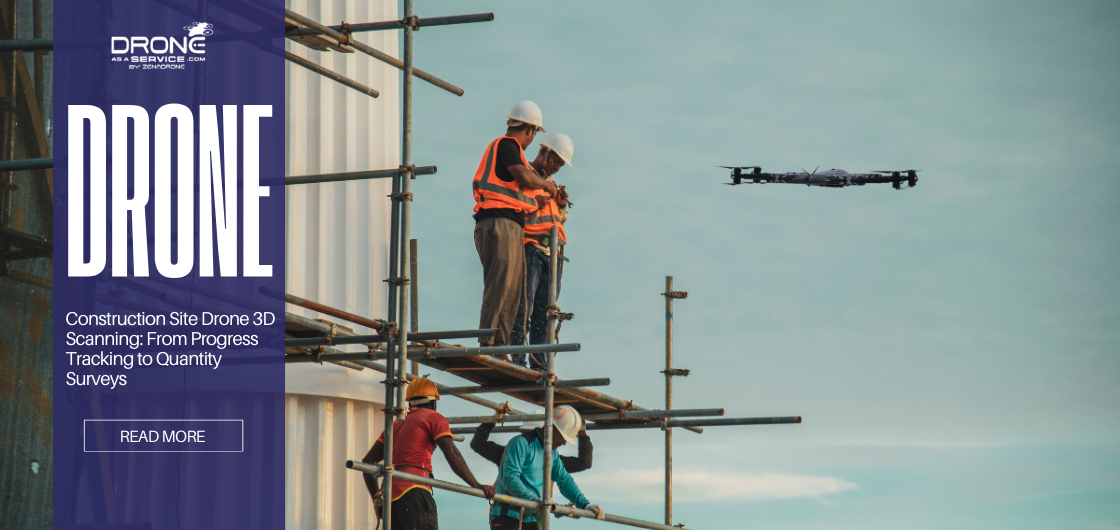
Construction Site Drone 3D Scanning: From Progress Tracking to Quantity Surveys
Why Construction Sites Use Drone 3D Scanning
Construction site drone 3D scanning systematically applies aerial photogrammetry and LiDAR technology. It captures high-fidelity, measurable digital twins of active job sites. This technology has evolved from a luxury to a necessity.
Traditional site documentation methods are slow and incomplete. A surveyor with a total station measures only individual points on a grid. This leaves gaps of unmeasured data between those points.
Drone 3D scanning for construction solves the problem of data latency on job sites. Drones cover the same area in minutes instead of days. This speed ensures decision-making data is always current and actionable.
The Problem with Manual Surveys
Manual surveying on large sites is dangerous for the crew. Surveyors walk near heavy machinery and navigate unstable terrain. This increases the risk of injury and liability claims.
Manual data collection is sparse by definition. A surveyor might capture one elevation point every 50 feet. This low resolution can miss critical terrain undulations between points.
Drone surveying for construction captures millions of points per acre. This creates a continuous “digital fabric” of the entire site surface. No detail is left unrecorded or unmeasured.
Large Site Coverage
Drones excel at mapping large horizontal infrastructure projects efficiently. They can fly over hundreds of acres in a single battery cycle. This makes them ideal for highways, solar farms, and residential developments.
The data is processed into a single orthomosaic map. Project managers can view the entire site context at once from their desk.
This holistic view is impossible to achieve from the ground. Growing cities and suburbs are increasingly relying on professional drone services in Tigard, drone services in Santa Rosa, and drone services in Tucson for accurate large-scale site scanning and 3D modeling. Construction sites use drone 3D scanning to capture large-scale, repeatable site data safely and efficiently.
Takeaway: 3D models allow construction teams to track real, measurable progress—not just visuals.
How Is Drone 3D Scanning Used for Construction Progress Tracking?
Effective construction drone mapping enables rigorous, time-based comparisons of site changes. This process transforms visual data into engineering insights.
Managers fly the exact same automated flight path weekly. They overlay these datasets to visualize specific changes over time. This creates a “4D” record of the project’s evolution.
Visual Progress vs. Measurable Progress
There is a critical difference between looking and measuring. Visual progress relies on photos to estimate completion. This subjective approach often leads to optimistic reporting and delays.
Measurable progress uses the 3D point cloud for verification. It confirms what percentage of concrete has been poured. It verifies that the elevation is accurate to within centimeters.
3D models allow construction teams to track real, measurable progress—not just visuals.
The Workflow of Tracking
Flight Planning: The pilot sets a grid pattern with high overlap.
Ground Control: GCPs are checked to ensure the map anchors correctly.
Data Capture: The drone flies the mission autonomously.
Processing: Images are stitched into an Orthomosaic and Point Cloud.
Overlay: The new map is placed over the previous week’s map.
Schedule Validation
This data is directly compared against the Gantt chart. If the schedule says foundations are complete, the drone proves it. Discrepancies are flagged immediately for discussion.
Stakeholders receive a transparent, unalterable record of reality. Investors no longer need to rely on verbal assurances. The data speaks for itself.
The data speaks for itself. In central Florida, many teams use responsive local options such as drone services in Baymeadows for regular progress tracking and volume calculations.
Takeaway: Accurate volume measurements help prevent cost disputes and material miscalculations.
How Are Quantity and Volume Measurements Performed Using Drone 3D Scanning?
Drone volume measurement calculates earthworks and stockpiles with precision. This technology is standard for “cut and fill” calculations.
Drones generate a Digital Elevation Model (DEM) of the site. Software then computes material volume by measuring the space between the current ground and a reference plane.
The Mechanics of Cut and Fill
Contractors must know exactly how much dirt to move. The drone compares the current site DEM against the design DEM. The difference represents the exact volume of work remaining.
Cut: Material that is too high and must be removed.
Fill: Depressions that are too low and must be filled.
Net: The balance between cut and fill volumes.
Processing software performs these calculations instantly, replacing days of manual work. Results are presented as color-coded heat maps for clarity.
Stockpile Inventory Management
Mining and aggregate sectors use drones for inventory management. Drones measure stockpile volumes more quickly and safely than manual methods, making the technology highly valuable.
Drone volume measurement is typically accurate within 1-3%, rivaling traditional ground survey methods and providing an objective basis for billing.
Financial Implications
Inaccurate volume estimates can cause costly disputes. Drone data verifies subcontractor claims, preventing overpayment and protecting the project budget.
Accurate volume measurements help prevent cost disputes and material miscalculations.
How Does Drone 3D Scanning Enable Planned vs. Actual Comparisons?
The power of drone surveying for construction is realized in integration. The drone data is overlaid on the design models (BIM). his “Planned vs. Actual” analysis highlights deviations instantly. Engineers generate clash detection reports using the point cloud, superimposing drone data over digital blueprints. Any discrepancies are immediately visible as misalignments. This process depends on a structured drone 3D scanning workflow where aerial data is converted into survey-grade 3D models before construction decisions are made.
Detecting Deviations Early
Common issues include misplaced footings or incorrect pipe depths. Drone scans reveal off-center trenches, allowing corrections before concrete is poured.
Structural Elements: Verifying column locations before steel erection.
Earthworks: Ensuring the grading matches the drainage plan.
Utilities: Mapping underground pipes before they are buried.
Detecting deviations early saves thousands in potential rework.
Reducing the Cost of Correction
The cost of fixing a mistake increases over time. Fixing a digital error costs nothing. Fixing a poured concrete wall costs thousands.
Early issue identification allows for immediate field correction. The team fixes the error while equipment is still on-site. This prevents the schedule from slipping due to rework.
Takeaway: Comparing planned vs actual site data helps reduce rework and delays.
Role-Based Users of Construction Drone Data
Different stakeholders on a project rely on the same data. Drone 3D scanning creates a unified source of truth. It answers different questions for different roles.
Project Managers
Project managers use the orthomosaics for high-level planning. They visualize site logistics and plan crane locations. They communicate clear progress updates to remote owners.
They use the data to manage the overall schedule. They verify that subcontractors are performing as promised. It reduces the need for daily site walks.
Surveyors
Surveyors are the guardians of site accuracy. They use the raw point cloud to validate coordinates. They ensure the drone data aligns with ground instruments.
They use the drone to handle mass data collection. This frees them to focus on high-precision layout tasks. It makes the survey team more efficient.
Estimators
Estimators rely heavily on the volumetric data. They use cut/fill reports to verify subcontractor invoices. They ensure material orders match the remaining work.
They use historical data to refine future bids. Knowing actual productivity rates improves future accuracy. This protects the company’s profit margin.
BIM Managers
BIM managers import the point cloud into design software. They update the “as-built” model to reflect reality. This ensures the digital twin stays accurate.
Takeaway: Different construction roles rely on the same drone data for different decisions
Cost of Rework Due to Bad Data
Inaccurate site data is a silent budget killer. If a site survey is outdated, the project suffers. The team proceeds on false assumptions.
The risks are tangible and expensive for everyone. Construction rework accounts for a significant portion of project waste. Bad data is the root cause.
The Ripple Effect of Errors
Initial Error: A surveyor misreads a grade stake.
Construction: The foundation is poured at the wrong elevation.
Discovery: The steel beams do not fit the foundation.
Correction: The foundation must be jackhammered and repoured.
This scenario delays the steel erectors and the roofers. The schedule slips by weeks. The cost is high compared to a drone flight.
Budget Overruns
Design corrections often lead to “change orders.” These strain relationships with the client. They erode the contractor’s profit margin.
Worse, disputes over quantities lead to legal battles. “He said, she said” arguments are common. Drone data provides an objective, time-stamped record.
Inaccurate site data leads directly to costly construction rework.
Risks of Using the Wrong Output
We discussed outputs in the previous cluster. Applying them incorrectly in construction is dangerous. Using a 2D map for 3D decisions fails.
Measurement Errors
Using an orthomosaic to estimate a stockpile is wrong. It ignores the pile’s height profile entirely. This leads to massive inventory variances.
Using a DSM (including trees) for grading is fatal. The road would be designed to float on trees. You must use a DTM (bare earth).
Loss of Trust
If data proves unreliable once, the field team discards it. They revert to manual, slow methods. The investment in drone technology is lost.
Data must be validated to be trusted. If the drone data does not match the stakes, trust is lost. Validation protocols are essential.
Takeaway: Inaccurate site data leads directly to costly construction rework.
When Professional Drone 3D Scanning Services Are Required
While some sites use internal pilots, professionals are often needed. Professional drone 3D scanning services ensure compliance. Active sites are complex and hazardous environments.
Compliance and Safety
Compliance with safety regulations is non-negotiable. Pilots must navigate around cranes and active traffic. Professional services carry the necessary liability insurance.
They understand airspace restrictions and waivers. They ensure that flights do not violate federal laws. This protects the construction company from fines.
High-Value Decisions
High-value quantity decisions require certified workflows. When millions of dollars in payments are at stake, accuracy is essential. You need a certified third party.
Liability associated with accuracy demands rigorous validation. A professional service provides a signed accuracy report. This holds up in court if needed.
Professional drone 3D scanning services are required when construction decisions depend on accuracy.
Takeaway: Professional drone 3D scanning services are required when construction decisions depend on accuracy.
Conclusion
Construction site drone 3D scanning has evolved from a novelty. It is now a necessity for modern project management. It provides a transparent, measurable site record.
Providing accurate data protects the project’s budget. It secures the schedule from bad information. It unifies the team around a single source of truth.
To understand the workflow behind these outputs, check out Drone 3D Scanning: How Aerial Data Is Converted Into Survey-Grade 3D Models for Industry Decisions.To understand how these outputs are generated from the initial flight, revisit our pillar guide on Drone 3D Scanning: How Aerial Data Is Converted Into Survey-Grade 3D Models for Industry Decisions.
FAQS
How is drone 3D scanning used on construction sites?
It captures weekly 3D snapshots of the site. Teams track progress and measure earthwork volumes accurately. It overlays “as-built” reality on “as-designed” plans.
Can drone 3D scanning replace traditional construction surveys?
It replaces mass data collection like topography. Traditional surveyors still perform high-precision layout tasks. The two methods complement each other.
How accurate are drone-based volume and quantity calculations?
Correctly executed surveys are accurate to within 3%. This rivals traditional ground survey methods for inventory. Accuracy depends on Ground Control Points (GCPs).
Is drone scanning safe on active construction sites?
Yes, it removes surveyors from hazardous areas. Pilots must still follow strict safety protocols. Flights are planned to avoid active loads.
Who uses drone 3D scanning data on construction projects?
Project Managers use it for logistics planning. Estimators use it for budget verification and billing. BIM Managers use it for model updates.