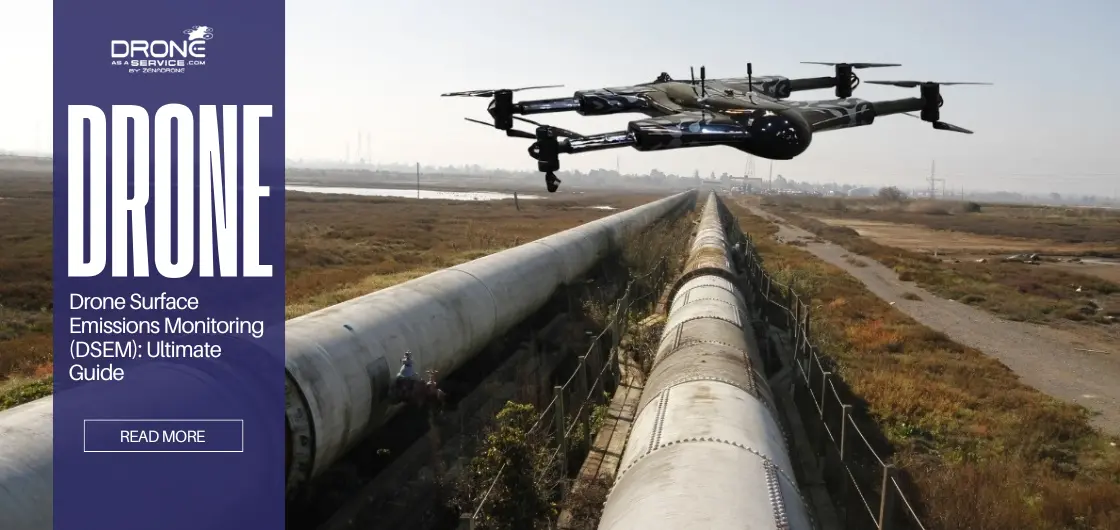
Drone Surface Emissions Monitoring (DSEM): Ultimate Guide
Drone Surface Emissions Monitoring (DSEM) is changing how we protect the environment. It focuses on tracking strong greenhouse gases like methane (CH4).
This new technology uses drones to check emissions faster and more safely. Automated flights can scan large areas in a short time and remove the risks that workers face during ground surveys.
Today, DSEM is widely used in industries such as waste management, energy, and agriculture. It helps businesses meet growing environmental rules, including those under the Inflation Reduction Act, and supports their efforts to reduce their overall impact on the environment.
DSEM Decoded: Technology and Analytics Driving Emission Control
- DSEM is revolutionizing emission management for industry and environments with fugitive emissions. It relies on drones equipped with unique types of sensors to obtain surface-level gas concentrations that provide safe and quality data.
- DSEM vs. Traditional methods: It replaces the unsafe and subjective approach of manual walkover surveys (Method 21) with fast, automated flights that can capture up to 150 acres/day (EPA OTM-51).
- Potential Emissions: Focus on potent greenhouse gases such as Methane (CH4) & Carbon Dioxide (CO2), and odorant-contaminants such as Hydrogen Sulfide (H2S) (for odorant control).
- Integrated Technology: Sensor systems use multiple sensors with a combination of surface sampling features and laser-guided terrain following to ensure precise data capture.
- Actionable Insights: Data is transformed into actionable leak location, geo-referenced insights, accessible through simple cloud analytics. Then, sent to a mobile app seconds after the flight, and can maximize operations and rapid remediation.
DSEM in Action: The Automated Leak Detection Workflow
The transition from manual inspections to highly intelligent, automated Drone Surface Emissions Monitoring is occurring rapidly. It moves towards achieving maximum efficiency and accuracy of environmental management.
- AI for Prediction: The next generation of DSEM systems will incorporate AI and machine learning to draw insights from historical measurements. It transitions into predictive modeling beyond mere detection, allowing for proactive mitigation.
- Regulatory Driving Force: EPA approval (OTM-51) and legislation like the Inflation Reduction Act are accelerating the transition from pilot schemes to broader state adoption, as seen in Washington and Florida. It will push clients towards proactive drone inspections to avoid regulatory action from satellite data.
- Hardware Evolution: Advances in technology aim to overcome the battery life challenge with lighter drones and improved sensors, including dedicated H2S detectors for odor control.
- Full Integration: DSEM is becoming a component of wider IoT networks, combining data with wellhead information for holistic root cause analysis.
Maximum Efficiency: The ultimate goal is the deployment of fully autonomous drone systems to maximize data consistency and minimize human intervention.
Inside DSEM: Key Components Driving Next-Generation Monitoring
Drone Surface Emissions Monitoring represents an integrated technical ecosystem. It provides unmatched accuracy and speed to obtain environmental data, which is necessary for compliance and remediation.
- Sensor Payload: Drones deploy a combination of sensors, including gas detection sensors such as TDLAS and NDIR, or direct sampling for CH4. As well as thermal and visual images to assess cover integrity.
- Geospatial Rigor: GPS and geotagging provide important locational information within pm2 meters, logging measurements at high frequency to accurately delineate emissions.
- Real-time analytics: Raw, geo-referenced data are immediately transmitted to the Cloud, allowing software to perform calculations, interpolation, and spatial transposition through GIS software.
- Future-proofing: Integration of AI and machine learning algorithms is emerging to analyze long-term data, enabling predictive emission trends and patterns for proactive operational management.
- Operational constraints: The efficiency of flight may be relatively high, but managing the batteries required to overcome the technological burdens of widened coverage continues to be an issue.
DSEM Applications: Industry Adoption and Environmental Impact
The revolution in “Drone Surface Emissions Monitoring” is in response to the demand for maximum efficiency, accuracy, and global compliance with the updated, stringent environmental regulations.
- AI for Prediction: Future DSEM systems will employ AI and machine learning to analyze historical data, beyond mere detection, to predict emissions and give operators the ability to mitigate before detection or reporting.
- Regulatory Driving Force: EPA approval (OTM-51) and legislation such as the Federal Inflation Reduction Act are driving states to enact regulations. It facilitates client migration to drone-based proactive inspections to avoid enforcement regulatory action based on satellite imagery.
- Hardware Evolution: Advances in technology aim to overcome the battery life challenge with lighter drones and improved sensors, including dedicated H2S detectors for odor control.
- Full Integration: DSEM will become a part of wider IoT networks, integrating information from the new well-headed systems into comprehensive root cause analyses.
- Maximum Efficiency: The goal of Environmental Drone Monitoring is to achieve full autonomous drone systems that optimize the data and minimize human reliance on collecting data.
The DSEM Advantage: Safety, Speed, and Savings
The use of drones for environmental tracking enhances compliance and efficiency by eliminating the burdens associated with manual surveys, which can be hazardous and time-consuming.
- Safety First: Surface Emission Tracking Drones takes the need for individuals to walk into hazardous or inaccessible areas like steep slopes, the top of tanks, out of the equation, reducing human exposures to toxic environments.
- Speed & Scale: DSEM can successfully perform automated missions faster than manual inspections up to 150 acres per day. It makes it a scalable and economical option for broad, repeat monitoring in sectors such as Waste, Energy, and Agriculture.
- Precision Intelligence: Drones provide data that can obtain high precision, typically >90% accuracy for detecting leaks, with the ability to report the findings in real-time. The data is put together in seconds, pushed to the field crews instantly, and remediation is performed efficiently and with precision.
Navigating the Hurdles: Challenges in DSEM Implementation
Despite its revolutionary potential, incorporating Drone Surface Emissions Monitoring poses multiple technical and operational challenges that need to be identified to allow for widespread scalability and adoption.
- Upfront Investment: Deploying a DSEM approach has a significant upfront investment for specialized hardware to include advanced sensors (NDIR, TDLAS) and integrated ground-sampling systems.
- Operating Limitations: Weather conditions (wind, rain, etc.) can severely limit flight safety and data accuracy, while existing battery-life limitations limit coverage per battery charge to just a few acres per flight.
- Regulatory and Skill Limitations: Providers must deal with complex regulatory constraints on drone flights and skilled, accredited operators (Part 107 certifications), in order to be able to adequately monitor surface emissions while ensuring the data is useful and consistent.
- Data Complexity: Despite the speed of analysis, data processing remains complex for large-scale operations, requiring sophisticated software and GIS concatenation to transform dense sensor readings into actionable, compliant reports.
DSEM’s Reach: Key Sectors Adopting Advanced Emissions Tracking
Drone Surface Emissions Monitoring is an adaptable solution that is an essential tool for industries worldwide, targeting the primary sources of greenhouse gases (GHGs) and other emissions in furthering regulatory compliance and sustainability.
- High-emission industries: The energy sector (oil & gas, power plants) employs DSEM to identify CH4 leakages for safety and asset integrity. The manufacturing sector also utilizes DSEM for compliance and emissions reporting.
- Environmental and food sector: The agriculture sector is using DSEM to measure CH4 emissions from livestock and barn manure, and for improvements in sustainability, gaseous measurements related to nitrous oxide (N2O) emissions, at livestock operations
- Regulatory compliance oversight: Environmental agencies are using practices in DSEM to effectively track and enforce urban and rural pollution.
- Specialized monitoring adaptations: Implementation practices extend to practical and specialized use by Research institutions, observing GHGs, and in the Ports and shipping sectors for observing maritime platforms and offshore platforms (FPSO systems).
DSEM’s Horizon: Smart, Autonomous, and Predictive
The future of Industrial emission detection with drones will be characterized by a transition toward a very intelligent, integrated environmental diagnostic system, delivering unprecedented efficiency and compliance on a global scale.
- Smart Analytics: The integration of AI and machine learning will empower predictive analysis and trend forecasting, enabling operators to preemptively manage emissions before they reach a regulatory threshold.
- Technology Developments: To address current limitations, the industry is developing lighter drones that can fly longer and have better sensors and detection capabilities for a wide range of broader, more accurate detection (e.g., dedicated H2S monitoring).
- Widespread Integration: DSEM is integrating fully into IoT networks and operational data, assimilating for real-time detection and total root cause analysis.
Automation: Regulatory frameworks embracing methods like EPA OTM-51 are establishing the foundation of fully automated and autonomous emission systems, optimizing consistency with minimal human interaction across smart cities and industries.
Choosing Your DSEM Partner: Key Selection Criteria
Choosing a Drone Surface Emissions Monitoring service is a significant decision. This is to ensure accurate data, compliance with emissions regulations, and maximize operational cost savings.
- Technology & Accuracy: You will want to assess the sensors and technology used. Choose technologies such as: OTM-51 approved “Sniffer Method” with reasonable accuracy (>90% leak localization accuracy) and/or terrain following systems for higher accuracy.
- Experience & Compliance: You will want to assess experience related to your industry and compliance with local drone regulations, and EPA-approved analysis methods, such as OTM-51.
- Data Speed: Assess how quickly data will be reported & analyzed in accordance with your needs. The service provider should be able to convert raw data into actionable recommendations & reportable data within seconds.
- Scalability & Support: Determine the scalability of the service provider to multiple large sites rapidly and efficiently. Assess maintenance of systems as well as support mechanisms, especially protocols in your advantage, such as “Sniffing for Dollars” for RNG project optimization for grant writing.
DSEM Case Files: Proven Impact Across Global Industries
DSEM has shifted from concept to demonstrated use, evidencing success in enhancing compliance and improving operations in many diverse high-emission contexts.
- Waste Management Success: Blind tests at landfills confirm OTM-51to detect many more leak points (i.e., 27 leaks versus 17 leaks with the manual Method 21). It causes customers to shift systems based on higher leak capture rates and revenue potential (Sniffing for Dollars).
- Energy & Maritime: Several supermajors, for example, Total Energies, utilize global drone campaigns to provide monitoring and detection of fugitive methane. DSEM principles also extend to the offshore side, whereby drones monitor GHG emissions from FPSO systems (Floating Production Platforms).
- Community & Research: DSEM helps urban-adjacent communities with Landfill Odor Hunting, utilizing methane as a tracer to find H2S leak points. A research institution has validated reliability, providing actionable precision data that surpasses lower-resolution satellite monitoring employed by regulators.
- Agriculture: DSEM is actively being applied in the dairy industry and for biogas applications, monitoring CH4 and GHG production more broadly.
Mastering DSEM: Tips for Optimized Monitoring
To realize the fullest potential for a drone surface emissions monitoring program, applying operational best practices is critical for ensuring data accuracy and regulatory compliance.
- Timeliness: Conduct flights during the best possible weather within regulatory limits for wind/precipitation to ensure the best possible readings will be obtained.
- Accuracy and Consistency: Drone sensors should be calibrated regularly, and flight plans that support and maximize consistency in coverage should be in place.
- Skilled Operators: Operators should be well-trained on safety, regulatory compliance, such as OTM-51 protocol, and advanced interpretation of the data.
- Actionable, Integrable Data: Data should be easily integrated with different analytics platforms to convert readings to actionable, geo-referenced data in order to detect anomalous conditions and remediate them quickly.
Pioneering a Sustainable Future with DSEM
Drone Surface Emissions Monitoring is quickly changing environmental compliance for industries and agencies around the world. DSEM provides faster, safer, and more cost-effective monitoring than manual or other traditional methods. It allows industries like energy, agriculture, and manufacturing sectors to comply with growing environmental strictness.
Even with challenges such as upfront costs, regulatory acceptance, and weather dependencies. DSEM is fundamentally built on real-time actionable analytics to apply smarter decision-making. It is only going to get better with the advancement of AI and IoT networks. Early adoption of DSEM is the first step toward having cleaner, smarter, more sustainable industrial processes globally.
Read Our Other Blogs
27 February 2026
How to Check Weather Forecast Before Flying a Drone
How to Check Weather Forecast Before Flying a Drone Weather is not just a background condition for drone flying; it...
26 February 2026
Drone Surface Emissions Monitoring (DSEM): Ultimate Guide
Drone Surface Emissions Monitoring (DSEM): Ultimate Guide Drone Surface Emissions Monitoring (DSEM) is changing how we protect the environment. It...
26 February 2026
Geocaching Drones: How They Work and Revolutionize Modern Treasure Hunting
Geocaching Drones: How They Work and Revolutionize Modern Treasure Hunting What is Geocaching? Geocaching is considered a modern treasure hunt....
24 February 2026
How Drone Services Increased ROI For Irish Companies
How Drone Services Increased ROI For Irish Companies Drone Services ROI – Ireland TL;DR This guide shows how Irish businesses...
24 February 2026
Photogrammetry in Archaeology: Methods, Use Cases & Limitations
Photogrammetry in Archaeology: Methods, Use Cases & Limitation TL;DR Photogrammetry is a passive technique of remote sensing that uses redundancy...

23 February 2026
The Role of Software in Smarter Drone Power Distribution
The Role of Software in Smarter Drone Power Distribution With the constant development of technology, drones are now classified as...


