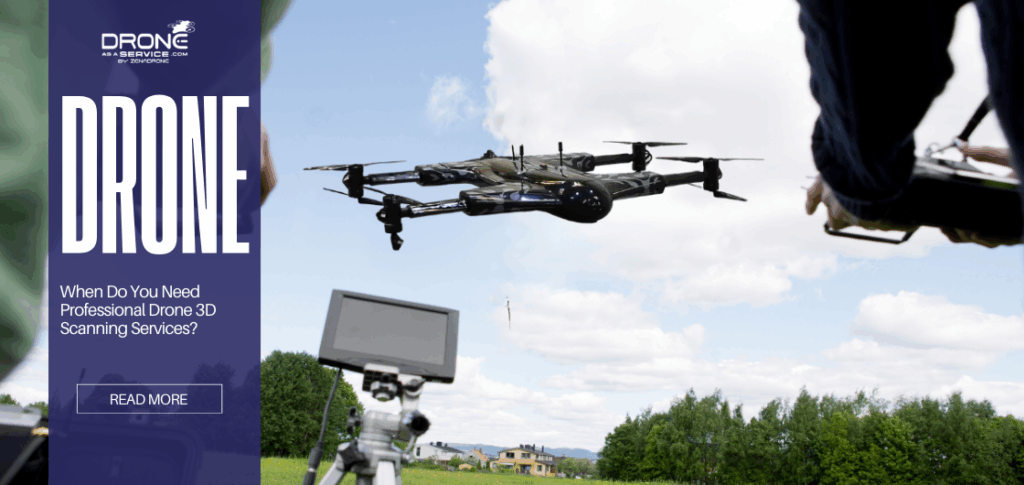
When Do You Need Professional Drone 3D Scanning Services?
What Is the Difference Between DIY Drone Mapping and Professional Drone 3D Scanning?
Professional drone 3D scanning is a disciplined engineering process. It validates data accuracy against known ground controls for reliability. DIY drone mapping is often an automated, “black box” process.
Owning a drone does not make someone a surveyor. A DIY operator typically relies on the drone’s internal GPS for positioning. This GPS can drift by several meters during a flight.
Professional drone survey services use rigorous workflows to ensure data integrity. They employ calibrated sensors, mechanical shutters, and external validation tools. The focus is on quantifiable engineering data, not just pretty pictures.
Tools vs. Expertise
DIY tools are designed for ease of use and automation. Apps often automate the flight and processing, hiding technical details. This “black box” approach hides potential errors from the user until it is too late.
Professional expertise involves understanding the science of geodesy and photogrammetry. Professionals know how coordinate systems affect measurements on a curved earth. They know how to correct distortions like wind or heat shimmer.
Data Capture vs. Validated Data
DIY capture focuses on getting full visual coverage. If the map looks complete and has no holes, it is considered a success. There is rarely an independent check of the scale or vertical accuracy.
Validated data requires mathematical proof of precision. Professionals use checkpoints to verify the model against the real world. They provide a signed report showing the accuracy of the scan at specific locations.
Responsibility for Accuracy
In a DIY scenario, the software vendor is often blamed for errors. However, software terms of service usually disclaim liability for measurement accuracy. The risk remains with the user.
In a professional engagement, the service provider accepts liability for their work. They stamp the drawing or sign the quality report. They stand behind the data if it is challenged in a dispute.
DIY drone mapping captures visuals, while professional drone 3D scanning delivers validated data.
What DIY Is Usually Used For
DIY mapping is excellent for general situational awareness and communication. Site managers use it to see where materials are stored on a given day. It helps plan logistics paths for trucks and cranes.
It is useful for marketing and stakeholder communication. A fly-through video or an overhead map does not need centimeter accuracy. Visual inspections of safe-to-access areas are also common use cases.
What DIY Is NOT Suitable For
DIY data should never be used for survey-grade drone scanning decisions. You cannot build a concrete foundation based on a DIY map. The risk of the map being warped or shifted is high.
It is not suitable for legal boundary disputes or property line assessments. Courts require data with a proven chain of custody and professional oversight. Contractual payment quantities also require professional validation to avoid fraud or error.
What Accuracy Thresholds Require Professional Drone 3D Scanning Services?
Accuracy is the primary driver for hiring external professionals. When a project requires survey-grade results, DIY methods almost always fail. This usually means absolute accuracy within 0.1 feet (3 cm).
Key Accuracy Concepts
RTK (Real-Time Kinematic) and PPK (Post-Processing Kinematic) are essential technologies for professionals. They correct satellite errors to achieve centimeter precision. However, simply owning an RTK drone is not enough to guarantee results.
Ground Control Points (GCPs) are the gold standard for validation in the industry. These are physical targets painted on the ground and measured by a surveyor. They anchor the drone model to the real world and prevent it from floating.
Absolute vs. Relative Accuracy is a critical distinction that professionals understand. Relative accuracy means the map is consistent internally (scale is correct). Absolute accuracy means it matches the real world (latitude and longitude are correct).
Situations Where Professionals Are Required
Tight Tolerance Projects:
If you are installing prefabricated steel or aligning concrete forms, you need high precision. A deviation of 5 centimeters can stop construction instantly. Only professionals can guarantee this level of detail and verify it before delivery.
Volume-Based Payments:
Earthmoving and aggregate hauling are often paid by the cubic yard. A 5% error on a large excavation site involves large sums of money. Both parties need a neutral, professional measurement to agree on the final invoice.
Engineering Decisions:
Civil engineers design drainage and retention ponds based on slope. If the drone data fails to flatten the terrain or misses a berm, water will pool. Professional scanning ensures the terrain model is correct and safe.
When accuracy directly affects cost or liability, professional drone scanning is required.
Liability and Compliance Triggers
Data becomes a significant liability when money changes hands based on it. Drone surveying services are often hired to transfer this risk away from the project team.
Legal Responsibility for Incorrect Data
If a building is placed incorrectly due to bad data, who pays for the move? If the internal team flies the drone, the company pays the full cost. This can bankrupt a project.
Hiring a professional service shifts this financial burden. The provider carries professional liability insurance. They are legally and financially responsible for the correctness of their deliverables.
Acceptance of Survey Data
Many construction contracts specify strict data standards for payment. They may require a licensed surveyor to oversee the data capture process. DIY data often fails to meet these strict technical specifications.
Subcontractors may refuse to accept unverified data for their work. They will not warranty their concrete pour based on a DIY map they did not measure. Professional data is the standard currency of trust on a job site.
Industry or Regulatory Requirements
Public works projects often have strict government reporting mandates. They may require specific file formats and detailed accuracy reports. Federal aviation regulations also apply to all commercial drone flights.
Flying over populated areas or near airports requires specific waivers. Professionals manage the complex airspace authorizations and safety plans. This ensures the project remains legal and fines are avoided.
Liability increases when drone data is used for official or contractual decisions.
How Should Cost vs Risk Be Evaluated for Drone 3D Scanning Projects?
Project managers must weigh the cost of the service against the risk of error. Cheap data often becomes the most expensive item on the budget.
Cost of Wrong Quantities
Imagine a project requires importing 50,000 cubic yards of structural fill. An error of 10% equals 5,000 yards of missing or extra material. At $20 per yard, that is a $100,000 error.
A professional scan might cost $2,000 to $3,000. The ROI of avoiding that single error is massive. The service pays for itself immediately by preventing overpayment or material shortages.
Cost of Re-Surveying
Bad data is often discovered too late in the process. The crew arrives to work, and the site does not match the plan. Work stops immediately while a new, correct survey is ordered.
The cost of standing machinery dwarfs the survey cost. A day of delay for a full crew can cost tens of thousands. Reliable data prevents these delays and keeps the iron moving.
Delays Caused by Inaccurate Data
Inaccurate data causes a flood of RFIs. The design team must stop working to redesign grading or drainage. This administrative churn slows down the entire build and frustrates the owner.
Using professional data eliminates this friction. Designs fit the real world the first time. The project moves smoothly from digital plan to physical reality.
Takeaway: Cheap drone data often becomes expensive when decisions depend on it.
How Professional Drone 3D Scanning Fits Into Project Workflows
Professional drone 3D scanning is not an isolated, chaotic event. It is a fully integrated, disciplined stage of the project lifecycle. It ensures data flows smoothly into design tools like Civil 3D and Revit.
Stage 1: Planning
Professionals estimate the hazards of the site, ground, and airspace limitations. They design the routes of flights in order to provide the best coverage of the terrain. They decide the required GSD (resolution) to achieve the tolerance of the project.
They also strategize the ground control network. They determine the site where to install GCPs to achieve optimum stability of the model. This is a step that is not followed in the DIY workflow.
Stage 2: Data Capture
The pilot performs the mission in an efficient and safe manner. They also keep track of such aspects as the speed of wind, cloud cover, and light consistency. They make sure that the sensor settings are adjusted according to the conditions. They also take the ground check shots with high-precision GPS rovers. This independent data is essential in the following stage of validation. It guarantees that the drone data does not drift in space.
Stage 3: Processing and validation
The obtained raw data is fed into specialized photogrammetry software. Professional filters out noise, equipment, and vegetation. They classify the point cloud into usable layers.
They compare the model’s coordinates to the independent checkpoints. Finally, they generate a quality report that certifies the results meet the required RMSE, following the same drone 3D scanning workflow used to convert aerial data into survey-grade 3D models.
Stage 4: Delivery of Decision-Ready Outputs
The final step is formatting and delivery. Professionals deliver files that open correctly in the client’s software. They ensure the coordinate systems match the project files exactly.
Professional drone 3D scanning integrates into projects as a controlled, repeatable workflow.
Summary of Decision Factors
This table summarizes when to choose between internal capabilities and external experts.
Accuracy Goal | Visual Context (1-5m) | Engineering Grade (1-3cm) |
Validation | None or GPS only | GCPs & Checkpoints |
Liability | Internal / High Risk | Insured / Low Risk |
Primary Output | Photos / Basic Maps | Classified Point Clouds / CAD |
Best Use Case | Marketing / Progress Photos | Volumes / As-Builts / Legal |
Equipment | Consumer Drone (Rolling Shutter) | Enterprise Drone (Global Shutter) |
Processing | Cloud Auto-Process | Manual Classification & QA |
Conclusion
The choice between DIY and professional services is ultimately a risk calculation. DIY is sufficient for pictures and general awareness. Professional drone 3D scanning services are required for reliable data.
When the cost of error is high, professionals are essential. They deliver the RTK PPK drone surveying accuracy that modern engineering demands. They provide peace of mind with insured, validated results.
To understand the technology behind these professional results, check out Drone 3D Scanning: How Aerial Data Is Converted Into Survey-Grade 3D Models for Industry Decisions.
FAQS
When do you need professional drone 3D scanning services?
You need them when data accuracy affects the budget or timeline. If you are paying for earthworks, pouring concrete, or settling a legal dispute, hire a pro.
Is DIY drone mapping reliable for important decisions?
Generally, no, it is not reliable enough. Without ground control validation, DIY maps can drift significantly in elevation. They are unsafe for engineering or legal decisions.
What accuracy level requires RTK, PPK, or GCPs?
Any project requiring accuracy better than 10cm needs these tools. Survey-grade work (sub-3cm) mandates both RTK/PPK technology and physical Ground Control Points.
Are drone 3D scans legally accepted for professional projects?
Yes, but only if they are properly validated. The scan must be accompanied by an accuracy report and often a surveyor’s stamp. DIY scans are rarely accepted in court.
Is professional drone 3D scanning worth the cost?
Yes, specifically for high-risk or high-value projects. The cost of a single error usually exceeds the price of the scan service. It acts as an insurance policy against expensive rework.
Read Our Other Blogs
16 February 2026
What Is Right of Way (ROW) in Drone Operations?
What Is Right of Way (ROW) in Drone Operations? In recent years, the recent spike in drone commercial operations has...
16 February 2026
When Do You Need Professional Drone 3D Scanning Services?
When Do You Need Professional Drone 3D Scanning Services? What Is the Difference Between DIY Drone Mapping and Professional Drone...
16 February 2026
Construction Site Drone 3D Scanning: From Progress Tracking to Quantity Surveys
Construction Site Drone 3D Scanning: From Progress Tracking to Quantity Surveys Why Construction Sites Use Drone 3D Scanning Construction site...

13 February 2026
How Drones Are Transforming Renewable Energy Inspection and Monitoring
How Drones Are Transforming Renewable Energy Inspection and Monitoring TL;DR Drones eliminate the need for manual climbing, significantly reducing workplace...
13 February 2026
Point Clouds, DEMs, and Orthomosaics: What Drone 3D Scanning Actually Delivers
Point Clouds, DEMs, and Orthomosaics: What Drone 3D Scanning Actually Delivers What Is Point Cloud in Drone 3D Scanning? A...
13 February 2026
How Drone Photogrammetry and LiDAR Work Together in 3D Scanning
How Drone Photogrammetry and LiDAR Work Together in 3D Scanning What Is Drone Photogrammetry and How Does It Create 3D...


