


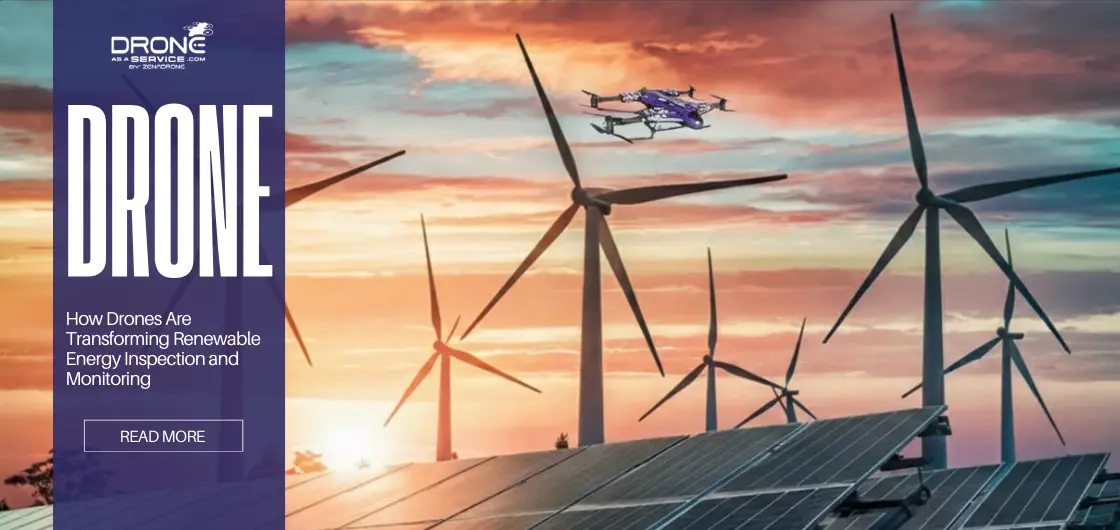
How Drones Are Transforming Renewable Energy Inspection and Monitoring
TL;DR
- Drones eliminate the need for manual climbing, significantly reducing workplace hazards at complex solar and wind farms.
- Early detection allows for proactive repairs, preventing costly system failures and minimizing energy production downtime.
- High-resolution thermal and 3D imaging identify micro-cracks and hot spots faster and more accurately than human inspection.
- Renewable energy operators use this data to reduce downtime, cut maintenance costs, and improve asset reliability.
- Automated flights provide a cost-effective way to monitor vast renewable energy infrastructures with minimal environmental footprint.
As renewable energy projects continue to expand at a rapid pace, inspection and monitoring have become more critical than ever. Solar farms now stretch across thousands of hectares, wind turbines rise higher and farther offshore, and energy assets are often placed in remote or hard-to-reach locations. As this growth comes with increasing responsibility, operators should also be trained to keep these systems safe, reliable, and efficient during their long lifespan. Nevertheless, traditional inspection methods, i.e., manual, scaffolding, or rope inspections, are time-consuming, costly, and, most of the time, put workers at risk, which is unjustified. Such difficulties may slow down maintenance timetables and drive up the expenses of the operations.
This is where drones are reshaping renewable energy inspections. By providing fast, detailed, and repeatable assessments, drones reduce safety hazards while capturing high-quality data in a fraction of the time. They allow teams to spot issues early, minimize downtime, and make smarter maintenance decisions. More than a convenience, drones have become a practical response to the real-world demands of modern renewable energy infrastructure.
What Drone-Based Inspection and Monitoring Means
Drone-based inspection and monitoring refers to using drones to collect detailed information about renewable energy assets without relying on manual, on-site checks.
Inspection focuses on close-up assessments to identify current conditions at a specific time, allowing teams to examine equipment by capturing high-resolution visual and thermal data from hard-to-reach areas, all while reducing safety risks. Meanwhile, monitoring has a more long-term goal, unlike inspections, which consider a specific time. Monitoring is a recurring investigation. This allows drones to demonstrate the subtle shifts as well as the indicators of damage that might not be visible in a single inspection.
Three types of data that Drones can collect.
Drones do more than take photos. Depending on what the needs are to learn about the assets, drones help gather three main types of data:
- Visual data: These are standard photos and videos captured by a camera attached to the drone. They help to see visual problems, such as cracks, corrosion (rust that forms on metal), or parts that have come loose.
- Thermal data: These are images or readings that show heat patterns captured by special cameras on drones. High heat can reveal problems not visible to the eye, like overheating parts or electrical problems in panels.
- Spatial Data:This type of data uses GPS and sensors to create 3D maps or models. These maps show the exact shape and position of structures, how much they move, or how they change over time. Monitoring changes helps spot possible issues early.
Inspections show issues at one moment; monitoring reveals changes over time. Drones make both safer, faster, and more accurate, transforming asset management while reducing risk, saving time and money, and boosting efficiency.
Why Renewable Energy Needs Smarter Inspections
The renewable energy project is becoming larger and more distributed worldwide. The solar farms are hundreds of acres, wind turbines hundreds of feet in the air, and hydroelectric plants may be in some of the most difficult-to-reach or rugged locations. Conventional approaches to verifying things simply cannot match this magnitude, and this is where more intelligent solutions, such as drones, have a real blast.
Large and Remote Installations
Inspections of renewable energy locations such as solar farms and wind turbines, which are large or difficult to access, are time-consuming, costly, and physically challenging. Thanks to drones, it is now possible to gather detailed information in a vast region in a short period and save on labor, time, while enhancing safety levels.
Safety Risks for Workers
There are big risks when climbing turbines, walking on rooftops, or checking out dam structures. A slip or being around dangerous equipment can have very bad outcomes. Drones provide a complete view of assets from every angle while keeping workers safely on the ground. This approach is much safer and significantly less stressful for everyone involved.
Downtime and Maintenance Challenges
Drones reduce downtime and maintenance costs by quickly identifying issues before they escalate. By pinpointing exactly where attention is needed, they allow targeted repairs, keeping energy production steady and preventing small problems from becoming big and disruptive.
Environmental Sensitivity
Sending large teams or heavy machinery can harm them or disturb wildlife because many renewable sites are environmentally sensitive. Drones operate quietly and minimize disruption while capturing needed data, making inspections less harmful.
Key Applications in Renewable Energy
- Solar Energy Inspections: Inspecting solar panels row by row is slow and exhausting. Drones can scan an entire solar farm in minutes, quickly detecting dirt, broken panels, and shading issues. Early detection helps maintain maximum energy production.
- Aerial inspection: Turbines would be hazardous and time-consuming to reach. Drones have the ability to fly over towers, nacelles, and blades and inspect them for mechanical degradation, corrosion, and cracking. The detailed images can be observed closely without posing a threat to anyone.
- Hydroelectric Hydro Inspections: Inspecting spillways, penstocks, and dams manually is difficult and risky. Drones can quickly assess erosion, water flow structures, and structural integrity from the air, providing detailed images and data without putting anyone in danger.
Technologies Behind Modern Drone Inspections
Modern drone inspections use advanced technologies to collect accurate and useful data while making inspections faster, safer, and more efficient. These high-tech tools help simplify complex tasks and reduce risks for workers. These technologies are:
- RGB Imaging: These are High-resolution cameras that take pictures and videos of cracks, rust, loose bolts, or surface damage.
- Thermal Imaging: Thermal imaging involves the use of heat detection to notice any hidden problems that may have been missed by the human eye, like overheated panels or other electrical problems.
- LiDAR and 3D Mapping: The LiDAR sensors create highly detailed 3D models of infrastructure, with great accuracy in aligning, deforming, and moving. With this equipment combined, raw flight photos can be transformed into high-resolution images. This enables operators to detect structural issues early and plan precise maintenance using the detailed data collected by drones.
Operational Advantages of Drones in Inspections of Renewable Energy
Drones in renewable energy inspection and monitoring focus on results rather than the technology itself. A complete survey of a solar farm, wind turbine, or hydro structure can be completed in a fraction of the time it would take ground-based crews. This speed allows problems to be identified early, addressed before they escalate, and ensures a steady stream of energy.
Safety is greatly improved, as there is no longer a need to send personnel onto 200-foot wind turbines or slippery dams. Drones can survey dangerous or hard-to-reach areas from the air, providing high-resolution images without putting anyone at risk. High-resolution images, thermal data, and 3D spatial information provide a complete view of assets. Minor issues, such as small cracks, overheating components, or slight structural changes, can be detected before they turn into costly failures. Early detection allows for smarter maintenance planning, more efficient resource use, and significant time and cost savings.
Cost Efficiency
Less labor and equipment: Fewer people and machines are needed on-site.
Targeted maintenance:Focus resources only where problems actually exist.
Drone-Based Inspections vs Traditional Inspection Methods
| Aspect | Traditional | Drone-based |
|---|---|---|
| Time | Hours-days | Minute-hours |
| Safety | High | Low |
| Data Accuracy | Limited | High resolution and thermal |
| Maintenance | Reactive | Proactive |
| Cost | Higher | Lower |
Drones provide comprehensive visibility of assets and enable more strategic maintenance planning. The outcome includes the acceleration of inspections, enhanced team safety, and reduced operational costs.
Challenges and Limitations
Even though drones have some grave advantages, they are not restricted. However, there are specific challenges that should be taken into consideration before they are fully incorporated into the operations. Such challenges can make the planning of the planning more efficient and prevent unexpected difficulties.
Regulatory issues
Drone flight regulations vary across different regions, so it’s important to follow local rules. Flying a drone requires legal approval, an operator license, and airspace clearance. Restricted areas like airports or military zones cannot be flown in without permission. Ignoring these rules can lead to fines, drone confiscation, or legal action. Therefore, obtaining all necessary approvals before flying is essential.
Weather restrictions
Drones are sensitive to weather conditions and cannot operate in rain, strong winds, or fog. Such conditions make flying risky and can cause equipment damage. Bad weather may delay inspection tasks and extend project timelines. It can also reduce the accuracy and quality of the data collected. Therefore, inspections are usually scheduled during clear and calm weather for best results.
The issue of data management
Drones collect large volumes of data, like high-resolution images, thermal scans, and 3D models. Without a proper system to organize and analyze it, valuable information can easily be lost. Efficient data management ensures accurate insights and effective decision-making. Handling this data properly is crucial for maximizing the benefits of drone surveys.
Proficient operators are needed
Flying drones in large or complex areas isn’t as simple as pressing a button. The crew must be trained on the equipment, safe operation, and how to interpret the collected data. Proper training ensures accurate results and prevents accidents. Understanding both the drone and the data is essential for effective operations.
Despite these obstacles, drones have great benefits. Through proper planning, training, and consideration of the weather and regulations, a great deal in improving work procedures and keep the staff safe. When the limitations are known and dealt with early enough, they are in manageable situations instead of being experienced unexpectedly.
Service-Based Drone Models: A Versatile Approach to Work
Service-based drone models are a versatile and flexible solution for modern work. Taking advantage of this technology does not require owning a fleet or building an internal team. Many organizations prefer service-based models because they are flexible and avoid long-term complexity.
A service-based model involves partnering with an external team that supplies the drones, operators, and handles data processing. Expertise can be accessed as needed without the need to purchase equipment or train personnel. This approach often includes:
- Availability of experienced and qualified pilots.
- Utilization of modern drone equipment and sensors.
- Data handling and reporting assistance.
The model works well where the inspection requirements vary throughout the year. Value checks may also be necessary at higher rates during the time of maintenance and lower during off-seasons. It is flexible, which enables the operations to expand or decrease without extra overhead.
The reason why this type of model is usually preferred by organizations is that it provides:
- Scalability: The degree of examination can be changed with project development or redevelopment.
- Less overhead: There is no need to have constant expenses in the form of storage, maintenance, and upgrades.
- Rapid deployment: Drones do not require developing solutions that are specific to each project.
In the case of most teams, this will simplify the process of managing and controlling the drone inspections.
Sustainability Impact: Supporting Environmental Goals
There is something bigger involved with drones; they assist in conserving the environment while conserving infrastructure. Traditional inspections are usually done using vehicles, heavy equipment, and large crews. Land and wildlife can be disturbed by that activity. On the contrary, drones are small and accurate. Larger areas can be surveyed with a much smaller footprint.
From a sustainability point of view, drones help in several ways:
- Less environmental disturbance: Reduced number of vehicles and people on-site means less destruction in sensitive areas.
- Lower carbon footprint: Shorter checkouts and fewer journeys save on fuel consumption and emissions.
- Stronger ESG alignment: More responsible operations and reporting are done with the help of cleaner inspection methods.
The system provides organizations with a framework that enables them to meet regulatory requirements while maintaining open operations and developing their future strategies. Ultimately, drones are not only beneficial in improving inspections. It provides guidance on how to run a renewable energy organization. While producing clean energy and maintaining it in cleaner ways.
Future of Drones in Renewable Energy
Automation:
Drones can be programmed to carry out routine inspections automatically. This allows inspections to be completed faster with minimal delays. They can quickly respond if anything unusual is detected. Automation makes monitoring more efficient and consistent.
Predictive maintenance
Predictive maintenance involves continuously collecting data over time. Drones can detect early signs of problems and patterns that manual inspections often miss. This helps prevent failures before they become serious. Using drones makes maintenance more proactive and efficient.
Smarter analytics
Drones provide clear, high-quality data, eliminating the need to waste time on blurry images. Companies can focus on making quick, informed decisions. This speeds up processes and improves overall efficiency. Actionable insights from drones lead to better outcomes.
Better system integration
Drone data can be easily integrated with maintenance systems, asset management software, and reporting tools. This allows seamless tracking and analysis of assets. It improves coordination and streamlines reporting processes. Connecting data systems ensures more efficient decision-making.
All these changes point to a future in which drones work quietly behind the scenes, enabling better planning, more responsive actions, and optimal performance of renewable energy systems.
Conclusion: The Growing Role of Drones in Renewable Energy
Drones in renewable energy inspection and monitoring are transforming how assets are managed as projects grow larger and more complex, including expansive solar farms, tall wind turbines, and remote hydro sites. Traditional methods struggle to keep up due to safety risks, long inspection times, and high costs.
Drone-based inspection and renewable energy monitoring offer a practical, data-driven alternative, enabling continuous tracking of asset performance. These drones improve reliability, enhance safety, and support the long-term performance of renewable energy assets.
FAQS
How do drones improve renewable energy inspections?
Drones in renewable energy improve inspections by allowing large or hard-to-reach assets to be surveyed quickly, keeping teams safely on the ground and reducing delay.
What kind of data do drones collect during inspections?
Visual images, thermal heat data, and spatial mapping are typically collected, providing insight into both surface issues and hidden problems.
Are drone inspections safe to use in active energy sites?
When operated correctly, drones in renewable energy inspection and monitoring reduce the need for risky climbs and close contact with heavy equipment, making inspections safer overall.
Do drones replace human inspectors?
No, they support inspectors by giving better visibility and data, while people still make the final decisions and judgments.
How often should you use drones for renewable energy monitoring?
Renewable energy monitoring should be scheduled based on the type of assets, but regular drone flights are recommended to detect changes early and prevent small issues from developing into major problems.
Can drone data help with long-term maintenance planning?
Absolutely, because repeated flights show trends over time, which helps plan maintenance more accurately and with fewer surprises.
Read Our Other Blogs

16 February 2026
What Is Right of Way (ROW) in Drone Operations?
What Is Right of Way (ROW) in Drone Operations? In recent years, the recent spike in drone commercial operations has...
16 February 2026
When Do You Need Professional Drone 3D Scanning Services?
When Do You Need Professional Drone 3D Scanning Services? What Is the Difference Between DIY Drone Mapping and Professional Drone...
16 February 2026
Construction Site Drone 3D Scanning: From Progress Tracking to Quantity Surveys
Construction Site Drone 3D Scanning: From Progress Tracking to Quantity Surveys Why Construction Sites Use Drone 3D Scanning Construction site...
13 February 2026
How Drones Are Transforming Renewable Energy Inspection and Monitoring
How Drones Are Transforming Renewable Energy Inspection and Monitoring TL;DR Drones eliminate the need for manual climbing, significantly reducing workplace...

13 February 2026
Point Clouds, DEMs, and Orthomosaics: What Drone 3D Scanning Actually Delivers
Point Clouds, DEMs, and Orthomosaics: What Drone 3D Scanning Actually Delivers What Is Point Cloud in Drone 3D Scanning? A...
13 February 2026
How Drone Photogrammetry and LiDAR Work Together in 3D Scanning
How Drone Photogrammetry and LiDAR Work Together in 3D Scanning What Is Drone Photogrammetry and How Does It Create 3D...