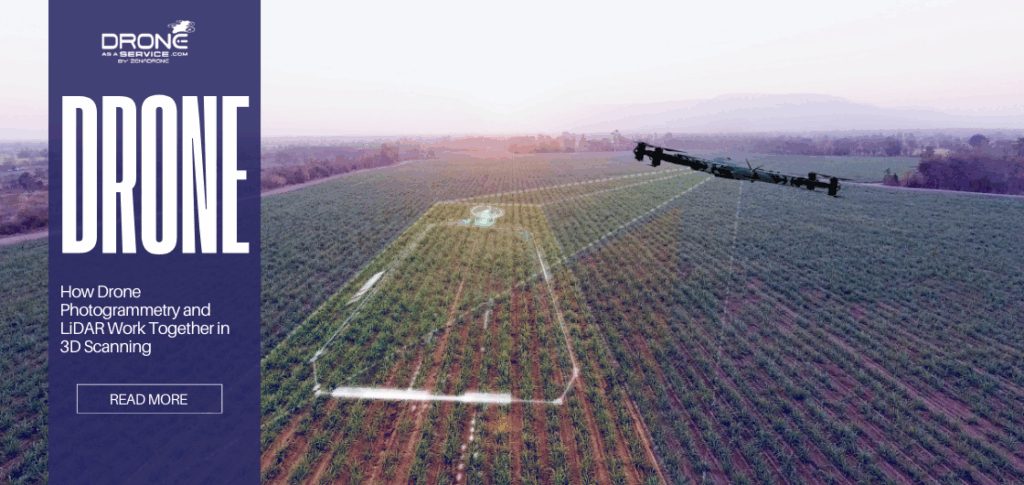
How Drone Photogrammetry and LiDAR Work Together in 3D Scanning
What Is Drone Photogrammetry and How Does It Create 3D Data?
Drone photogrammetry involves the use of drones in taking high-quality overlapping aerial images of various angles and altitudes. Its application is extensive in surveying, construction, and land development to assist in the provision of clear information on distance, angle, and elevation.
Specialized software recognizes features in intersecting images and performs triangulation to determine X, Y, and Z values, creating a high-density 3D point cloud. This point cloud can then be turned into a textured 3D mesh or model.
Success is determined by 60-80% image overlap, optimal flight altitude, constant drone movement, and proper geotagging using GPS or RTK. Ground Control Points (GCPs) are another way to enhance the accuracy and create centimeter-level precision.
Photogrammetry demands visual contrast. It performs well on rough surfaces, such as asphalt or rocky ground, and does not work on smooth surfaces, such as white roofs, sand, or water, where the software cannot identify unique features to match.
Ground Sampling Distance (GSD), conditions of light, and complexity of terrain determine the quality of the final model. There are also gaps in the data, caused by the shadows and resulting in gaps in the model.
Best Applications for Drone Photogrammetry
- Open Terrain: This is ideal in construction sites, quarries, and paved roads where the ground can be seen clearly through the sky.
- Cleared Surfaces: Ideal to be used in mapping building facades, rock walls, and stockpiles where visual clarity is important.
- Cost-Sensitive Projects: High-quality photogrammetry does not require expensive hardware as LiDAR, which makes photogrammetry a cost-effective option in general mapping.
- Cost-Sensitive Projects: High-quality photogrammetry needs less expensive hardware than LiDAR, making it a cost-effective choice for general mapping.
Limitations of Drone Photogrammetry
Dense Vegetation: Cameras cannot see through foliage. In a forest, photogrammetry maps the top of the tree canopy instead of the ground, resulting in inaccurate terrain elevation data.
Uniform or Reflective Surfaces: Glass, water, and fresh snow cause noise or holes in the data, as the software does not have the capability to triangulate the motion of a reflection or the uniform white pixels.
Takeaway: Photogrammetry works best when surfaces are clearly visible and accuracy requirements are moderate.
What Is LiDAR Drone Scanning and How Is It Different From Photogrammetry?
LiDAR drone scanning is a remote sensing technique in which a drone with a LiDAR (Light Detection and Ranging) sensor emits thousands of laser pulses to measure the distance and form high precision three dimensional point clouds of the terrain or object.
The LiDAR sensor mounted on a drone emits high-frequency laser rays that reflect on the surfaces and come back to itself allowing the sensor to measure elevation, shape, and structure precisely.
This active sense approach works equally well during the day and night and cuts through vegetation to provide a bare ground map and offers centimeter to millimeter accuracy. These features render LiDAR especially applicable in the complicated, vegetated or dim conditions.
Meanwhile, photogrammetry is an inactive technology which involves the use of overlapping two-dimensional pictures taken by a drone-mounted camera. Triangulation is used on these images by specialized software to form a three-dimensional model.
Despite the fact that photogrammetry can render visually rich, photorealistic models with full RGB texture, the accuracy depends greatly on the lighting conditions, the overlap of the images, and the surface texture. Photogrammetry is ineffective in heavy vegetation, in dark spots, or during the night.
Best Application of LiDAR:
Vegetation-Heavy Areas: Important in forestry management, surveys of undeveloped lands and agricultural drainage mapping where the ground lies concealed.
Elevation-Critical Projects: This type of project is necessary in flood modelling and hydraulic engineering, where it is unsafe to assume that the top of the grass is at the true ground level.
Compliance or Survey-Grade Work: These are required in order to map over thin structures like power lines or cell towers that fail to be resolved by a camera.
Limitations of LiDAR
Greater Cost: LiDAR sensors are significantly more expensive than cameras and typically 5 to 10 times more expensive than a typical photogrammetry payload used in place of a camera.
More Complex Processing: The raw data is a monochromatic cloud of points that must be expertly classified to isolate noise like birds or dust as opposed to valid ground points.
Takeaway: LiDAR is preferred when terrain visibility is limited or elevation accuracy is critical.
How Do Drone Photogrammetry and LiDAR Compare for 3D Scanning Projects?
Selecting between photogrammetry and LiDAR depends on your specific environment and data needs. The table below compares these methods across key decision factors.
Feature | Drone Photogrammetry | LiDAR Drone Scanning |
Accuracy (Vertical) | Moderate (Dependent on texture/GSD) | High (Direct measurement) |
Accuracy (Horizontal) | High (Excellent for X,Y features) | High |
Terrain Suitability | Open, textured ground | Any (including complex terrain) |
Vegetation Handling | Poor (Maps top of canopy) | Excellent (Penetrates gaps) |
Visual Quality | Photorealistic (Color/Texture) | Point Cloud (Often monochromatic) |
Cost | Low to Mid | High |
Typical Use Case | Visual inspections, orthomosaics, simple volumes | Topographic surveys, power lines, forestry |
Takeaway: The right technology depends on terrain conditions, accuracy needs, and project risk.
Understanding the differences between photogrammetry and LiDAR is important, but the real value comes from how drone 3D scanning workflows turn raw aerial data into validated engineering models.
When Should Photogrammetry and LiDAR Be Used Together?
The two technologies are usually used together to form a holistic digital twin that has realistic looks as well as accurate structure.
Photogrammetry adds context of the rich colorized image that is missing in the raw LiDAR. Meanwhile, LiDAR provides the ground truth and structural integrity that photogrammetry lacks in obscured regions. This combination makes every section of the site unmapped.
Use Case Examples:
Construction Sites: LiDAR is used to calculate earthworks with accurate digital terrain models, and photogrammetry is used to create high-resolution orthomosaic maps that can be used to provide logistics and progress reports of the site.
Mining Operations: LiDAR records stockpile volumes, including those under the cover of vegetation or dust, whereas photogrammetry can determine the type of material under the cover, like gravel or sand, by its color.
Infrastructure Corridors: In highway expansion projects, LiDAR maps terrain beneath roadside trees for drainage analysis, while photogrammetry documents pavement markings and signage conditions.
Takeaway: Combining photogrammetry and LiDAR reduces blind spots and improves decision reliability.
Limitations of Each Method
Photogrammetry Limitations
The primary weakness of photogrammetry is “vegetation blindness.” It cannot distinguish between the ground and what covers it, making it unsuitable for topographic surveys in woods or tall grass. It also depends on lighting; heavy shadows or overcast days can flatten image contrast and reduce 3D reconstruction accuracy.
LiDAR Limitations
The main barrier to LiDAR adoption is cost and interpretability. The hardware requires significant investment, making it excessive for simple visual tasks. Raw LiDAR data is often just a cloud of geometric points without color; without simultaneous camera capture, it can be hard for non-technical stakeholders to interpret.
Takeaway: No single drone 3D scanning method fits every project.
Role of These Technologies in Professional Drone 3D Scanning Services
Professional drone 3D scanning services leverage LiDAR drone scanning and photogrammetry as their core technologies, strategically deploying them to meet rigorous industry standards. Both have benefits and are often used together to get the best outcomes.
The effectiveness of a professional service depends on the ability to evaluate the unique characteristics of a site and select the appropriate sensor to satisfy the client’s specific requirements.
Employing photogrammetry for a drainage study in areas with tall grass is considered inappropriate, while using LiDAR for mapping a simple parking lot is unnecessarily costly. Professionals select the most suitable tool for each specific application.
Whichever sensor is chosen, the professionals use Ground Control Points (GCPs) and checkpoints to strictly test the final model. They give a signed report to verify the accuracy of the data collected.
Takeaway: Professional drone 3D scanning services exist to ensure the right technology is used and validated.
Conclusion
Regardless of whether drone photogrammetry is employed for visual detail or LiDAR scanning is utilized for structural precision, the primary objective is to capture reality to inform decision-making. A thorough understanding of the underlying principles enables project managers to select the most appropriate data for specific applications.
For further information on converting these datasets into deliverables such as digital elevation models (DEMs) and point clouds, consult the comprehensive guide on Drone 3D Scanning: How Aerial Data Is Converted Into Survey-Grade 3D Models for Industry Decisions.
FAQS
What is the difference between drone photogrammetry and LiDAR scanning?
Photogrammetry involves the use of overlapping photographs to produce three-dimensional models, thus it works well in capturing visual detail. LiDAR involves laser pulses and is suitable in clearing vegetation and recording bare earth surfaces.
When is photogrammetry better than LiDAR?
Photogrammetry is used where high quality visual textures are required, e.g. in surface inspection of detailed surfaces or mapping open hard surfaces where the cost factor must be considered.
Can photogrammetry and LiDAR be used together in one project?
Yes. Advanced sensor payloads frequently acquire both datasets simultaneously. LiDAR provides geometric accuracy, while photogrammetry supplies realistic color and texture to the resulting model.
Does LiDAR completely replace photogrammetry?
No. LiDAR cannot deliver fine visual information on the lane marks, corrosion, or textual information on signage. Photogrammetry is still necessary to give visual context.
Which technology is more accurate for terrain and elevation data?
LiDAR is more precise in terrain elevation (Z-axis) in vegetated areas since it does not have to infer a terrain feature based on a photograph but actually measures the surface of the ground.
Read Our Other Blogs
16 February 2026
What Is Right of Way (ROW) in Drone Operations?
What Is Right of Way (ROW) in Drone Operations? In recent years, the recent spike in drone commercial operations has...
16 February 2026
When Do You Need Professional Drone 3D Scanning Services?
When Do You Need Professional Drone 3D Scanning Services? What Is the Difference Between DIY Drone Mapping and Professional Drone...
16 February 2026
Construction Site Drone 3D Scanning: From Progress Tracking to Quantity Surveys
Construction Site Drone 3D Scanning: From Progress Tracking to Quantity Surveys Why Construction Sites Use Drone 3D Scanning Construction site...
13 February 2026
How Drones Are Transforming Renewable Energy Inspection and Monitoring
How Drones Are Transforming Renewable Energy Inspection and Monitoring TL;DR Drones eliminate the need for manual climbing, significantly reducing workplace...
13 February 2026
Point Clouds, DEMs, and Orthomosaics: What Drone 3D Scanning Actually Delivers
Point Clouds, DEMs, and Orthomosaics: What Drone 3D Scanning Actually Delivers What Is Point Cloud in Drone 3D Scanning? A...
13 February 2026
How Drone Photogrammetry and LiDAR Work Together in 3D Scanning
How Drone Photogrammetry and LiDAR Work Together in 3D Scanning What Is Drone Photogrammetry and How Does It Create 3D...


