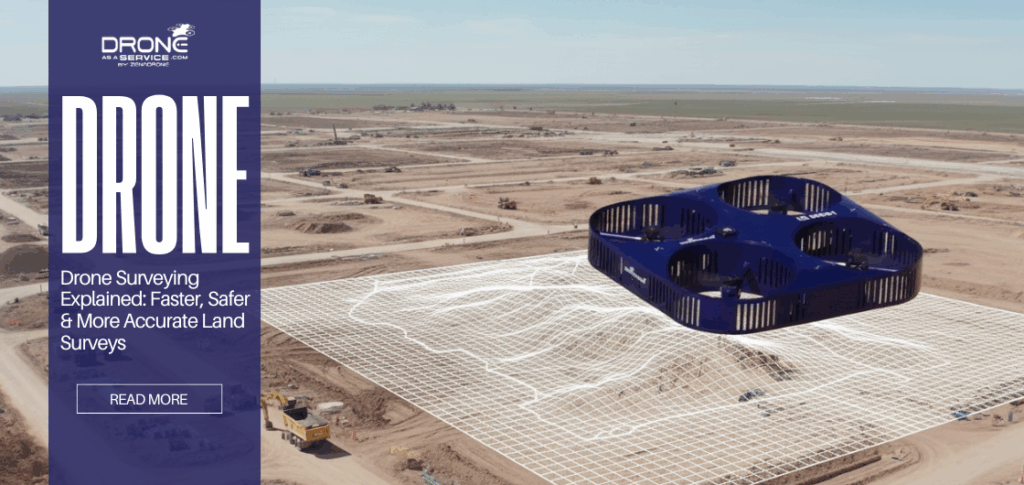
Drone Surveying Explained: Faster, Safer & More Accurate Land Surveys
Introduction to Drone Surveying
Drone surveying has rapidly become a core tool for modern land, construction, and mining projects. Instead of relying solely on ground-based measurements, industries now use UAV drone land surveys to capture accurate, up-to-date site data in a fraction of the time.
For project managers, surveyors, and engineers, drone surveying is not just about aerial images it is about decision-ready data that improves planning, reduces rework, and minimizes risk across the project lifecycle.
Traditional Land & Construction Surveying: Where Projects Fall Short
Before drone surveys, most land and construction projects relied on traditional surveying methods such as total stations, GNSS receivers, and manual field measurements.
While accurate, these methods introduce several challenges:
- Slow data collection cycles
- Limited site visibility between survey updates
- Higher safety risks for field crews
- Manual volume calculations and reporting delays
- Communication gaps between site and office teams
- Increased risk of disputes due to outdated or incomplete data
As projects scale and timelines tighten, these limitations directly impact cost control and decision-making.
What Is Drone Surveying?
Drone surveying is the process of using unmanned aerial vehicles (UAVs) equipped with high-resolution cameras or LiDAR sensors to collect geospatial data over land, construction sites, and properties.
This data is processed into outputs such as:
- Orthomosaic maps
- 3D surface models
- LiDAR point clouds
- Cut/fill and stockpile volume reports
Drone land surveying enables teams to understand site conditions accurately, consistently, and safely without placing personnel in hazardous environments.
How Does Drone Surveying Work?
Drone surveying follows a structured workflow designed to deliver survey-grade results.
The Role of Ground Control in Drone Surveying
Ground Control Points (GCPs) or checkpoints are physical markers surveyed on the ground. They are critical for aligning aerial data with real-world coordinates and ensuring accuracy.
Well-planned ground control significantly improves confidence in measurements such as distances, elevations, and volumes.
Photogrammetry: How Drone Images Become a 3D Survey?
Photogrammetry uses overlapping aerial images captured from multiple angles. Specialized software processes these images to reconstruct the terrain as accurate 3D models and maps.
This method is commonly used for:
- Topographic mapping
- Construction progress tracking
- Earthworks volume calculations
RTK vs PPK: Accuracy Explained
Modern UAV surveys often use RTK (Real-Time Kinematic) or PPK (Post-Processed Kinematic) positioning systems.
- RTK applies corrections in real time during flight
- PPK applies corrections after data capture
Both methods can achieve 1–5 cm accuracy, reducing or eliminating the need for extensive ground control while maintaining survey reliability.
Drone Surveying Workflow (Practical Steps)
1. Pre-Planning
Survey objectives are defined first: accuracy requirements, data outputs, and site constraints. Flight plans are created to ensure full coverage and proper image overlap.
2. Ground Control Placement
GCPs or checkpoints are placed strategically across the site to validate accuracy and support high-precision mapping.
3. Drone Flight Execution
The drone captures data following the predefined flight plan. Factors such as altitude, weather, and lighting conditions are carefully managed to maintain data quality.
4. Data Processing & Quality Control
Captured data is processed using photogrammetry or LiDAR software. Quality checks verify accuracy before final outputs are delivered.
Benefits of Drone Surveying for Civil Construction
Improved Efficiency
Drone surveying drastically reduces the time required to collect and process site data, allowing teams to work with current information instead of waiting days or weeks.
Better Project Management
Accurate site surveys support better scheduling, earthworks planning, and progress reporting helping teams stay aligned from site to office.
Improved Safety Standards
Drones reduce the need for surveyors to work in active construction zones, unstable terrain, or high-risk environments.
Benefits of Drone Surveying for the Mining Industry
Mine Exploration & Inspection
Drone surveys provide rapid site assessments, pit mapping, and bench monitoring without interrupting operations.
Stockpile & Volume Tracking
Accurate stockpile measurements improve inventory control and reporting accuracy.
Safety & Compliance
Regular aerial surveys reduce exposure to hazardous areas and support environmental and safety compliance.
You may love to read also: Drone Mining Services: Complete Guide to Surveys & Stockpile Measurement
Types of Data Generated from Drone Surveys
Drone surveying delivers actionable datasets, including:
- Orthomosaic Maps: Accurate, measurable aerial maps
- 3D Surface Models: Visualize terrain and site changes
- LiDAR Data: High-density point clouds for complex terrain
- Cut/Fill & Stockpile Reports: Precise volume calculations
- Progress Comparison: Time-based changed detection
Advantages of Drone Surveying: How Industries Use the Data?
Industries use drone survey data to:
- Remove guesswork from pre-bids and planning
- Track earthworks progress accurately
- Avoid costly rework
- Improve communication between field and office teams
- Reduce disputes with objective site records
- Save time and operational costs
- Minimize safety risks
Drone vs Traditional Land Surveys
Aspect | Traditional Survey | Drone Survey |
Speed | Slow | Rapid |
Site Coverage | Limited | Large areas |
Safety | Higher risk | Reduced risk |
Data Frequency | Infrequent | On-demand |
Visualization | Limited | High-detail 3D |
Both methods remain important, but drones significantly enhance coverage, efficiency, and insight.
Addressing Common Myths About Drone Surveying
- “Drone surveys are not accurate.”
With RTK/PPK and proper workflows, drone surveys achieve survey-grade accuracy. - “Drones replace surveyors.”
Drones enhance surveyors’ capabilities; they do not replace professional judgment. - “Drone surveys are only for large projects.”
UAV surveys scale effectively for small, medium, and large sites
FAQ Section
What is drone surveying used for?
Drone surveying is used for land mapping, construction progress tracking, volume calculations, and infrastructure planning.
How accurate is drone land surveying?
With proper setup, accuracy typically ranges from 1–5 cm.
Can drone surveys replace traditional surveys?
They complement traditional methods by providing faster, more frequent data.
Is LiDAR better than photogrammetry?
LiDAR performs better in dense vegetation; photogrammetry is ideal for open sites.
Conclusion: Integrating Drone Surveying into Modern Workflows
Drone surveying has become an essential component of modern land, construction, and mining operations. By delivering fast, accurate, and safe site data, UAV surveys empower teams to make better decisions, reduce risk, and improve project outcomes.
As projects grow more complex, drone surveying is no longer optional, it is a competitive advantage.
Ready to Get Started with Professional Drone Surveying?
Drone surveying delivers the most value when it’s executed with the right workflows, equipment, and expertise. That’s where Drone as a Service (DaaS) comes in.
At DaaS, we provide end-to-end drone surveying solutions from flight planning and data capture to processing and survey-ready outputs. Our team works with construction firms, land developers, infrastructure teams, and industrial operators to deliver accurate, decision-ready aerial data without the overhead of owning or managing drone hardware.
Why Choose Drone as a Service (DaaS)?
- Survey-grade drone data using RTK/PPK workflows
- Construction, land, and infrastructure-focused expertise
- Fast turnaround with reliable accuracy
- No equipment ownership, pilot training, or software management required
- Scalable drone survey solutions tailored to your project needs
Whether you need drone land surveying, construction progress tracking, or LiDAR-based terrain analysis, DaaS helps you turn aerial data into confident decisions.
Read Our Other Blogs
09 January 2026
Drone Surveying Explained: Faster, Safer & More Accurate Land Surveys
Drone Surveying Explained: Faster, Safer & More Accurate Land Surveys Introduction to Drone Surveying Drone surveying has rapidly become a...

08 January 2026
LIDAR Archaeology: How Drone LiDAR Reveals Hidden Ancient Landscapes
LIDAR Archaeology: How Drone LiDAR Reveals Hidden Ancient Landscapes TL;DR Drone LiDAR archaeology reveals ancient landscapes hidden beneath dense forest...
02 January 2026
Drone Mapping Explained: How Aerial Mapping & LiDAR Create Accurate Data
Drone Mapping Explained: How Aerial Mapping & LiDAR Create Accurate Data Drone mapping has transformed how industries capture, analyze, and...

01 January 2026
What Is a Drone Service? How UAVs Are Used by Modern Businesses
What Is a Drone Service? How UAVs Are Used by Modern Businesses? As businesses look for faster, safer, and more...

18 December 2025
Drone Insurance: What You Need to Know
Drone Insurance: What You Need to Know The insurance industry is currently undergoing a massive shift. For decades, the sector...

18 December 2025
Night Vision Drones: Technology, Applications & Buying Guide
Night Vision Drones: Complete Guide Night vision drones have changed the way we watch and explore the world after dark...


