How Drone Warehouse Logistics Improves Efficiency, Inventory Accuracy, and Operational Visibility
EXECUTIVE SUMMARY
As warehouses face increasing pressure to improve inventory accuracy, reduce labor-intensive audits, and maintain real-time visibility, traditional inventory management methods often struggle to keep pace with growing operational demands. Drone warehouse logistics provides a scalable solution by combining aerial automation, AI-powered analytics, and centralized reporting systems.
By deploying warehouse inventory drones for inventory counts, inspections, and facility monitoring, organizations can enhance warehouse efficiency, improve inventory accuracy, and gain faster operational insights across both single-site and multi-location warehouse environments.
What Is Drone Warehouse Logistics?
Drone warehouse logistics is the application of drones for warehouse inventory, inspection, and workflows.
Warehouse drone operations usually involve inventory audits, warehouse mapping, warehouse monitoring, pallet verification, and inspections of aisles. It has automated aerial data collection systems that are connected with warehouse operations.
The Role of Drones in Logistics Environments
In logistics, drone technologies can aid in the management of inventories and reduce manual work in the warehouse.
The drone can maneuver around the warehouse aisles more efficiently than the current manual scanning system. It is also able to collect data like barcodes, RFID, images, and mapping data for warehouse management systems.
Why Warehouses Are Adopting Drone Technology
Drones are being used by more warehouses to better comprehend their ever-growing and more sophisticated storage needs. In addition, the desire for higher inventory turnover and accuracy is forcing the demand for automated monitoring.
Several industry trends are accelerating the adoption of warehouse drone logistics and inventory automation:
- According to Gartner, inventory inaccuracies can significantly impact operational efficiency and customer satisfaction across distribution networks.
- McKinsey & Company reports that AI-enabled supply chain solutions can reduce forecasting errors by up to 50%, helping organizations improve inventory planning and operational decision-making.
- Warehousing and logistics operators continue to face labor shortages and increasing demand for faster fulfillment, making automation technologies more attractive for repetitive inventory tasks.
These trends are encouraging organizations to explore warehouse inventory automation solutions that improve visibility while reducing manual workloads.
How Do Warehouse Drones Improve Inventory Management?
Drones can help inventory management teams verify and scan warehouse stock significantly faster than traditional manual counting methods. It saves time on manual scanning and makes work more efficient.
They can scan barcodes and inventory information quickly in large storage spaces. It improves team members’ inventory information and provides faster operational reports.
Barcode and QR Code Scanning
Warehouse inventory drones can automatically scan barcodes and QR codes to enhance warehouse inventory management. With drone mounted camera systems, inventory data can be acquired in a fraction of time from racks at high shelves.
Faster Inventory Audits
Using a drone for stock audits helps to shorten the time spent on warehouse cycle counting and stock audits. The traditional audit process may need coordinated teams of workers, and the aerial scanning process provides better warehouse coverage.
Real-Time Inventory Visibility
Automated aerial data collection enhances real-time visibility of inventories throughout warehouse activities. Integrated reporting systems serve to track the flow of stock, to detect stock losses, and to facilitate quicker decision-making.
Why Are Businesses Using Drone as a Service for Warehouses?
Capital Equipment Costs Avoidance
Warehouses can reduce their expenses to start aerial inventory with ‘Drone as a Service’. Businesses can sidestep the management of:
- Drone hardware procurement
- Software licensing costs
- Internal pilot training
- Ongoing maintenance coordination
Access to Drone Expertise
Service-based drone operations offer a trained team of operators, workflow inspection, and operational support systems. This allows warehouse teams to conduct aerial inventories and inspections without the need to build in-house drone teams.
Scalable Operational Deployment
Drone as a Service allows warehouses to operate in multiple locations and conditions. Standardized warehouse workflows and centralized reporting provide companies with increased visibility into their operations as they scale.
How Do Warehouse Drones Improve Operational Efficiency?
Drones can support warehouse operations by detecting stock irregularities, tracking inventory, and reporting in a timely manner. These systems allow for quicker monitoring procedures, more frequent reporting, and reduced needs for manual coordination.
Reduced Manual Inventory Work
Drone-assisted inventory workflows reduce repetitive manual counting and stock verification across warehouse operations.
Examples of common operations are:
- barcode scanning
- pallet verification
- elevated rack inspections
- inventory cycle counting
Faster Warehouse Inspections
To increase the speed of warehouse inspections, warehouse drones can cover more areas and aisles. In fact, it’s more consistent than humans walking through the warehouse. Organizations looking to improve warehouse efficiency with drones often use aerial inspections for faster warehouse coverage.
Automated Operational Monitoring
Automated aerial monitoring enhances operational visibility in inventory movement, storage, and warehouse activity. Centralized monitoring systems can also help to ensure more timely operational reporting and better management of warehouses.
What Technologies Fuel the Present-Day Warehouse Drones?
Today’s warehouse drones have communication software, navigation, and automation systems that provide inventory operations and warehouse monitoring. These technologies contribute towards better warehouse navigation, visibility, and data synchronicity.
AI Analytics
AI warehouse drones are utilized for inventory, while operations are data-captured and processed more efficiently with an analytics system. These technologies can aid warehouse operations to pinpoint irregularities in stock, keep track of inventory, and report on time.
Obstacle Avoidance
New warehouse drones are able to navigate safely through narrow aisles thanks to their obstacle avoidance capabilities. This technology includes sensor technologies that reduce the chance of collisions with equipment, pallets, and racks.
Indoor Navigation Systems
In the absence of GPS signals, the drones can operate in an indoor environment with the help of indoor navigation systems, which enable them to work more accurately. These can be combined with visual mapping, sensors, and pre-programmed flight paths to provide stable indoor operations.
Integration with Warehouse Management System (WMS)
Integrated warehouse drone systems can meet warehouse management systems with real-time visibility and synchronization of inventory. This recorded data can then be used to report inventory quicker, reconcile inventory, and automatically update warehouse data.
How Indoor Drone Technology Supports Warehouse Operations
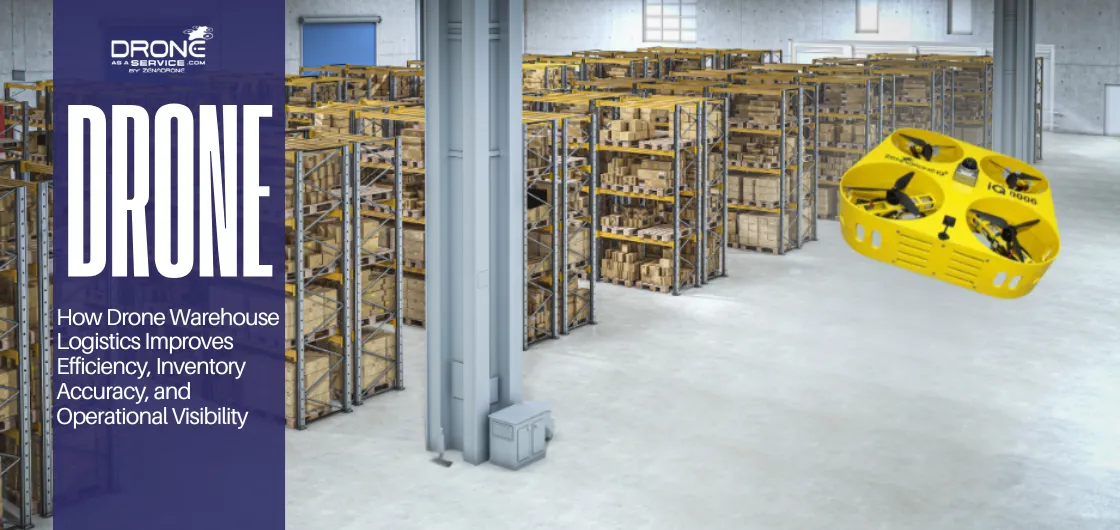
Recent indoor drone developments demonstrate how autonomous drones are being designed specifically for warehouse inventory management and operational monitoring. For example, Zena Drone’s IQ Nano platform has undergone testing for inventory management applications using autonomous swarm technology.
Indoor drone systems can support inventory verification, barcode scanning, warehouse mapping, and operational monitoring while navigating environments where GPS signals are unavailable. These developments highlight how warehouse drone logistics continues evolving toward greater automation, scalability, and operational visibility.
Traditional Warehouse Operations vs Drone-Powered Operations
The accuracy of inventory and workflow assessment is key to aerial automation. Drones’ systems offer greater reporting speed, operational visibility, and consistency of warehouse monitoring than traditional systems.
Manual Inventory Counting vs Drone Scanning
Traditional inventory counting has been done manually throughout the aisle from one aisle to another. The use of drones for warehouse scanning improves inventory coverage through consistently higher data capture in higher areas of the warehouse.
Human Inspections vs Autonomous Monitoring
A warehouse inspection is more traditional with walk-throughs that are scheduled with the warehouse staff and supervisor. Warehouse automation drones allow you to track operations and automate aerial inspections, which allows for more frequent monitoring.
Periodic Reporting vs Real-Time Operational Visibility
Traditional reporting periods often result in late stock keeping and operational issues throughout the plant. Drones can help to eradicate these issues, as they can sync data faster, allowing users to make more accurate reports.
Which Industries Benefit Most from Warehouse Drones?
Warehouse drone operations are improving inventory management in many industries by speeding up productivity and improving visibility.
Aerial inventory support systems can be beneficial for a business that has a high stock level and a spread-out distribution network.
eCommerce
E-commerce businesses often employ drones to do fast inventory audits, particularly when handling many orders.
Common operational uses include:
- inventory cycle counting
- pallet verification
- elevated rack scanning
- fulfillment area monitoring
Retail Distribution
In a retail distribution center, for example, a drone can be used to check on the stock and keep track of the distribution center at all times. According to a 2024 report from The Verge, IKEA deploys over 250 drones to monitor inventories.
Manufacturing
To keep track of materials stored in the warehouse, production inventory, and warehouse operations, manufacturers are using drones. Teams can also more effectively use drone inspections to cover elevated storage areas.
Industrial Logistics
The real-time tracking of stock and the streamlined management of warehouse operations. Commercial warehouse drone services support large-scale monitoring in complex logistics applications.
Supply Chain Operations
Operators in the supply chain are relying on the drones to enhance the accuracy of reporting and the workflows related to inventory synchronization. Coordinated warehouses and transportation activities occur more rapidly with more consistent operational data.
How Do Warehouse Drones Improve Safety?
Drones used in a warehouse increase the safety of the operation by minimizing direct contact with dangerous tasks such as inspection and inventory. Using drone workflows, warehouse teams can monitor high-level storage areas without an undue risk to human safety.
Reduced High-Rack Climbing
Drone inspections help to eliminate the need to access the high storage racks for inventory verification tasks. They reduce the risk of falls from ladders, lifting equipment, and high racks that would otherwise be present.
Less Manual Inspection Risk
Manual exposure is minimized during repetitive monitoring activities in warehouses by using drone inspections. Teams can audit storage spaces, storage racks, and zones without having to make constant physical visits.
Remote Operational Monitoring
How remote aerial monitoring enables better management of a warehouse in large-scale operations.
Warehouse drone inspections enable the operator to view areas of stock and the conditions of the warehouse from a central monitoring system.
What Is the Future of Drone Warehouse Logistics?
A growing number of warehouse companies are adopting a more automated approach to inventory management, centralized data analysis, and flexible coordinated operations. Soon, future warehouses will likely involve aerial automation, AI-based reporting, and interconnected inventory management systems.
Fully Automated Inventory Systems
Autonomous warehouse drones enable improved inventory verification and warehouse surveillance. Other operational capability may include:
- scheduled inventory scanning
- automated pallet verification
- recurring warehouse mapping
- integrated inventory reporting
AI-Powered Warehouse Analytics
With AI analytics, users can find operational information in real-time and detect discrepancy of the inventory at the time of its occurrence. The system continuously checks what the sensors and drones see and do away with the need for end-of-month reports.
McKinsey & Company reported in 2023 that AI-enabled supply chain solutions can cut forecasting mistakes by up to 50 percent. In practical terms, this means fewer overstocked items, fewer stockouts, and more accurate demand planning.
Scalable Multi-Location Drone Operations
Centralized drone management systems allow to deploy drones in many warehouse and logistics areas in a scalable manner. Standardized reporting processes also simplify access to distributed locations’ warehouse operations and supply chain teams.
Key Takeaways
- Warehouse drones automate inventory audits and stock verification.
- Drone scanning can improve inventory visibility and reduce manual counting requirements.
- AI-powered analytics help transform aerial data into operational insights.
- Drone as a Service enables warehouse automation without purchasing drone infrastructure.
- Multi-location warehouses benefit from standardized workflows and centralized reporting.
- Autonomous drone technology continues advancing warehouse inventory management capabilities.
Conclusion
Warehouse drone logistics is transforming how organizations manage inventory, monitor operations, and improve warehouse efficiency. Through automated scanning, AI-powered analytics, and centralized reporting, warehouse inventory drones help businesses strengthen inventory accuracy while reducing manual workloads.
As warehouse operations become more complex and distributed, Drone as a Service (DaaS) is emerging as a practical way to adopt warehouse automation without investing in internal drone programs. Organizations can access advanced drone technology, operational expertise, and scalable deployment models while avoiding hardware ownership, pilot training, and ongoing maintenance responsibilities.
For businesses seeking better inventory visibility, more efficient warehouse inventory management, and scalable operational monitoring, Drone as a Service offers a flexible path toward modern warehouse automation.
Contact our team today to learn how Drone as a Service can support your warehouse operations.