Military Drones Explained: Roles, Types, Capabilities, and How They Are Used Today
TL;DR
- Military drones are unmanned aerial vehicles (UAVs) used in modern defense operations for surveillance, reconnaissance, combat support, and logistics. Operated remotely or through semi-autonomous systems, these platforms reduce human risk while providing real-time intelligence, persistent monitoring, and integration with advanced AI and encrypted communication networks.
What Are Military Drones?
Military drones, which are also known as uncrewed aerial vehicles (UAVs), are designed to conduct defense operations without a human pilot on board. These are remotely operated or autonomous flying systems that perform operations in hazardous conditions.
The difference between a UAV and a UCAV (Unmanned Combat Aerial Vehicle) is vital for understanding their operational roles. A UAV is a general technical term for all pilotless aircraft, usually with an intelligence and observation focus. Conversely, a UCAV is a highly specialized model that is designed to transport and deliver ordnance, e.g., air-to-surface missiles or laser-guided bombs.
Modern defense forces prioritize these systems because they act as force multipliers on the battlefield. Their unmanned design and advanced sensors make them ideal for tasks once done by manned aircraft, often at lower cost, less risk, and greater efficiency.
They are also employed in Surveillance, Reconnaissance, and Target Acquisition operations (ISR).
The combination of these systems into a single command framework enables militaries to hold a persistent presence on enemy ground so that strategic choices are made using the latest available intelligence.
Takeaway: Military drones enable defense units to operate without direct human risk to provide constant overwatch.
Evolution of Military Drones
Drones, developed initially for military use in the 20th century, have since entered widespread commercial adoption. However, they are still widely popular in the defense sector, and more militaries around the world are embracing them for their operations.
Early military UAV systems had limited modern drone capabilities. Still, they established the foundational technology that has led to today’s widespread commercial adoption of military drone roles in global defense operations.
Today, Artificial Intelligence (AI) and autonomy are entering drone warfare. Modern systems can analyze data, recognize patterns, and make real-time flight adjustments independently.
The evolution toward “smart” drones and autonomous swarms allows for coordinated, large-scale operations that can operate effectively even when GPS signals are jammed.
As drone technology advanced from basic reconnaissance platforms to AI-enabled systems, their strategic importance in defense operations expanded significantly.
Why Military Drones Are Important in Modern Defense
Military drones have become an essential part of modern defense strategy because they reduce operational risk while expanding military reach. Unlike traditional aircraft, unmanned systems can operate for extended periods without pilot fatigue, allowing continuous monitoring of large or hostile areas.
They also lower the need to deploy personnel into high-threat environments. By using remote or semi-autonomous systems, armed forces can gather intelligence, support ground operations, and monitor sensitive regions without direct human exposure.
Another key factor is cost efficiency. Military drones typically require fewer onboard life-support systems and less pilot training infrastructure compared to manned aircraft. This allows defense organizations to maintain persistent aerial capability at comparatively lower operational cost.
Beyond surveillance and combat roles, drones now support logistics, maritime patrol, disaster response, and communication relay missions. As a result, they are no longer viewed as supplementary tools but as core components of integrated defense systems.
Because military needs vary across air, land, and maritime environments, drones are designed in multiple configurations to serve specific operational roles.
Types of Military Drones
While all military drones are uncrewed, their designs and onboard features vary to meet the needs of different environments. For instance, open areas and marine environments have factors that make them different from cramped urban areas.
To grasp the diversity of these systems, it is essential to categorize them by operational roles and physical capabilities:
- Surveillance & Reconnaissance: These drones serve as the military’s eyes in the skies. They are equipped with sensors like infrared and synthetic aperture radar, letting operators track targets across several miles.
- Combat Drones (UCAVs): These drones are designed to conduct offensive attacks and are equipped with precision-guided missiles. Combat drones can spend hours in the air hovering over a target area and strike their target with surgical precision. It minimizes the possibility of collateral damage in contrast to traditional bombers.
- Logistics & Support: These are flying cargo trucks that transport ammunition, medical supplies, and food to the troops in remote or dangerous areas. Drones help logistics support on the front lines by using autonomous flight paths to resupply them without exposing the ground convoys to IEDs or ambushes.
- Maritime & Naval: These drones are designed to withstand the harsh environment of the sea in monitoring the coastline and assisting with fleet operations. A high-altitude, long-endurance (HALE) unmanned system offers an uninterrupted connection between the fleet and the command center.
- Tactical Short-Range: These are small and mostly hand-launched units that are utilized by individual squads. Drones like RQ-11 Raven offer direct over-the-hill visibility to ground troops and allow them to survey a village or a pass in the mountains before entering it, and save thousands of lives at the tactical level.
Examples of Military Drone Systems in Use Today
To better understand how military drones function in real-world defense operations, it helps to look at some widely recognized systems currently in service.
MQ-9 Reaper
A long-endurance unmanned combat aerial vehicle (UCAV) used for intelligence gathering and precision strike missions. It is known for its extended flight time and multi-role capability.
RQ-4 Global Hawk
A high-altitude reconnaissance UAV designed for large-area surveillance. It operates at significant altitudes and provides strategic-level intelligence coverage.
Bayraktar TB2
A tactical medium-altitude drone used for reconnaissance and limited combat operations. It has been widely adopted in regional conflicts due to its flexibility and cost-effectiveness.
Heron TP
A medium-altitude long-endurance UAV used primarily for intelligence and monitoring missions.
Regardless of model or country of origin, most modern military drones share a set of core technological capabilities that define their operational value.
Core Capabilities of Military Drones
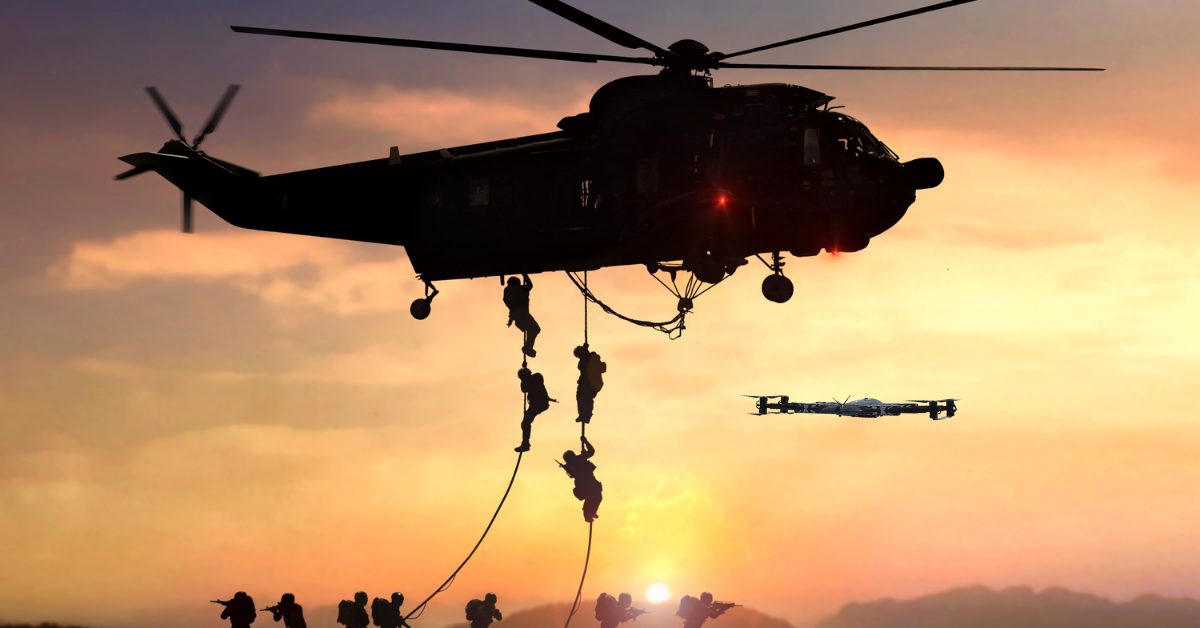
Modern military drones feature AI capabilities that let them perform tasks traditional aircraft cannot. Military drone capabilities mark a fundamental shift in defense operations.
By combining long-distance endurance with precision technology, drones provide a persistent presence without risking a pilot’s life.
The value of these drones lies in their ability to remain in station for hours and collect intelligence that is automatically transmitted to command centers. Military-grade encryption is used to ensure that real-time data does not fall into the hands of the enemy by intercepting the sensitive mission information.
Moreover, advanced navigation enables these drones to work within GPS-denied locations, as visual sensors help them locate their path in situations when traditional satellite signals are blocked.
Capability | What it Supports |
Long Endurance | Constant overwatch of a target for 24+ hours without landing. |
Real-Time Data Collection | Instant streaming of HD and thermal video to global command centers. |
Precision Navigation | Accurate flight in complex terrain or areas where GPS is blocked. |
Remote & Autonomous Control | Operation from thousands of miles away or via independent AI flight paths. |
Secure Communications | Encrypted links that protect data from jamming and cyber-attacks. |
How Military Drones Are Used Today
Military drones are widely adopted in almost every aspect of defense, from small unit operations to international borders. They can adapt to dynamic environments and provide aerial views that were once only available via satellite imagery.
Military drone applications focus on operational efficiency, speed, and the ability to perform in environments that are dangerous to human personnel.
- Intelligence and Reconnaissance: Drones act as the primary sources of information for Intelligence, Surveillance, and Reconnaissance (ISR) networks and base support. Commanders rely on real-time drone data to ensure successful field operations.
- Border and Area Monitoring: Long-range drones can patrol expansive coastlines and international borders to monitor potential illegal crossings and smuggling in real-time.
- Night-time Operations: Drones’ night vision and infrared sensors let them function even in night operations. Field operators can track movement and heat signatures without needing visible light.
- Infrastructure and Base Monitoring: Drones provide 24-hour security services on important military bases such as airfields and fuel depots by providing automated patrol and surveillance services to identify intrusions or structural damage.
- Logistics and Emergency Support: Autonomous cargo drones deliver supplies to field operators in critical areas. As a result, they also help reduce the risks that ground convoys often face.
How Military Drones Operate in Night Missions
One of the major advantages of military drones is their ability to operate effectively in low-light or complete darkness. Unlike traditional ground units that depend on visible light, unmanned systems rely on specialized sensors to maintain visibility and situational awareness.
Thermal Imaging Systems
Thermal sensors detect heat signatures rather than visible light. This allows drones to identify vehicles, equipment, and movement even in total darkness.
Infrared (IR) Cameras
Infrared imaging enhances night visibility by capturing radiation emitted from objects. It helps in distinguishing objects from their background environment.
Reduced Human Risk at Night
Night operations are often considered high-risk due to limited visibility. Drones minimize this risk by conducting reconnaissance or monitoring without deploying personnel into uncertain environments.
Operational Limitations
Despite their advantages, night operations can still be affected by heavy weather conditions, signal interference, or terrain obstacles.
Night capability makes military drones valuable assets for continuous monitoring and rapid response, especially in areas where 24-hour visibility is critical.
The effectiveness of these missions largely depends on the onboard sensor systems and payload configurations integrated into each platform.
Common Sensors and Payloads Used in Military Drones
Military drones rely on specialized onboard systems, known as payloads, to perform their missions effectively. These payloads vary depending on the drone’s role and operational environment.
Electro-Optical Cameras
High-resolution cameras used for daytime surveillance and visual intelligence gathering.
Infrared and Thermal Sensors
Enable drones to detect heat signatures and operate effectively during night-time missions or in low-visibility conditions.
Synthetic Aperture Radar (SAR)
Allows terrain mapping and target detection even through clouds, smoke, or darkness.
Signals Intelligence (SIGINT) Sensors
Used to intercept and analyze communication or electronic emissions in certain defense operations.
Communication Relay Systems
Extend communication range between units by acting as airborne transmission platforms.
These payload systems allow military drones to adapt to a wide range of missions, from intelligence collection to logistics coordination.
Beyond sensors, secure communication infrastructure plays a critical role in ensuring that collected data reaches decision-makers in real time.
How Military Drones Communicate and Transmit Data
Military drones rely on secure, multi-layered communication systems to maintain continuous connectivity with command centers and ground forces. These systems typically include encrypted satellite links, line-of-sight radio transmission, and integration within broader C4ISR frameworks.
Real-time telemetry, live video feeds, and sensor intelligence are transmitted using military-grade encryption to prevent interception, spoofing, or signal hijacking. In contested environments, redundancy protocols allow drones to automatically switch communication channels if jamming is detected.
This communication architecture ensures operational reliability even in high-threat or GPS-denied environments.
As communication networks improved, artificial intelligence further enhanced how drones process and act on incoming data.
Role of AI in Military Drones
Artificial Intelligence is the core component that transforms drones from basic remote-controlled devices into intelligent operational partners.
Through computer vision, AI allows drones to identify and classify objects fast, including the ability to differentiate between civilian and military tanks, which a human eye cannot. Such development reduces the sensor-shooter cycle and improves the maneuverability of the defenses.
In addition to visual processing, AI can be used to perform autonomous navigation and pattern recognition, enabling drones to identify any anomalous activity that could be overlooked by human operators.
Machine learning algorithms can recognize a movement pattern over time to predict threats or discover hidden equipment. It guarantees that only the most valuable data is brought for human review to reduce the information overload on operational teams.
A key part of this technology is the human-in-the-loop approach. AI handles tasks like complex calculations, flight adjustments, and data filtering, but a human commander always makes the final decision to act. This setup helps maintain ethical judgment and legal compliance, even as military technology advances quickly.
Takeaway: AI improves speed and situational awareness while humans retain final mission control.
These advancements have also reshaped how unmanned systems compare to traditional crewed aircraft.
Military Drones vs. Manned Aircraft
The main difference between military drones and manned aircraft is the nonexistence of a human pilot in the cockpit. Traditional aircraft offer speed and firepower but are limited by pilot endurance.
Drones are designed for persistence and can hover over a target for days without rest. It lets defense forces maintain a constant eye in the sky, which a human-crewed jet cannot match.
Drones also offer a significant economic advantage in procurement and maintenance. A high-end combat drone costs less than a fighter jet, which also needs life-sustaining systems and extensive pilot training.
However, manned aircraft still have the advantage within high-intensity contested airspace, where fast human decision-making is needed to evade advanced defenses. Many air forces are now adopting a hybrid model, with piloted jets leading groups of unmanned loyal wingman drones.
Feature | Military Drones (UAVs) | Manned Aircraft |
Risk | Zero risk to aircrew during the mission. | High risk of pilot casualty or capture. |
Cost | Significantly lower purchase and operating costs. | Extremely high procurement and maintenance costs. |
Endurance | It enables constant overwatch for 24–40+ hours. | It is limited by pilot fatigue and life support. |
Deployment Speed | It enables rapid launch from remote, rugged areas. | It requires established airbases and support crews. |
Operational Flexibility | Ideal for persistent overwatch and expendable missions. | Best for air superiority and complex dogfighting. |
Integration with Defense Systems (C4ISR)
C4ISR stands for Command, Control, Communications, Computers, Intelligence, Surveillance, and Reconnaissance.
This framework is the nervous system of a modern defense drone technology, connecting every asset into a synchronized network. It guarantees that a commander at headquarters sees what a scout sees on the front lines.
Drones are the primary sensors of this network, sending high-definition video and electronic signals directly to the C4ISR hub. Since they can loiter for long periods, they provide a steady stream of raw data for analysis by AI or intelligence officers.
This linkage shortens the kill chain, the time needed to find, fix, and track a target. When a drone identifies a threat, the information is instantly shared with artillery, naval, or air units, allowing for a coordinated response.
Despite their integration and technological sophistication, military drones present both operational strengths and strategic limitations.
Advantages and Limitations of Military Drones
The main advantage of military drones is the reduction of human risk. Sending a machine into a high-threat zone lets commanders gather intelligence or strike targets without risking a pilot down scenario.
This unceasing awareness supports continuous monitoring that traditional aircraft cannot sustain. The cost efficiency of drones also means defense forces can deploy more units for the same budget as a fighter jet.
Despite these benefits, drones are constrained by their electronic dependence. Since they rely on radio or satellite links, they are highly vulnerable to electronic jamming and cybersecurity risks. A sophisticated enemy can sever the control link, rendering the drone useless, or attempt to hijack the data feed.
Weather dependency remains an essential issue, as high winds, heavy ice, or lightning can quickly ground smaller tactical units that lack the robust engines of larger planes. Concerns also pose a significant limitation to the widespread use of autonomous military drones.
The debate over “killer robots” or machines making lethal decisions without a human-in-the-loop still influences international military policy. There is also the risk of psychological trauma for remote pilots and the risk of civilian casualties due to sensor errors.
Dealing with these moral and technical hurdles is essential as drone technology continues evolving and integrates into global defense strategies.
These limitations are not only technical but also legal and ethical in nature.
Regulations, Ethics, and Responsible Use
The use of military drones is controlled by the International Humanitarian Law (IHL) and domestic laws. By the Geneva Conventions, the use of drones is not restricted to weapons, and their application is subject to the principles of distinction and proportionality.
Each drone attack must distinguish between justified military targets and protected civilians. It is the duty of military commanders to ensure that the drone operations have not resulted in unnecessary suffering or excessive collateral damage compared to the military advantage gained.
Data Security is an essential regulatory aspect, as drones are flying computers that relay masses of sensitive intelligence. It needs to have secure communication protocols and robust encryption to ensure that hostile actors cannot spoof or hijack drone signals.
There is also the issue of airspace sovereignty, where the flying of a drone over the territory of another country without authorization will be against international law unless it can be explained by a specific UN directive or self-defense.
Ethics is one of the most discussed issues of military drones in modern warfare. According to critics, the separation between a drone operator and the battlefield may result in a PlayStation mentality, which dehumanizes the personnel to the impact of lethal force.
Most militaries, in response, issue stringent Rules of Engagement whereby, before any weapon is discharged, multiple levels of human verification must be followed. It holds that a human will be morally and legally liable for all actions of the machine.
As regulatory frameworks evolve, technological innovation continues to push the boundaries of what military drones can achieve.

Future of Military Drone Technology
The military drone technology is increasingly shifting to autonomy and reduced human intervention in flight operations. In the next generation, the current drones will be operated by advanced AI to navigate, avoid obstacles, and identify targets without the assistance of remote pilots. This change enables drones to work in hostile areas where enemy jamming can cut conventional communication channels with a human pilot.
A significant advancement in this field is the development of coordinated uncrewed aerial vehicle (UAV) swarms. Swarms consist of numerous small, cost-effective units collaborating to achieve a unified objective. It enhances operational resilience because the remaining drones can autonomously reorganize to complete missions even if several units are lost.
Modern UAV swarms are vital in logistics, surveillance, and autonomous patrols by using synchronized movement to reinforce traditional security frameworks.
Advanced AI and machine learning enable these systems to manage data-intensive tasks such as radar jamming and signal diversion. High-level strategic decisions remain with the responsibility of human operators. These advancements improve coordination, allowing UAV swarms to maintain precise formations and serve as reliable partners in human-machine teaming scenarios.
FAQS
What are military drones used for?
Intelligence, surveillance, and reconnaissance (ISR) employs the use of military drones to collect real-time data. They also carry out precision attacks, border monitoring, and supply troops in dangerous areas.
Are military drones autonomous?
The majority of the modern military drones are semi-autonomous, which are capable of flying and navigating on their own, but a human controls lethal decisions. Completely autonomous killer robots are the topic of a heated international legal and ethical discussion.
What is the difference between UAV and UCAV?
A UAV (Unmanned Aerial Vehicle) is a generic term for any pilotless aircraft, usually used in scouting. A UCAV (Unmanned Combat Aerial Vehicle) is a specialized version that has weapons to carry out offensive strike missions.
How do military drones communicate securely?
Military drones rely on encrypted satellite connectivity and frequency-hopping radio frequencies in order to avoid jamming or hacking by an enemy. These encrypted channels will guarantee that only authorized military personnel can access data and control commands.
Are military drones legal?
Yes, military drones are not prohibited by international law, assuming that they are employed according to the laws of armed conflict. It involves adherence to rigid standards concerning target differentiation, proportionality, and civilian protection.
How long can military drones stay in the air?
Military drone endurance depends on the model and mission profile. Tactical short-range drones may operate for a few hours, while medium- and high-altitude long-endurance systems can remain airborne for 24 to 40+ hours. Advanced fuel systems, aerodynamic efficiency, and satellite communication allow long-endurance drones to maintain persistent surveillance over large areas without landing.
Can military drones operate without GPS?
Yes, modern military drones are designed to function in GPS-denied environments. They use alternative navigation systems such as inertial navigation systems (INS), terrain mapping, visual positioning, and encrypted military satellite networks. This ensures mission continuity even when GPS signals are jammed or disrupted.
Conclusion
Modern military UAV systems have transformed the global defense industry by combining persistence and accuracy while minimizing human risk. These technologies have become essential for mitigating danger through various functions, including logistical support.
Through continuous scanning and monitoring, these platforms deliver reconnaissance that enhances security without exposing personnel to direct threats.
As technology advances toward autonomous swarms, the emphasis remains on enhancing safety through precision and reliable data gathering efforts. It is essential to maintain strong ethical standards and human oversight as these systems take on more complex monitoring tasks.
Ensuring that modern technologies are protected will be a key challenge as humans and technology work together in the future.
Glossary of Key Military Drone Terms
UAV (Unmanned Aerial Vehicle): A pilotless aircraft operated remotely or autonomously for defense, surveillance, or support missions.
UCAV (Unmanned Combat Aerial Vehicle): A weapon-capable UAV designed to conduct offensive military operations.
ISR (Intelligence, Surveillance, and Reconnaissance): A coordinated process used to collect, analyze, and distribute battlefield information.
C4ISR: A military framework integrating command, control, communications, computers, intelligence, surveillance, and reconnaissance into a unified system.
Autonomous Drone: A drone capable of performing navigation and certain mission tasks with minimal real-time human input.
Human-in-the-Loop: A control model in which a human operator retains final authority over critical decisions, especially the use of force.
Loiter Time: The duration a drone can remain airborne over a specific area before needing to return or refuel.
Payload: The mission equipment carried by a drone, such as cameras, sensors, communication systems, or radar units.
Drone Swarm: A coordinated group of unmanned aerial systems operating together using synchronized or AI-assisted control.
GPS-Denied Environment: An operational area where satellite navigation signals are blocked or disrupted.