RF Drone Detection: How It Tracks and Identifies UAVs
In today’s market, commercial, industrial, and governmental operations have undergone significant transformations in how organizations manage their environments, both physical and digital environments, due to the proliferation of unmanned aerial vehicles (UAVs).
Drones now enable rapid execution of tasks such as logistics, surveying, inspection, media production, and night-time emergency response using advanced vision technologies.
Consequently, demand for drone detection frameworks has surged. Among these solutions, radio frequency (RF) drone detection has been introduced. The detection of radio frequency is a method used for identifying, classifying, and tracking UAVs based on their unique characteristics.
Many companies are relying on the use of RD drone detection in businesses such as airports, large event venues, and even in corporate infrastructures due to its effectiveness in upholding airspace integrity, which has been proven.
In this article, you’ll learn how RF drone detection works, why it’s become an important security measure for businesses today, and what you need to know to decide if it’s a good way to protect your airspace.
What Is RF Drone Detection?
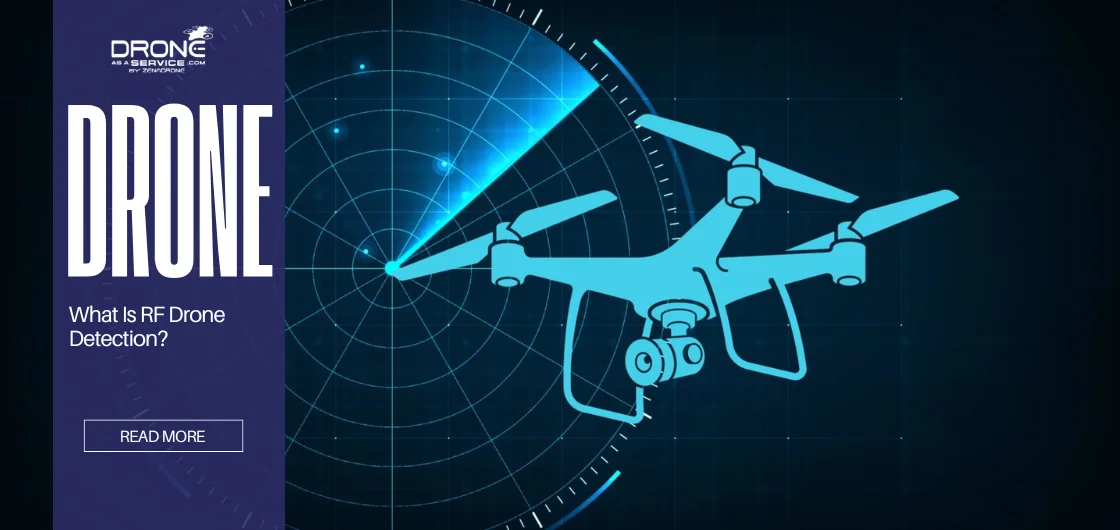
Radio frequency (RF) drone detection is recognized as a specialized surveillance method that focuses on analyzing radio frequency signals.
The purpose of such analysis is to detect, track, and identify unmanned aerial vehicles (UAVs) in real-time. This type of technological innovation often involves the active interception and interpretation of electromagnetic waves that can be emitted during the operational lifecycle of drones.
Drones are operated with remote controllers, ground stations, or onboard systems. Whenever they are used, they generate distinct RF signatures, such as control commands, telemetry data, video feeds, and GPS synchronization signals, that can be captured and analyzed without direct physical contact.
RF detection differs from radar, which detects objects through echoes, and optical detection, which employs cameras. Eventually, the focus of RF detection turns to electromagnetic waves.
As a result, it is currently gaining traction in modern technology due to its UAV tracking capabilities. It operates without requiring line of sight, detecting signals from miles away while also identifying drone types and operators.
This technology is non-invasive, meaning it does not disrupt drone operations, respects privacy concerns, and delivers precise identification. Crucially, RF drone detection is versatile, adapting to both urban and rural environments.
In contrast to traditional detection technologies, such as:
- Radar systems, which depend on electromagnetic waves reflecting off physical objects. Small drones constructed from plastic or composite materials produce minimal radar signatures, which complicates their detection and tracking.
- Optical systems, which utilize cameras or thermal imaging. These require optimal weather, visibility, and clear sight lines.
Radio frequency drone detection functions passively, listening to the environment without emitting signals. This method is non-intrusive, adheres to regulatory constraints, and accommodates a wide range of operational scenarios.
This detection method has significant and valuable applications in business settings. These instances cover the delivery of consistent performance, the experience of cost-effectiveness, and the attainment of an improved situational awareness for its users without necessitating extensive infrastructure.
How RF Drone Detection Works
The operation of an RF drone involves a process of spectrum monitoring, signal identification, and data interpretation, which enables the transformation of raw data into actionable security intelligence.
This detection begins with identifying the control and telemetry signals, which serve as the lifelines of drone operations. The real-time transmission of commands from a remote controller is facilitated by the control signals to the UAV’s flight controller, which are often modulated in formats such as Frequency Hopping Spread Spectrum (FHSS) to enhance its reliability.
Telemetry signals relay critical data such as altitude, speed, battery status, and sensor readings back to the operator. RF sensors capture these signals, exhibiting unique characteristics such as variations in signal strength, modulation patterns, and bandwidth usage.
Other important elements of an RF detection system are RF sensors, high-sensitivity antennas used as an omnidirectional or directional receiver, with a large range. Signal analyzers use digital signal processing to decode and demodulate signals that have been captured. Software platforms add algorithms used to remove noise and detect anomalies in the system in data processing units. These units are embedded with scalable processing with cloud-based analytics.
The operational framework of this method involves continuous monitoring across a broad spectrum of frequency bands to identify patterns linked to UAV communications. Most drones can operate within established ranges such as 2.4 GHz and 5.8 GHz, which overlap with Wi-Fi and other consumer devices. Advanced detection systems can distinguish these signals through analysis techniques.
Component Breakdown
RF detection system compromises generally on:
- RF Sensors: These devices are strategically placed to capture wideband signals.
- Signal Analyzers: These are systems that decode and interpret RF patterns.
- Data Processing Units: These are software that integrates with security operations platforms to classify signals.
- Triangulation Technology: Algorithms that pinpoint the drone’s geographic location and, where feasible, the operator’s position.
These elements collaborate to facilitate ongoing monitoring, early threat identification, and coordinated incident response.
Key Technologies Used in RF Detection Systems
The radio frequency detection system has adopted a combination of advanced technologies that serve a highly accurate and reliable UAV identification and tracking.
Fast Fourier Transform (FFT) algorithms break down the surroundings of the RF environment into frequency segments using spectrum analysis. The process enables a clear visualization of the spectral activity of where the drone signals can emerge as distinct peaks or recognizable patterns within the noise, allowing analysts to isolate UAV-specific emissions with confidence.
Signal pattern recognition makes use of a sophisticated pattern-matching algorithm that matches the measured signal pattern to a large database of known pattern profiles of the UAVs. The system is able to extract the signature details through the cross-correlation and machine learning-based classification methods and detect the most popular encryption structures authorized by manufacturers like Parrot or Autel.
This assists in making sure that the operators can identify the type of drone with a more accurate rate, even in highly complicated settings.
The capability of the RF detection system is also enhanced further through the integration of machine learning and artificial intelligence.
The system can be trained to intelligently categorize UAVs by model, structural design, manufacturer, and even purpose, recreational or potentially malicious, by training AI models on large amounts of data, including real-world drone telemetry and in-simulated signal behavior.
It can also anticipate the change in signals and hence it minimizes detection delays and enhances reliability in dynamic or unpredictable situations.
To create a more comprehensive situational awareness, RF systems have been increasingly combined with radar and optical tracking technologies. Radar serves as a critical source of data for range, speed, and trajectory. At the same time, optical sensors provide visual confirmation, enhancing accuracy when RF signals are weak or absent.
This multi-modal fusion gives an idea of organizations with a resilient and redundant detection ecosystem. The approach not only strengthens operational security but also brings peace of mind to stakeholders managing high-risk and sensitive environments.
Applications of RF Detection in Drone Security
Different sectors in organizations implement RD detection to safeguard assets, operational security, and comply with risk management protocols. Passive monitoring renders its advantages in settings that prioritize safety, continuity, and data protection in the system. The benefits that companies often gain are the following:
Airport and Airspace Protection
Drone flying in the airspace of the airports creates serious safety concerns in the area. RF detection gives real-time situational awareness to the airports so that they avoid disruption of flights, secure the passengers and adhere to the international standards required in the entire aviation field of safety.
Border Security and Law Enforcement
Signal tracking departments in the government are used to reveal smuggling operations, illegal cross-border transactions, and surveillance drones in military operations within the region. RF detection makes intelligence-driven actions stronger and better at enforcing the law, especially when combined with defense UAV technology for enhanced monitoring.
Corporate and Enterprise Protection
RF detection is applied particularly in corporations in areas like technology, manufacturing, finance, and energy to safeguard sensitive locations even the headquarters, research, distribution center, and executive locations where UAV intrusions may jeopardize privacy or operations.
Critical Infrastructure Surveillanc
Security demand is applied in large organizations like telecommunication, power generation, oil and gas and water utilities. The RF detection will allow an active monitoring of the risks that are related to espionage, sabotage, or unauthorized data collection within the area.
Defense Operations and Counter-UAV
Many counter-UAV solutions rely on RF detection, which provides crucial intelligence to counter threats and helps security forces to track down operators, which is a crucial element to law enforcement and military interventions.
Benefits of Using RF Detection for UAV Tracking
Numerous strategic advantages have been implemented, providing benefits that make it a preferred solution for organizations that seek comprehensive airspace security within their area.
Passive and Non-Invasive Technology
The system does not interfere with communication signals or drone operations in its area. It enables businesses to comply with the stringent regulatory frameworks governing RF transmissions.
Dual Detection for Drone and Controller
By identifying the operator and the drone they operate, organizations can recall and address incidents effectively and pursue legal or administrative actions when necessary.
Operational Reliability in All Conditions
The system is resilient because its detection functions properly, regardless of the type of weather or environmental challenges that may arise within the location, ensuring continuous security coverage without operational interruptions.
Reduced False Alarm Rates
The signal-based method, which RF detection provides, offers more precise detection than visual or radar-based detection, reducing false positive results and improving the accuracy of the results.
Limitations and Challenges of RF Detection
While RF detection offers several advantages that can be found in a system, it also has its limitations in certain areas.
Limited Detection of an Autonomous Drone
Drones that operate without the recognition of an RF communication may not be able to get detectable with RF-only systems.
Interference in High-Density RF Environments
It should be carefully noted that the clarity of the detection in urban locations with significant RF activity may not be consistently clear. In this regard, careful system configuration and site planning are essential.
Frequency Overlaps With Consumer Devices
Particularly, the shared communication bands have the potential of resulting in signal congestion. In relation to this, advanced classification algorithms could help overcome this limitation, but they cannot be eliminated.
Legal and Regulatory Considerations
An organization needs to navigate regulatory frameworks when deploying RF monitoring systems effectively.
Data Privacy and Ethical Compliance
Regarding RF detection, the system captures the transmission of metadata without compromising the message content. Hence, businesses need to implement effective data governance practices to comply satisfactorily with privacy laws.
Spectrum Monitoring Regulations
Many countries have enforced strict rules in having RF monitoring activities. The legal teams must always ensure the erection of all operations that will fall within the permitted guidelines.
Aviation and Communications Standards
All regulations set by bodies such as the FAA, FCC, and the EU Aviation Safety Agency determine the acceptable use of UAV detection systems.
Compliance protects the organization from penalties that may arise and ensures the safe deployment of its systems and data. The Federal Communications Commission (FCC) regulates spectrum usage, mandating licenses for monitoring equipment and prohibiting unauthorized interception of it.
The standards from the European Union (EU), such as the Radio Equipment Directive (RED) and GDPR, emphasize data protection and transparency. At the same time, regional regulations, such as FAA guidelines for airspace security, dictate the integration requirements.
The Future of RF Drone Detection
The future of RF drone detection is focused on greater automation, accuracy enhancements, and the large-scale integration of RF drones, often driven by technological convergence.
AI-Driven Recognition and Predictive Analytics
It is expected that the use of Advanced AI technologies will increase the effectiveness of possible threat prediction, autonomous classification, and behavior analysis of the product.
5G Integration and Distributed Detection Networks
The implementation of a 5G infrastructure will enable widespread network-based detection systems that communicate in real-time across a large number of regions. It can have more valuable applications, as it facilitates the easier detection of networks.
Unified Airspace Management Systems
RF detection will soon play a significant role in national and private airspace management frameworks. With these multi-layered systems, it will combine drone tracking, authorization management, and real-time defense measures to enhance the functionality of its system.
Conclusion
This form of detection has proved to be vital as far as companies that require safe, regulated, and adherent airspace conditions are concerned. It delivers highly sophisticated features of locating rogue UAV flights, expediting decision-making, and increasing the resilience of the organization.
With the drone technology developing at a high rate, it will be more important to combine RF detection with the defense and monitoring solutions to maintain an efficient system of operational risk management and security.
Besides, this has to be supplemented with the use of radar, optical, and acoustic systems to develop a multifaceted defense against possible issues.
Considering this, it may be interesting to consider the advantages of establishing a partnership with dedicated providers to receive advice on how to apply or modify solutions to your specific operational needs of operation.