How Much Weight Can Drones Carry? | Ultimate Guide
Drones were largely used for years as a hobby for photography and videography, but now they are invaluable in many industries. Construction, agriculture, logistics, emergency response, filmmaking, and many other industries have embraced drones as an integral part of the technological environment. Drones have changed the way data is collected, projects are tracked, and complex tasks are accomplished quickly and efficiently.
But that leads people new to drones or experienced with them to ask one question: how much weight can a drone carry?
Understanding a drone’s capacity is important because a drone’s capacity, weight, size, etc., relates directly to flight performance, battery life, stability, & safety.
Whether the drone is carrying a high-end camera for filmmaking, delivering medical supplies as an emergency delivery service, carrying sensors for mapping, or carrying equipment for inspections, knowing a drone’s weight capacity allows it to be reliable and efficient.
In this guide, let’s discover how drone payload capacity is calculated, factors that affect capacity, safety protocols to consider, and how upgrades or modifications can increase a drone’s capacity. See how you can select the appropriate drone for your purpose and make sound decisions to keep every flight safe and effective.
What Is Drone Payload Capacity?
Drone carrying capacity is the maximum weight a drone can lift and hold while flying without losing stability or safety. This includes the payload as well as any other additional attachments like cameras, sensors, or spraying tanks.
It is important to understand that payload capacity does not mean max takeoff weight (MTOW). MTOW is the total weight of the drone when fully loaded. In addition to the payload, this includes the weight of the drone frame, battery, and anything else.
For example, assume a drone has an MTOW of 25kg, but the drone itself weighs 15 kg. The drone could then safely have up to 10kg of additional weight (the payload).
What the drone is for will usually determine its payload. Some feature light cameras for taking images, while others include drones using LiDAR technology or agricultural sprayers for use in the field. The greater the drone lifting capacity, the wider the range of applications it can handle.
Factors That Define Drone Payload Capacity
A drone’s payload capacity depends on several key factors. Knowing these things will help you make sure you get the correct tools for your needs.
- Motor Power: Stronger motors enable the drone to lift heavier things without sacrificing stability.
- Battery Capacity: A bigger battery can make the flight last longer, but it also adds extra weight, which impacts how much the drone can carry.
- Propeller Size: Wider propellers give the drone more lift, which improves overall drone lifting capacity.
- Frame Design: Lightweight yet durable materials, such as carbon fiber, provide a balance between strength and efficiency.
- Environmental Conditions: External factors like wind, temperature, and altitude can affect how much weight a drone can safely carry.
A Simple Guide to Calculating Drone Payload Capacity
The drone payload can be determined with the formula shown below.
Payload Capacity = Total Thrust — Drone Weight (no payload)
A 6-kilogram drone with a total thrust of 10 kg may have approximately 4 kg of payload. But for a drone to operate safely and stably, it must have a thrust reserve of 20-30%.
You may determine your drone’s maximum payload capacity in increments, first by adding small amounts of weight and observing how it flies. Please refer to the manufacturer’s documentation prior to making these tests.
How Much Can a Drone Carry Based on Its Size?
Mini drones weigh less than 250 grams and can lift 0.1 – 0.3 kilograms. The dimensions of a drone determine the amount of weight it can carry. They are suitable for casual photography and personal use.
Small drones weigh between 250 grams and 2 kilograms and can lift between 0.3 and 2 kilograms. People use them for artistic or semi-professional work.
Medium drones weigh between 2 and 7 kilograms and can also lift between 2 and 10 kilograms. They strike a balance between power and portability for mapping, inspection, or filming, with a weight range of 7 kilograms or more and between 10 and 200 kilograms for the heavy-lift UAVs.
Here is a table for easier comparison.
| Drone Size | Weight Class | Typical Payload Capacity | Example Models |
|---|---|---|---|
| Mini Drones | < 250 g | 0.1 – 0.3 kg | DJI Mini 4 Pro, Ryze Tello |
| Small Drones | 250 g – 2 kg | 0.3 – 2 kg | DJI Air 3, Autel EVO Nano+ |
| Medium Drones | 2 – 7 kg | 2 – 10 kg | DJI Matrice 300 RTK, Freefly Alta 8 |
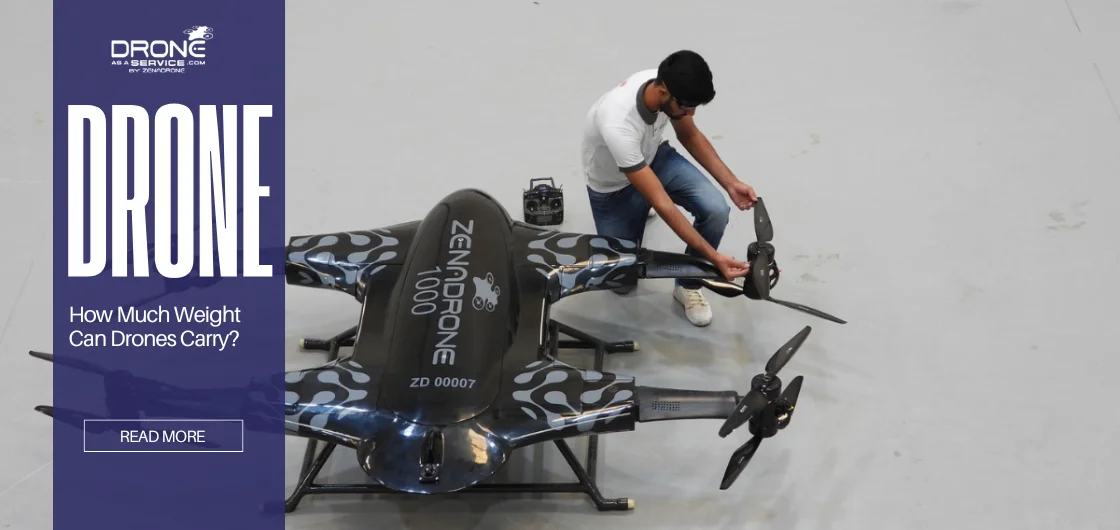
| Large or Industrial Drones | 7 – 25 kg+ | 10 – 200 kg+ | ZenaDrone 1000, Griff 300 |
Knowledge of the relationship between UAV size and payload capabilities also helps users select the appropriate UAV models for their application-specific needs. Large-scale lifting (i.e., cargo transport) becomes increasingly common in industries like logistics, agriculture, and surveillance of critical infrastructure.
How Much Can a Drone Carry Based on Its Use Cases?
Each industry utilizes drones differently, based on the type of work required, which directly affects the weight they need to carry.
For photography and filming, smaller drones with lightweight cameras or gimbals are better because they need to be able to move quickly and stay steady in the air, rather than hauling heavy equipment. On the other hand, agricultural drones need to be able to carry more weight because they often have tanks and sensors for spraying or analyzing crops.
Take a look at this table to see the drone’s payload range for its various use cases.
| Use Case | Common Drone Type | Typical Payload Range | Example Payloads |
|---|---|---|---|
| Photography, Filmmaking | Mini / Small | 0.2 – 0.8 kg | Cameras, gimbals |
| Agriculture, Spraying | Medium / Large | 10 – 30 kg | Tanks, sensors |
| Mapping, Surveying | Medium | 2 – 16 kg | LiDAR, thermal cameras |
| Delivery, Logistics | Large / Industrial | 5 – 200 kg | Packages, medical kits |
| Search & Rescue | Medium / Large | 5 – 50 kg | Rescue gear |
| Construction, Inspection | Medium | 2 – 10 kg | Tools, cameras |
Medium-sized UAVs incorporating sensors such as LIDAR technology or thermal cameras will provide a balance of accuracy with operating time and, therefore, will likely be well-suited to mapping and surveying applications.
Large drones used for delivery and logistics transport heavier packages or medical kits, while search and rescue models must lift rescue gear safely and efficiently. Drone construction & drone inspection typically have the same types of items (e.g., tools, cameras) to check buildings, roads, bridges, etc.
Understanding drone payload by application and UAV capacity by purpose helps operators choose the right model that meets their operational goals while maintaining efficiency and safety.
Average Drone Payload Capacity by Category
Examining various types of drones, the payload capabilities of these drones reveal how they’re being utilized within different industries. Consumer drones typically carry between 0.2 and 0.5 kilograms, making them ideal for enthusiasts and photographers who want something easy to carry and manage.
Professional drones, capable of handling payloads of 2-10 kg, can perform demanding missions such as film capture, mapping, and inspections. Heavy-duty drones can carry loads of 20-200 kg, or more, enabling them to perform industrial, rescue, and delivery applications that require greater power and stability than professional drones.
The above example compares the various types of drones, illustrating how each is suited to different uses, ranging from creative pursuits to large-scale logistical operations.
Drones That Take Heavy Lifting to the Next Level
Several models demonstrate the significant advancements in the capabilities of modern heavy-lift drones, particularly in supporting specific industries.
- DJI Matrice 600 Pro: Can carry 6 to 10 kg and is often used for LiDAR mapping and creating movies.
- Freefly Alta X: Can lift up to 16 kg, making it perfect for camera setups that need to look like they were shot in a movie.
- Griff 300: Can carry up to 200 kg, so it’s suitable for moving big things around.
- ZenaDrone 1000: Can carry 10 to 12 kg and is ideal for farming and inspection work.
These examples demonstrate how commercial UAV payloads are continually improving in their ability to lift objects in various situations.
It is essential to note that the performance of a payload in the real world may not align with the manufacturer’s requirements due to factors such as battery life, flight stability, and weather conditions. Knowing the difference between these two things helps consumers pick drones that fulfill their needs while still being safe and efficient.
How Payload Affects Drone Performance
Drone overload occurs when a drone carries a load that exceeds its intended Capacity. As soon as the payload exceeds the designed payload, all of these factors negatively affect the aircraft’s flight performance, typically causing it to be less stable, lift more slowly, and have hotter motors.
An overloaded drone causes additional stress, forcing the motor(s) to produce more power, which in turn reduces both flight range and overall endurance and the lifespan of your equipment.
Suppose you fly a drone with an excessive weight for an extended period. In that case, it can result in several types of damage, including motor burnout, battery damage, and an increased likelihood of crashing, which may potentially void the warranty. A pilot will be able to notice if a drone has been overloaded due to difficulty lifting off, excessive vibration, and/or a tilted position while in flight.
To prevent overloading your drone, it is recommended to follow the manufacturer’s guidelines for loading the drone, load it evenly, and conduct regular thrust/payload testing. When you load your equipment responsibly, it will last longer, be safer to use, and have superior flying control.
How Weight Shapes a Drone’s Flight and Handling
A drone’s payload has a direct impact on its in-flight performance. Increasing the weight (payload) will increase the required power, thus shortening the flight time. Each operator should evaluate the relationship between payload and flight time.
More weight will require the motor(s) to produce more horsepower to maintain the same speed at liftoff as with less weight, causing faster battery loss and decreasing motor efficiency, which limits longer and smoother flights.
In addition to power consumption, carrying an extra amount of weight will affect the drone’s ability to accurately make turns or stay hovered with the same level of accuracy as when no excess weight is carried.
Also, the weather can increase the amount of energy needed for the drone to push through the added force caused by the added wind resistance that the drone will experience while flying under heavy payloads. The repeated exposure to this high level of stress will continue to degrade the drone’s performance, as the increased stress is being applied continuously to the drone at its maximum payload.
Flying Within the Law and Staying Safe
In addition to understanding the operational aspects of carrying significant payloads with your drone, you must understand and comply with local and international regulations.
Organizations such as the Federal Aviation Administration (FAA), European Aviation Safety Agency (EASA), and Civil Aviation Authority (CAA) establish strict laws and guidelines regarding how much weight an uncrewed aircraft vehicle (UAV) can carry, what altitude UAVs can fly at, and where UAVs are permitted to operate.
Compliance with established laws ensures that pilots remain in compliance with drone payload laws and reduces their risk of facing fines for violating the FAA limit or other jurisdictional rules and regulations.
Separate weight classes trigger separate licenses, but also insurance duties, above all for firms that operate the craft. The registration of heavy-lift drones and maintenance of adequate coverage shields the operator and the public from legal claims.
Rule observance forms only one part of UAV compliance – safety standards must guide every flight. Pilots perform routine maintenance, inspect the aircraft before takeoff, and utilize certified hardware to ensure each mission meets both legal and technical requirements.
Getting the Most Out of Your Drone Payload Capacity
Increasing a drone’s payload capacity may involve utilizing both design and hardware methods aimed at enhancing its performance without compromising safety.
By equipping the drone with higher-powered motors and larger, more efficient rotors, it will be able to carry a heavier payload. Using lightweight parts like carbon fiber helps cut down the drone’s overall weight. This lets more power go toward carrying the payload.
Upgrading the drone’s battery and ESCs can also boost payload capacity by making power delivery more stable. It’s also important to keep the weight balanced and the center of gravity even to ensure smooth, steady flight.
Finally, switching from a quadcopter configuration to either a hexacopter or octocopter configuration will stabilize the drone’s flight while enhancing its ability to lift payloads. Fine-tuning the flight control software to balance thrust distribution can also make the plane more efficient and easier to move around.
It is essential never to go over what the manufacturer says. Drone upgrades should always meet all the requirements to prevent overloads, thereby protecting both the drone and the pilot from harm.
The Roles of Heavy Lift Drones Across Industries
By utilizing drones to perform tasks that traditional tools cannot complete efficiently, companies are transforming their operations.
Delivery and Logistics: Drones facilitate the transportation of food, medical supplies, and packages to locations that would be inaccessible or difficult for traditional transportation methods to reach.
Agriculture Drones: Use the ability to spray (with a tank) and monitor (using sensors) crops.
Filmmaking: Capable of carrying professional-grade cameras for dynamic aerial shots.
Construction and Mapping: Assists with material transport and inspections.
Search and Rescue Drones: Deliver essential equipment to disaster areas quickly.
AI, Efficiency, and the Future of Drone Payloads
Drones will continue to evolve in many ways including through the development of AI-assisted load management and autonomous fleet coordination. Payloads for drone systems will be developing toward a “smarter,” “lighter,” and more “green” format in the near future.
The most recent advancements in solid-state battery (SSB) and hydrogen fuel cell technology can provide longer flight durations and improved overall energy efficiency in the drone’s operation.
Additionally, AI-based automated load management technologies are currently under development to dynamically optimize payloads and improve flight control in real-time.
Next-generation drone payloads will include new lightweight and advanced composite materials that help create a stronger, yet lighter, airframe, allowing larger and/or heavier payloads to be safely carried on board the drone.
Next-generation UAVs (unmanned aerial vehicles) with fleet automation and specialized cargo drones also mark the beginning of a new generation of unmanned aircraft used in large-scale and efficient logistics operations.
Therefore, these technologies collectively show the emerging trends of future drone payload technology.
Drone Payload Essentials You Should Remember
The weight capacity of an average drone depends on its type and size. Small commercially available drones (UAVs), typically weighing less than one kilogram, can hold substantially more than larger commercial or industrial UAVs, which can be designed to hold hundreds of kilograms.
In order to safely load your drone, you should consult the manufacturer’s specifications, test the drone during a flight, and take into consideration both wind and terrain when determining your maximum payload.
Reducing the weight or “payload” of your drone will improve its overall performance and extend the lifespan of all your drone equipment.
By operating your drone under the rules governing drone operations and by maintaining your Unmanned Aerial Vehicle (UAV) to be compliant with the applicable laws, you can use your drone while ensuring both the safety of your drone and everyone else around you.
Conclusion
You can’t have a successful flight without understanding what your drone is capable of handling. Understanding your drone’s lifting capacity will help you match it to your project’s needs and the surrounding environment’s means/resources.
The lifting capacity of a drone is crucial for achieving optimal performance, ensuring safety while flying, and making each flight as efficient as possible.
Whether you are using drones for aerial photography, package delivery, industrial work, or other purposes, understanding the limitations of your drone will enable you to “fly smart” and “fly safe.”
Keep in mind that responsible flying and regular maintenance are what keep your drone at its best every time you take off.
If you’re ready to discover what your drone can truly achieve, contact us to learn more about high-performance drone solutions and explore the best models that meet your payload needs. The right drone can elevate your projects—literally and creatively.
Frequently Asked Questions
What happens if you overload a drone?
Overloading makes the plane less stable, reduces its flight time, puts more stress on the battery, and can cause the motor to fail or crash.
How do I calculate my drone’s payload?
First, check how much the manufacturer specifies you can weigh, then subtract the weight of the drone itself, plus any accessories attached to it, to determine a safe weight that allows you to utilize the full range of the drone’s thrust capabilities.
How can I safely increase the drone’s payload?
Use powerful motors, lightweight materials, and have a well-balanced setup.
Which drone can carry the heaviest weight?
ZenaDrone 1000 is designed for industrial heavy-lift drones. They’re also capable of handling high payloads, such as in cargo, rescue, and agricultural operations.
Are there drones that can carry humans?
Yes, there are experimental passenger drones, but they require special licenses and must still adhere to aviation regulations.
How does payload affect flight time?
It is essential to note that the batteries drain faster, require more energy, and also reduce flight time if the drone is carrying heavier payloads.