Autonomous Drones: Technology, Applications, and Advanced Solutions
Introduction
Autonomous drones are rapidly reshaping how industries collect data, monitor assets, and respond to real-world challenges. Unlike traditional drones that require constant human control, autonomous drones are designed to operate independently, using advanced software and sensors to make decisions in real time.
In this guide, we explore what autonomous drones are, how they work, the technology behind them, and where they are being used today. You’ll gain insight into real-world applications across agriculture, security, delivery, disaster response, and industrial operations, along with an overview of regulations and future possibilities. By the end of this blog, you’ll understand why autonomous drones are becoming a core component of modern aerial solutions.
What is an Autonomous Drone?
An autonomous drone is an aerial vehicle capable of flying and completing tasks without direct human control. It relies on artificial intelligence (AI), onboard software, and multiple sensors to perceive its environment, plan flight paths, and respond to obstacles or changes during a mission.
Unlike conventional drones, which depend on a pilot for navigation and decision-making, autonomous drones can independently execute complex operations. This shift has enabled businesses to scale drone operations, reduce human risk, and perform missions that would otherwise be impractical or unsafe.
As industries adopt automation and data-driven workflows, autonomous drone technology has become a critical tool for improving efficiency, accuracy, and operational safety.
How Does an Autonomous Drone Work?
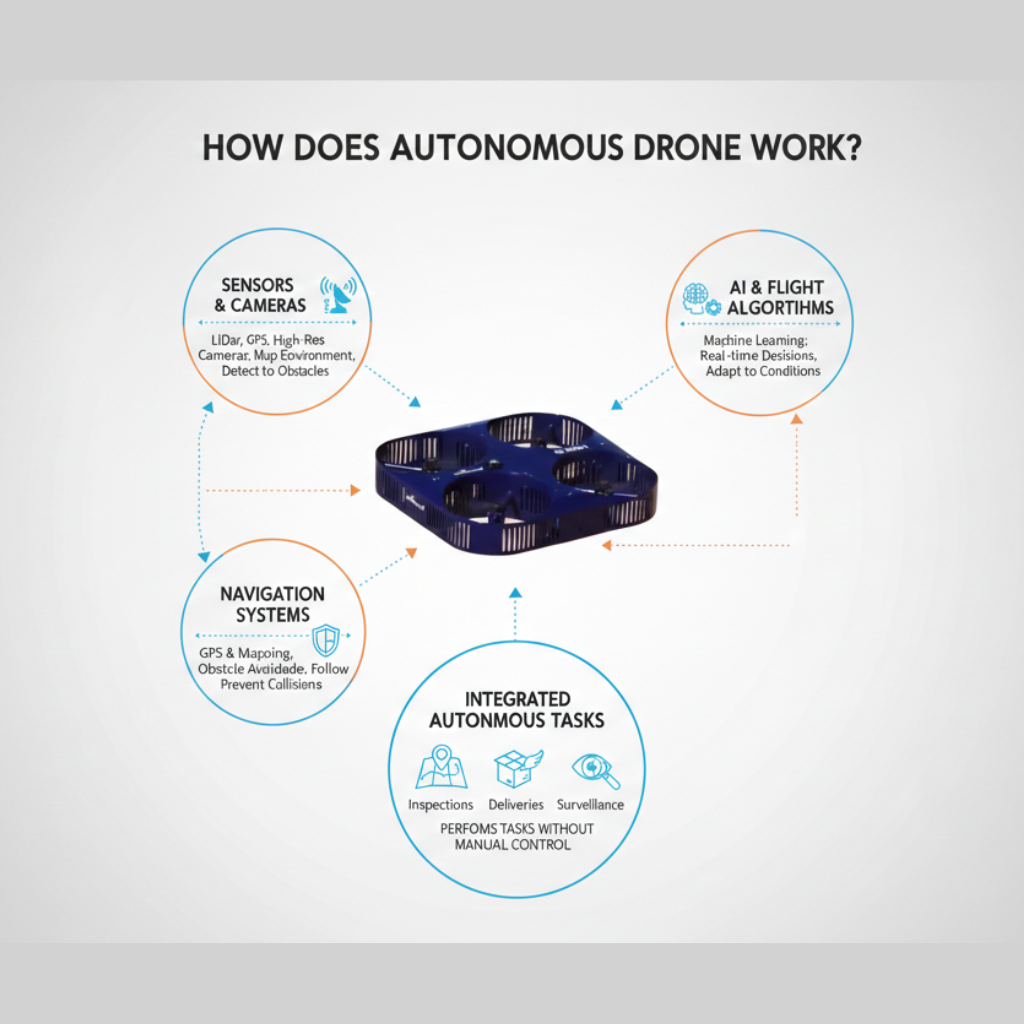
Autonomous drones function through the tight integration of hardware and intelligent software systems. Each component plays a role in allowing the drone to sense, think, and act independently.
- Sensors and Cameras
Technologies such as LiDAR, GPS, thermal sensors, and high-resolution cameras help the drone understand its surroundings. These sensors continuously collect environmental data, allowing the drone to detect obstacles, terrain changes, and objects of interest. - AI and Flight Algorithms
Machine learning models process incoming sensor data and determine how the drone should respond. These algorithms enable real-time decision-making, route optimization, and adaptive behavior during flight. - Navigation Systems
GPS, inertial measurement units, and onboard mapping software guide the drone along predefined or dynamically adjusted flight paths. Obstacle avoidance systems ensure safe operation even in complex or unfamiliar environments.
Together, these systems allow autonomous drones to perform inspections, surveillance, deliveries, and monitoring tasks with minimal human involvement.
You may love to read also: How Drones Detect and Avoid Obstacles
Components of Autonomous Drones
Understanding the core components of autonomous drones helps explain their growing reliability and adoption.
Hardware
Autonomous drones are equipped with sensors, cameras, LiDAR units, GPS modules, batteries, motors, and payload systems. These components enable environmental awareness, stable flight, and data capture.
Software
Autonomous drone software controls navigation, mission planning, obstacle avoidance, and data processing. AI models and flight algorithms continuously improve performance by learning from previous missions.
Communication Systems
Secure communication links connect the drone to ground stations or cloud platforms. This allows operators to monitor missions, receive data in real time, and intervene when necessary.
By combining advanced hardware with intelligent software, autonomous drones achieve higher efficiency, longer flight endurance, and more precise operations.
Advantages of Autonomous Drones
Autonomous drones offer significant advantages over traditional manned or remotely piloted drones.
- Cost Efficiency
Automation reduces the need for skilled pilots and constant supervision, lowering operational costs over time. - Enhanced Safety
Autonomous drones can operate in hazardous or hard-to-reach areas, minimizing risk to human personnel. - Precision and Accuracy
Real-time navigation and sensor fusion enable highly accurate mapping, inspections, and data collection. - Continuous Operation
Autonomous systems can function around the clock, making them ideal for monitoring, security, and large-scale industrial operations. - Scalability
Industries can deploy multiple autonomous drones simultaneously, allowing for faster coverage of large areas and complex projects.
These benefits make fully autonomous drones an attractive solution for industries seeking efficiency and reliability.
Autonomous Drones vs Traditional and Semi-Autonomous Drones
As drone adoption grows, many organizations struggle to understand the real difference between autonomous, traditional, and semi-autonomous drones. While all three serve aerial purposes, their capabilities, operational requirements, and scalability vary significantly. The comparison below highlights where autonomous drones truly stand apart.
Autonomous Drones vs Traditional Drones
Feature | Autonomous Drones | Traditional Drones |
Flight Control | Fully self-flying using AI and onboard software | Fully controlled by a human pilot |
Decision Making | Real-time, AI-driven | Manual, pilot-dependent |
Operational Efficiency | High, minimal human involvement | Limited by pilot availability |
Safety | Reduced human risk in hazardous environments | Higher risk to operators |
Scalability | Easily scalable across large sites | Difficult to scale consistently |
Data Consistency | Highly repeatable and standardized | Varies by pilot skill |
Mission Duration | Optimized for long and repeat missions | Shorter and manually constrained |
Use Cases | Industrial, security, delivery, inspections | Photography, basic inspections |
While autonomous drones clearly outperform traditional drones in scale and efficiency, many modern systems fall into the middle category of semi-autonomous drones.
Fully Autonomous Drones vs Semi-Autonomous Drones
Feature | Autonomous Drones | Semi-Autonomous Drones |
Level of Autonomy | Fully autonomous from takeoff to landing | Partial autonomy with human oversight |
Human Intervention | Not required during mission | Required at key stages |
Obstacle Avoidance | Advanced, AI-driven in real time | Limited or rule-based |
Mission Planning | Dynamic and adaptive | Predefined routes only |
Scalability | Ideal for enterprise-scale operations | Limited scalability |
Operational Cost | Lower long-term cost | Higher ongoing operational cost |
Reliability | Consistent and repeatable | Depends on operator involvement |
Best Use Case | Industrial automation and continuous monitoring | Transitional or assisted operations |
This distinction is why fully autonomous drones are increasingly preferred for large-scale, continuous, and mission-critical operations where reliability and efficiency matter most.
Applications - Autonomous Drones Services
Autonomous drones are now used across a wide range of industries, with different types of drone replacing manual processes and enabling new capabilities.
Surveillance and Security
Autonomous security drones patrol industrial facilities, borders, and critical infrastructure. They provide continuous monitoring, detect anomalies, and deliver real-time alerts, helping security teams respond faster and more effectively.
Mapping and Surveying
In construction, mining, and urban planning, autonomous drones generate detailed 3D maps and models. This accelerates planning, improves accuracy, and reduces the need for on-site inspections.
Equipment Inspection
Autonomous drones inspect pipelines, power lines, wind turbines, and industrial assets. By identifying defects early, organizations can prevent failures and reduce maintenance downtime.
Disaster Response
During natural disasters, autonomous drones assist in search and rescue operations, assess damage, and deliver medical supplies to inaccessible areas. Speed and autonomy are critical in these time-sensitive scenarios.
Agriculture
Farmers use autonomous drone services for crop monitoring, soil analysis, and precision spraying. These insights help optimize yields, reduce waste, and improve sustainability.
Military Operations
Autonomous drones support reconnaissance, surveillance, and tactical missions while minimizing exposure to human risk.
Delivery
Autonomous drone delivery systems are being developed for commercial and industrial logistics. These drones navigate complex environments to transport packages efficiently and safely.
Fully Autonomous Drones for Industrial Sites
Industrial environments demand reliable and repeatable drone operations. Fully autonomous solutions address these needs through advanced system design.
Drone-in-a-Box Solutions
These systems allow drones to launch, fly missions, recharge, and return automatically without human intervention.
Long-Range Autonomous Flight
Optimized power management and navigation enable coverage of large facilities and remote locations.
Advanced Obstacle Avoidance
AI-driven sensors allow drones to operate safely in cluttered or dynamic environments.
Self-Flying and Self-Piloting Capabilities
Autonomous drones adapt to changing conditions, ensuring consistent performance.
Real-Time Monitoring and Data Analysis
Collected data is streamed to centralized platforms for immediate analysis and decision-making.
FAA Autonomous Drone Regulations
Commercial use of autonomous drones must comply with aviation regulations to ensure safety and accountability.
Operators may require authorization for beyond visual line-of-sight (BVLOS) flights, adherence to airspace restrictions, and compliance with safety standards. Understanding autonomous flight regulations is essential for lawful and scalable deployment.
You may also explore: 10 Illegal Drone No-Fly Zones in the United States
How to Build an Autonomous Drone?
While many organizations purchase commercial systems, developers and enthusiasts can experiment with building autonomous drones.
This typically involves integrating sensors, GPS modules, cameras, and flight control software, then using AI frameworks to enable navigation and obstacle avoidance. Testing should always be conducted in controlled environments before real-world use.
Learn more about companies providing cutting-edge autonomous drones.
FAQ Section
What is an autonomous drone?
An autonomous drone operates without human control, using AI, sensors, and software to make real-time decisions.
How do autonomous drones deliver packages?
They follow pre-programmed routes, avoid obstacles, and communicate with monitoring systems during flight.
Which industries benefit from autonomous drones?
Agriculture, construction, security, logistics, disaster response, and military operations.
Are autonomous drones safe?
When operated within regulations and maintained properly, they significantly reduce human risk
How do autonomous drones differ from semi-autonomous drones?
Fully autonomous drones make independent decisions, while semi-autonomous drones still require human input.