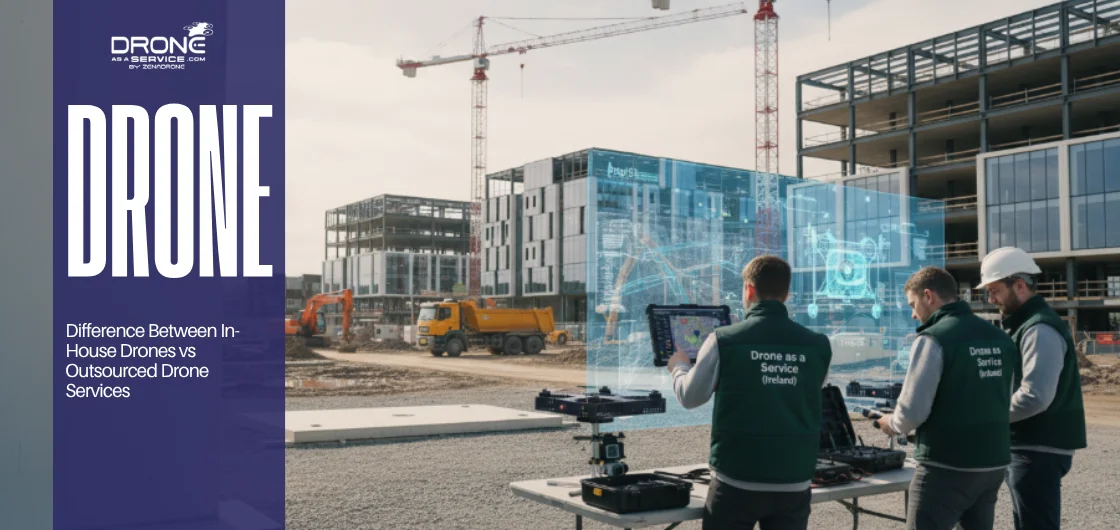
Choosing between in-house drones and outsourced drone services depends on cost, compliance responsibility, and operational scale. In-house models offer control but demand ongoing investment in equipment, training, and Irish regulatory compliance. Outsourcing provides flexibility, transferring technical and legal responsibilities to specialists while maintaining consistent data quality.
Introduction
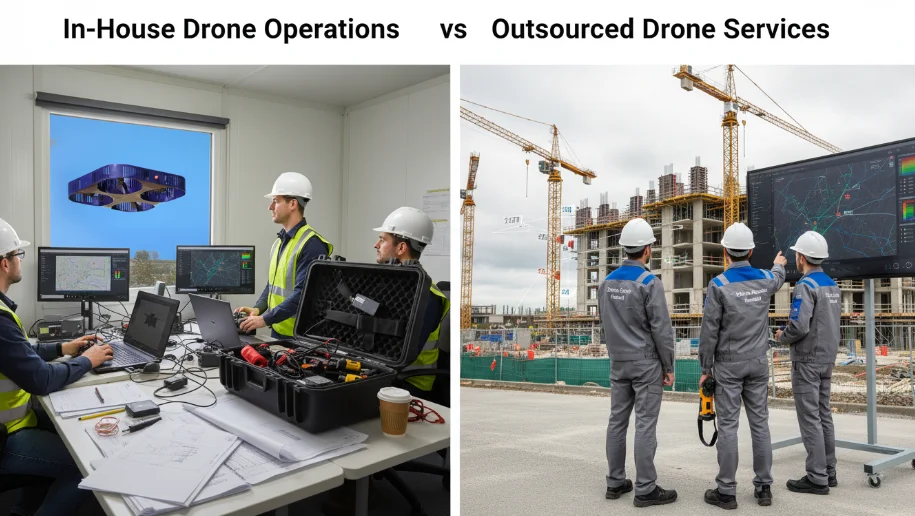
Choosing between in-house drone operations and outsourced drone services is a strategic decision shaped by cost, responsibility, and regulatory obligations in Ireland. Businesses can either build internal capability or engage external providers who manage equipment, pilots, and approvals.
The use of drones across Irish construction, infrastructure, and asset management continues to expand as data becomes central to decision-making. Construction and utility firms are currently weighing the pros and cons of flying themselves versus hiring pros to manage their needs.
Outsourced drone services allow organisations to reduce upfront investment while transferring operational and compliance risk to experienced providers. This approach also reduces exposure to rapid equipment obsolescence and the administrative burden of Irish Aviation Authority compliance. Internal teams remain focused on core operations rather than managing flight logistics and regulatory requirements.
This executive guide compares how both models impact finances and operations in Ireland. We provide a way to calculate total costs, insurance, and growth for each path. Our goal is to help Irish leaders choose a strategy that gets the best ROI while staying safe.
Why the In-House vs Outsourced Decision Matters
The decision between in-house drone operations and outsourced drone services directly affects cost control, regulatory exposure, scalability, and operational risk. Organisations must assess whether internal capability or external expertise better supports long-term efficiency and governance standards.
Leadership teams must consider how capital investment aligns with ongoing obligations under Irish and EU aviation frameworks. If this decision isn’t in line with corporate governance, the company could be at risk of major regulatory and financial problems.
Scalability is an important measure of how well a project is working, especially when managing a wide range of assets across Ireland.
An outsourced partnership lets you use resources when you need them without having to deal with the hassle of managing the lifecycle of your own assets. This lets the company stay lean while making sure that high-quality aerial intelligence is always available when and where it is needed.
Underestimating how complicated it is to keep a flight-ready department running is a big business risk.
The hidden costs of having your own flight are high, from getting pilots certified all the time to keeping sensor arrays in good working order. A disciplined approach to this decision will help the company avoid the common mistake of creating an expensive, underused internal department.
In-House Drone Operations Explained
In-house drone operations require organisations to manage equipment procurement, pilot certification, insurance, and regulatory compliance.
The main advantage is full operational control, including data handling and immediate deployment when required. A dedicated insurance policy, separate from standard public liability, is also mandatory to cover commercial flight risks on Irish sites.
The primary benefit of this model is the absolute control over data security and the immediate availability of equipment. Internal teams develop a deep understanding of company-specific assets, allowing for more nuanced inspections over time.
This direct oversight ensures that aerial surveys can be integrated seamlessly into existing project management workflows. However, the limitations include a significant compliance burden and the ongoing costs of training and technical maintenance.
Firms must actively manage their Specific Operating Permission (SOP) and stay up to date on evolving European aviation safety laws. Without a full-time commitment to these administrative tasks, an in-house program can quickly become an expensive operational liability.
Outsourced Drone Services Explained
Outsourced drone services involve engaging external specialists to manage aerial data capture, compliance, and reporting on behalf of the business. These professional drone service providers offer access to advanced sensors and experienced pilots without requiring internal investment.
You get to use the newest high-tech drones and work with pilots who really know what they’re doing, and you don’t have to buy anything. You can get professional results on your site without having to pay a lot of money up front to build your own team.
This setup is great for scaling up because the service provider can handle as many or as few flights as you need.
This model removes the need to manage equipment upgrades or continuous staff training as technology evolves. You only pay for the data you get for your project because they handle the insurance and maintenance.
Also, you don’t have to worry about following all the rules and regulations for flying anymore. The drone company keeps up with all the changes in the law and makes sure that every flight is legal and insured.
It’s a lot easier to do the job right and stay completely safe and legal.
Cost Comparison: In-House vs Outsourced
When looking at costs, you have to decide if you want to pay for everything upfront or just pay for the work as it happens.
Buying your own drone means spending a lot of money at the start on the machine, the camera, and the pilot’s training.
Using outsourced drone services is like renting a car with a driver; you only pay when you actually need a job done.
Owning a drone can be more expensive than it looks because you have to keep paying for repairs and new batteries over time.
The value of a drone drops quickly as newer, better models come out, which can feel like losing money on your investment.
A service-based plan keeps things simple because you know exactly how much a single flight will cost before you even start.
Total cost of ownership in-house often exceeds expectations, while outsourced models convert fixed costs into predictable operational spending.
| Cost Factor | In-House Drone Operations | Outsourced Drone Services |
|---|---|---|
| Initial Investment | High (Hardware, Sensors, Software) | Zero (Service-based) |
| Labor Costs | Salaries, Training, & Certification | Included in Project Fee |
| Maintenance | In-house Repairs & Upgrades | Managed by Provider |
| Insurance | Specialized Aviation Premiums | Covered by Provider |
| Administrative | IAA Compliance & Logbooks | Reduced Internal Burden |
Compliance & Regulatory Considerations
Compliance and regulatory considerations are a major factor when deciding whether to operate drones in-house or rely on outsourced drone services. Businesses must ensure that all aviation rules, licensing requirements, and safety standards set by the Irish Aviation Authority are fully followed.
Operating drones in Ireland requires adherence to Irish Aviation Authority and EASA compliance standards, including licensing and operational approvals.
You must keep detailed records of every flight, have the right licenses, and have special insurance in case something goes wrong. You are in charge of making sure that every rule is followed perfectly if you run your own drone team.
With outsourced drone services, these regulatory responsibilities are managed by the service provider as part of delivery.
Before they start, they take care of the paperwork, get the flying permits, and make sure their insurance is up to date. You don’t have to spend your time learning about complicated flight laws or filling out government forms over and over again.
The main difference is that a professional team knows these rules inside and out and deals with them every day. If you hire a pro, you won’t make a mistake that could get you in trouble with the law or cost you a lot of money. It’s a lot safer to get the job done this way than to learn a lot about aviation law yourself.
Operational Efficiency & Data Quality
Operational efficiency and data quality depend on how quickly drone data can be captured, processed, and delivered in a usable format. Whether handled internally or by outsourced drone services, the goal is to produce accurate aerial data that supports reliable project decisions.
Operational efficiency depends on the accuracy, consistency, and turnaround time of aerial data delivery.
Specialist providers bring sector-specific expertise, improving data accuracy for construction, infrastructure, and asset inspection projects. They know exactly how to capture the right shots so that the maps and models you get back are spot on every time.
On the other hand, in-house teams might not be able to get things done quickly because they don’t have staff or resources just for processing data. Outsourced drone services use standardized reporting methods and fast computers to give you useful information right after the flight.
These professional reporting standards make sure that everyone gets the same high-quality information that can be used right away in BIM and GIS systems.
If you try to do it all in-house, you might find that the quality of the reporting varies depending on who is flying that day.
Service providers use a set of high standards to make sure every report looks identical and meets your project requirements. It is a much more reliable way to get top-tier data without having to become a tech expert yourself overnight.

ROI & Long-Term Business Value
ROI and long-term business value depend on whether a company chooses to invest in building its own drone capabilities or rely on outsourced drone services that provide aerial data on demand. Each option affects upfront costs, operational flexibility, and how quickly a company can see financial returns.
At the end of the day, you want to know which option is going to help your bottom line the most over the next few years. If you go in-house, you are playing a long game where you have to earn back a lot of upfront cash spent on gear and licenses. Many organisations favour the ROI of outsourced drone services due to predictable costs and measurable output aligned with project needs.
This approach reduces exposure to rapid technology cycles and avoids underutilised capital investment.
Using a service lets you scale up or down whenever you need to, which is a massive advantage in the fast-moving Irish construction market. It takes the pressure off your team and lets you focus on the actual site work instead of worrying about drone maintenance.
The long-term value is really about reducing your risk while still getting top-tier data for your project meetings. You get the peace of mind that comes with professional reporting without the headache of managing a whole flight department.
It is a smart way to keep your projects lean and efficient while still using the best technology available today.

Real-World Decision Scenarios
A mid-sized construction firm in Ireland may use outsourced services for monthly progress surveys, receiving orthomosaics and inspection reports without internal overhead.
In contrast, a national infrastructure operator conducting daily inspections may justify building an internal drone department for continuous monitoring.
Choosing the right path depends on how often you need to fly and how much you want to manage yourself. If you only need a drone once in a while, hiring a professional is usually the safest and cheapest way to get great results. For companies that need to fly every day, building an internal team might be more expensive at first but can save time in the long run.
Decision Framework for Irish Businesses
Deciding whether to buy your own drones or hire a service is a choice between owning the gear or staying flexible. Leaders can use this guide to reduce risk while hitting their goals.
Check if your company is ready by looking at these five areas:
- •Project frequency: Occasional vs continuous operations
- •Budget: Capital investment vs operational spend
- •Internal expertise: Availability of trained personnel
- •Compliance capability: Ability to manage aviation requirements
- •Data complexity: Basic visuals vs advanced mapping outputs
- •Business drone strategy: Tactical use vs long-term integration
Frequently Asked Questions
Business Takeaway
The choice between in-house capability and outsourced drone services depends on balancing cost, compliance, and operational demand.
An in-house setup is great if you are flying every day, but for most, the hidden costs of training and paperwork add up fast. Hiring a pro gives you access to the best tech and keeps your team focused on their actual jobs on the ground.
Take a good look at your schedule and your budget before you jump into buying a fleet of drones for your office. It is all about finding the right fit for your daily operations and making sure you are not taking on more than you can handle.
A strategic move here will save you a lot of headaches and make sure your projects stay on track and under budget. A structured evaluation ensures the chosen model supports long-term efficiency, regulatory compliance, and reliable data outcomes.
Get Professional Drone Services Without the Overhead
Skip the investment in equipment, training, and compliance. Our certified drone specialists deliver accurate aerial data for your Irish projects on demand.